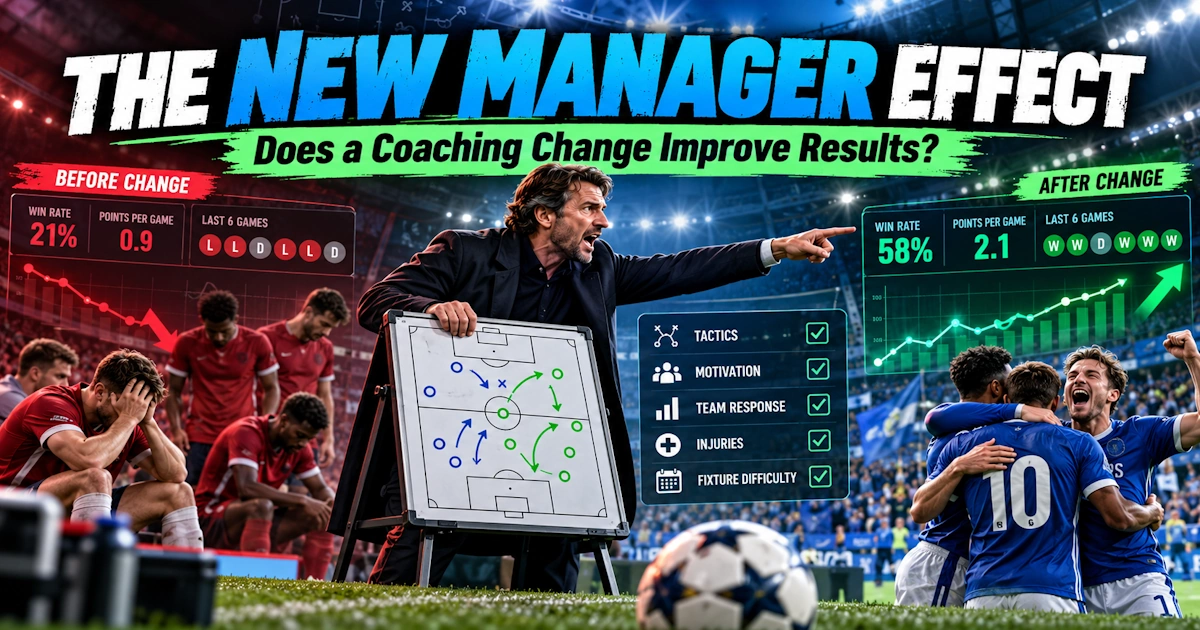
Football fans know the phrase: “New manager bounce.” A struggling club sacks its coach, appoints someone new and suddenly wins the next match.
Players look more energetic, and the crowd responds. A striker who could not score for weeks suddenly finds the net.
It is easy to assume the new manager caused everything. But football research suggests the effect is much less reliable than the popular story makes it sound.
Some coaching changes genuinely improve teams. Others make little difference, and some even make results worse.
One of the biggest problems is that managers are usually dismissed after unusually poor runs. Even if nothing changes, results may naturally improve afterwards.
For football predictions, the useful question is therefore not whether the team appointed a new manager. It is: What has actually changed since the new manager arrived?
That leads to much better analysis.
Why the New Manager Bounce Looks So Convincing
Imagine a team records a loss, loss, draw, loss, and loss. The manager is fired.
The next three matches are a win, a draw, and a win. It looks obvious that the new manager improved the team.
But there is another possible explanation. Perhaps the first five matches represented an unusually poor run.
The team may have faced difficult opponents, missed chances or suffered bad luck. Results might have improved even if the previous manager had stayed.
This is known as regression to the mean. Extreme performances are often followed by results closer to a team’s normal level.
That makes the new manager effect difficult to measure properly.
Premier League Research Found No Average Causal Improvement
One important study analysed English Premier League managerial changes from 2000/01 to 2014/15. The full dataset contained 5,700 Premier League matches and 84 in-season manager changes.
After constructing comparable control cases, researchers analysed 61 managerial changes in detail. At first glance, results improved after managers were replaced.
But similar improvements also occurred in comparable situations where the manager was not replaced. The researchers therefore concluded that, on average, replacing the manager did not cause an improvement in in-season performance.
That is a crucial lesson for football predictions. A team’s results may improve after a coaching change without the coaching change being the reason.
Some New Managers Still Make a Real Difference
An average result does not mean every manager change is useless. The same Premier League study found considerable variation between individual cases.
Some appointments worked well, while others were counterproductive. That makes sense, as managers are not identical.
One coach may immediately fix an obvious defensive problem. Another may introduce a complicated tactical system that requires months to learn.
A third may simply inherit a squad that does not suit his style. This means bettors should avoid one universal rule.
Assuming a new manager equals an automatic improvement is too simple.
Older Research Found Similar Problems With the Bounce
Research from Dutch football reached a similar conclusion. Teams often improved after managers were removed, but the improvement was not necessarily greater than what would have happened without the dismissal.
In the control comparison, performance sometimes recovered even more quickly when managers were not removed. Another long-term study of English football found that teams changing managers within a season actually underperformed over the following three months on average.
Short-term performance also became more unpredictable. This unpredictability matters for betting.
A manager change can increase uncertainty before it increases quality.
Recent Research Shows Clubs May Sack Managers After Bad Luck
A 2026 study covering manager replacements in the top five European leagues from 2017/18 to 2024/25 found evidence that clubs often react strongly to recent results rather than underlying performance. The research compared outcomes with indicators such as expected goals and bookmaker expectations, concluding that managerial decisions can be influenced by outcome bias.
In simple terms, a manager may be sacked because the team lost several games, even when the performances were not nearly as bad as the results suggested. That creates an obvious prediction trap.
If a team was already creating good chances before the coach was dismissed, improvement after the new manager arrives may simply reflect better finishing.
Check xG Before and After the Manager Change
Expected goals can help separate a genuine tactical improvement from better luck. Imagine the old manager’s final five matches produced zero wins, three goals scored, and 7.8 xG.
The attack was creating chances, but finishing was poor. The new manager arrives and the team scores six goals in three matches.
It looks transformative. But if the new manager’s team creates only 4.0 xG, the improvement may mainly come from finishing.
Now consider a different situation. Under the old manager, the team averaged 0.9 xG per match.
Under the new manager, they average 1.6 xG per match. That suggests something more meaningful has changed.
The team is creating better opportunities. That is stronger evidence of a real new-manager effect.
Look for Tactical Changes, Not Just Results
The most useful sign of a coaching impact is a visible tactical difference. For example, the new manager may change from a 4-3-3 to a 3-4-2-1.
That could affect:
Pressing
Width
Defensive numbers
Counterattacks
Shot locations
Results might not change immediately. But if the tactical structure improves, future results may eventually follow.
For bettors, the process is often more important than the first scoreline.
Defensive Managers Can Change Goal Markets Quickly
Some coaches can make a rapid defensive impact. Imagine a struggling team was previously pressing badly, leaving centre-backs exposed, and conceding many transitions.
They were allowing 1.9 xGA per match. The new coach introduces a deeper defensive block, two holding midfielders, and more conservative full-backs.
After several matches, xGA falls to 1.1. That change matters.
Old Over 2.5 statistics may now be much less relevant. The team’s identity has changed.
Attacking Managers Can Have the Opposite Effect
A new coach may immediately increase attacking risk. Suppose the previous manager preferred slow possession, one striker, and a defensive midfield.
The replacement introduces a high press, two attacking midfielders, and aggressive full-backs. The team may create more chances, but it may also concede more.
Possible outcomes shift from 0-0, 1-0, and 1-1 towards 2-1, 2-2, and 3-1. In that situation, BTTS or Over markets may become more interesting even before the overall results improve.
Practical Example: Real Tactical Improvement
Imagine a team changes manager after averaging 1.0 xG, 3.0 shots on target, and 1.6 xGA under the old coach. After four matches under the replacement, they average 1.7 xG, 5.4 shots on target, and 1.2 xGA.
The results have also improved. Now there is evidence behind the bounce.
The team is creating more, shooting more accurately, and conceding fewer good chances. That is much stronger than simply saying they won the manager’s first two matches.
Practical Example: Misleading New Manager Bounce
Now imagine another team. Before the change, they averaged 1.5 xG and 1.4 xGA, losing four out of five matches.
After the change, they average 1.2 xG and 1.6 xGA, but won three straight games. The results look fantastic, but the underlying numbers have actually become worse.
Maybe the team benefited from:
Penalties
Goalkeeper saves
Opponent red cards
Extremely good finishing
This is exactly the type of bounce that should be treated cautiously.
Players Can Respond Psychologically
Football is not played by spreadsheets. A managerial change can affect psychology.
Players who were out of favour may suddenly have another opportunity, and training may become more intense. The atmosphere may improve, and fans may become more supportive.
Players may initially work harder because everyone wants to impress the new coach. These effects are difficult to measure but can be real.
The problem is that they may also be temporary. The first two or three matches can contain extra energy that disappears once the novelty fades.
Selection Changes Can Matter Immediately
One of the fastest ways a new manager can improve a team is by changing personnel. Imagine the previous coach repeatedly left a productive winger on the bench, and the replacement immediately starts him.
Or a centre-back who struggled in a high defensive line is replaced by a quicker defender. The change does not require months of tactical training, and it can affect the next match.
For predictions, check:
Who has returned to the XI?
Who has been dropped?
Are players in more natural positions?
Has the striker role changed?
These details can be more useful than the manager’s reputation.
Home Matches May React Differently
A Spanish La Liga study examining managerial dismissals found that results tended to improve after coaching changes, but the effect appeared mainly in home matches. One possible explanation is that a new manager can combine with home crowd optimism and renewed player intensity.
That does not create a universal home-bet rule. But it gives bettors another reason to consider venue when evaluating the first few matches under a new coach.
Do Not Ignore the Fixture List
A classic new manager bounce can sometimes be explained by scheduling. Imagine the previous coach’s final matches were against 1st place, 3rd place, 5th place, and a strong away opponent.
The new manager begins against 17th place, a newly promoted side, and the bottom club. Results improve.
Was it the manager? Maybe partly, but opponent strength clearly matters.
Always compare fixture difficulty before and after the change.
The First Match Can Be Hard to Predict
The first game under a new coach contains additional uncertainty. The opponent may not know the formation, pressing strategy, starting XI, or set-piece routines.
That can help the new manager, but bettors face the same problem. Historical statistics were produced under a different coach, and the new system may not yet have enough data.
That makes the first match one where caution can be sensible.
Interim Managers Are Different
Not every managerial change introduces a long-term tactical project. Sometimes an assistant or academy coach takes control temporarily, and the approach may remain almost identical.
In other situations, the interim manager simplifies everything with a lower defensive line, a basic formation, and less tactical complexity. Do not assume every coaching change represents a completely new style.
Find out how different the replacement actually is.
Longer-Term Changes Need Time
Some managers require weeks or months. A coach trying to implement complex positional football, aggressive pressing, or three-at-the-back build-up may initially make performance worse.
Players need time to learn pressing triggers, passing angles, defensive distances, and rotation patterns. A poor first two matches does not necessarily mean the appointment has failed.
Likewise, two immediate wins do not prove success.
New Managers and Goal Predictions
For goal markets, classify the coaching change. For a more attacking system, look for:
Higher press
More forwards
Aggressive full-backs
Increased shot volume
This can support Overs or BTTS. For a more defensive structure, look for:
Deeper block
Extra holding midfielder
Lower pressing
Reduced transition risk
This can support Unders. If the new manager has only coached one game, the safest conclusion may be that there is not enough evidence yet, and uncertainty is itself useful information.
How Many Matches Should You Wait?
There is no magic number. But one or two matches are rarely enough to understand a manager’s real effect.
A practical approach is:
1–2 matches: mostly observation
3–5 matches: early tactical signals
6–10 matches: much more useful performance sample
This is a guideline, not a scientific law. If tactical changes are dramatic, you may identify them earlier.
If fixtures are unusual, you may need longer.
Check the Market Reaction
Bookmakers know about the new manager narrative too. Suppose a team wins its first game after changing coach.
The next match may receive heavy public support, and odds shorten. You may agree the team has improved but still dislike the price.
Imagine your estimated win probability is 50%, making the fair odds 2.00. The bookmaker offers 1.70.
The new manager effect may already be overpriced. A good story is not always a good bet.
New Manager Prediction Checklist
Before changing your prediction because of a new coach, check:
Why was the previous manager removed?
Were performances actually poor or only results?
What did xG show before the change?
Has the formation or pressing changed, and are different players starting?
Has xG or xGA improved, and are shots on target changing?
How difficult are the new manager’s fixtures, and is the first game home or away?
Is the manager permanent or interim, and is the squad suited to the new style?
Has the market already overreacted?
Is the improvement visible beyond the final score?
The more of these questions you can answer, the less you need to rely on the idea of a mysterious “bounce.”
Frequently Asked Questions
Does the new manager effect really exist? It can exist in individual cases, but research does not show a reliable automatic improvement. A major Premier League study found no average causal improvement after in-season manager replacements.
Why do teams often win after sacking a manager? Part of the improvement may come from tactics or psychology, but regression to the mean also matters. Managers are often dismissed after unusually poor runs, so results may naturally recover.
Should I back a team in its first match under a new manager? Not automatically. The first match often contains extra uncertainty because there is little evidence about the new tactical system.
Is xG useful after a coaching change? Yes. Comparing xG and xGA before and after the appointment can help determine whether performances have genuinely improved or only the results have changed.
How long should I wait before judging the new manager? Several matches are usually more informative than one or two. Look for repeated changes in chance creation, defensive quality and tactical behaviour.
Final Thoughts
The new manager effect is real enough to deserve attention. But it is not reliable enough to become a betting rule.
Teams often improve after changing manager because the coach changes tactics, selects different players or improves morale. But teams can also improve simply because an unusually bad run was always likely to end.
That is why results alone are dangerous. Instead of focusing on the fact that the old manager lost four matches and the new manager won two, look deeper.
Check xG, xGA, shots on target, tactical structure, player selection, and opponent quality. If those indicators improve as well, the new manager may genuinely be changing the team.
If the underlying numbers remain poor while results suddenly improve, be careful. The best football predictions do not bet on the phrase “new manager bounce.”
They identify what the new manager has actually changed—and whether those changes are likely to last.
Responsible betting: A coaching change can alter a team’s performance but does not guarantee improvement. Use several matches and multiple indicators before drawing conclusions, keep stakes controlled and never bet money you cannot afford to lose.