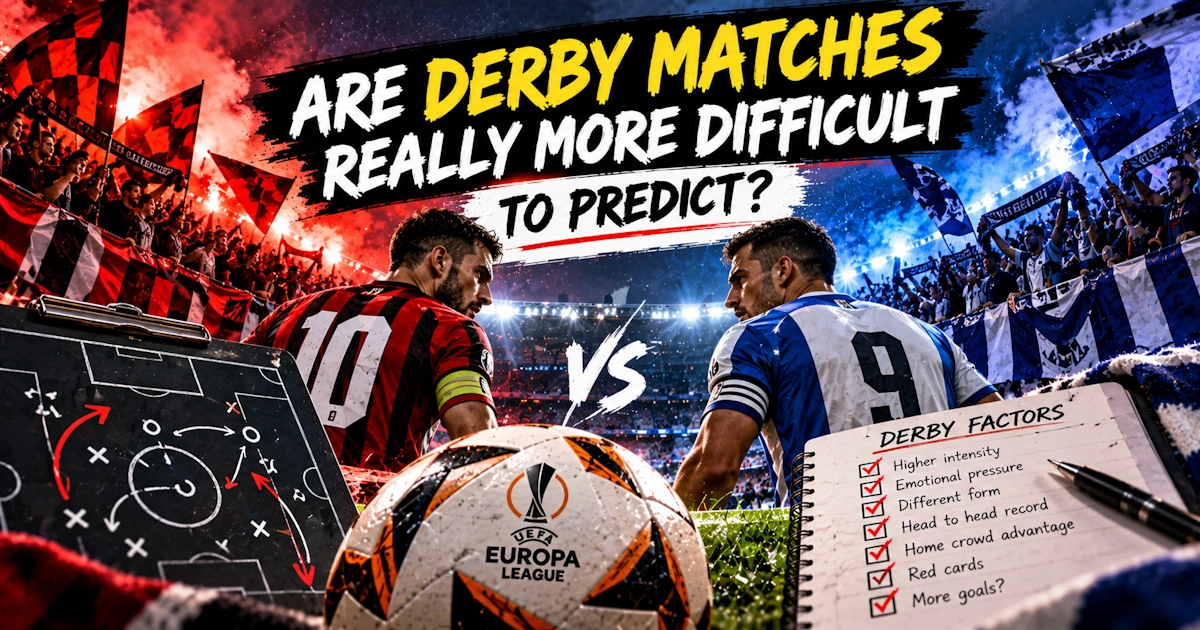
There is an old football saying: “Form goes out of the window in a derby.” It sounds believable.
Derby matches bring louder crowds, greater pressure, aggressive tackles and emotional moments. A struggling team can suddenly compete with a much stronger rival because losing to the club from across the city means more than losing an ordinary league game.
But does that actually make derbies impossible to predict? Not necessarily.
Recent data suggests that derby matches are different in some areas—particularly cards and physical intensity—but their results are not automatically random. Goals, home advantage and match outcomes often remain much closer to normal expectations than the popular derby mythology suggests.
For football predictions, the key is to understand what rivalry genuinely changes and what it does not.
Why Derbies Feel More Unpredictable
Derbies often involve teams that know each other extremely well. Players understand the importance of the fixture, supporters create additional pressure, and managers know that even a poor season can temporarily be forgotten after beating a major rival.
That can change the emotional intensity of the match. A stronger team may also find it more difficult to dominate because the underdog is prepared to:
Press harder
Defend more aggressively
Challenge for every second ball
Accept greater physical risk
Play with unusually high concentration
This can reduce the difference between teams. But narrowing the gap is not the same as making the match completely unpredictable.
Are Derby Results Actually More Random?
A large recent analysis examined 725 league derbies and rivalry matches across 24 countries. It compared them with matches involving the same teams under normal conditions.
The home team won 45% of derby matches, almost exactly matching the 45% expected from those teams’ other performances. Draws occurred in 27%, compared with an expected 26%.
That is important. If derbies truly caused form and team strength to become irrelevant, we would expect results to move much further away from normal expectations.
Instead, stronger teams generally remain stronger teams. Rivalry can alter how the match is played without turning it into a coin toss.
Academic Research Shows the Effect Can Vary
Not every study reaches exactly the same conclusion. Research covering German Bundesliga matches between 1999 and 2009 found evidence that normal home advantage was reduced or disappeared in derby situations when researchers examined goals, match results and attempts.
That shows why broad derby rules are dangerous. A local rivalry in Germany may behave differently from a major rivalry in Spain, Italy, Turkey or England.
Some clubs share a city, while some share a stadium. Others are called derbies even though they are separated by significant distance.
Each rivalry has its own history and competitive balance.
Home Advantage Still Matters
Home advantage is one of the strongest established patterns in football. A large study covering 111,030 matches across 52 UEFA countries found significant home advantage in 32 countries, with an overall measure of around 55.6% where it was observed.
Crowds can contribute to this effect. Research examining 4,844 European matches before and during pandemic-era games without supporters found that home teams gained fewer points and scored fewer goals when crowds were absent.
So even in a derby, do not automatically ignore the venue, because a loud home stadium can still matter. The smarter question is whether that particular rivalry historically reduces, maintains or increases the normal home advantage.
Derbies Really Do Produce More Cards
This is one area where the popular stereotype has strong support. In the recent 725-match derby study, matches averaged 5.17 yellow cards, compared with an expected 4.23.
That is roughly 22% more yellow cards. Red cards also increased, with a red shown in approximately 25% of derby matches, compared with 19% under normal conditions for the same teams.
This makes intuitive sense. Derbies can include:
Emotional challenges
Tactical fouls
Arguments
Crowd pressure
Players reacting strongly to incidents
Interestingly, the same analysis found that fouls increased only modestly, while cards increased much more strongly. So derby intensity may influence not only how often players foul but also the seriousness and emotional nature of those incidents.
Red Cards Make Goal Predictions More Difficult
This is where derby cards become relevant to goal markets. A red card can completely change a football match.
Suppose you predict Under 2.5 because both teams normally defend well. After 25 minutes, one team goes down to ten players, and the original statistical model may become much less useful.
The team with 11 players can dominate possession and create more chances. Alternatively, the team with ten may defend extremely deep, making the match even tighter.
The direction is not always predictable. What matters is that the chance of a major game-changing event can be slightly higher in emotional fixtures, which can increase variance.
Are Derbies Lower Scoring?
This is another popular belief: “Nobody wants to lose a derby, so they are always tight.” The data provides only limited support.
The 725-match analysis found derby games averaged 2.59 goals, compared with approximately 2.75 expected from the same teams’ other matches. Over 2.5 landed in 47% of derbies, compared with an expected 52%.
However, after adjusting for team quality, the difference in total goals became much smaller. So derbies may be slightly more cautious on average, but they are not automatically Under matches.
A 2-2 derby between attacking teams remains perfectly realistic.
BTTS Is Surprisingly Normal
Both Teams to Score provides another useful example. In the same large derby sample, BTTS occurred in approximately 53% of matches.
The expected rate from comparable matches involving those teams was also about 53%. That is a valuable reminder.
Rivalry alone does not suddenly destroy attacking ability. If both teams normally create strong xG and score regularly, the fact that the fixture is a derby should not automatically make you reject BTTS.
Practical Example: Strong Team vs Local Rival
Imagine Team A is top of the league, and Team B is 14th. Normally, Team A would be a strong favourite, but Team B is the local rival.
Many bettors may say that anything can happen in the derby. That is technically true, but anything can happen in every football match.
Instead, examine the stats. Team A has 1.9 xG per match, 6 shots on target, and strong home form.
Team B has 0.9 away xG, 3 shots on target, and weak defensive numbers. Unless the derby historically creates a specific tactical problem for Team A, the stronger side should still deserve favouritism.
The rivalry may reduce confidence slightly, but it should not erase months of performance data.
Practical Example: Derby Under Prediction
Now imagine two closely matched rivals. Both have strong defensive structures, low xGA, few big chances conceded, and conservative managers.
The rivalry adds another reason for caution because neither side wants to make the first mistake. Possible scores include 0-0, 1-0, and 1-1.
Here, derby context strengthens an Under prediction that already has statistical support. That is how rivalry should be used.
It should support the existing data, not replace it.
Practical Example: Derby Over Prediction
Now imagine two attacking rivals. Team A averages 2.0 home xG, while Team B averages 1.7 away xG.
Both press aggressively, use high defensive lines, concede regularly, and create plenty of shots on target. The previous derby atmosphere may make tackles stronger and tempers hotter.
But nothing in the current football profile suggests a low-scoring game, and possible results include 2-1, 2-2, or 3-1. In this case, blindly betting Under because “derbies are tight” can be just as misleading as blindly betting Over.
Old H2H Can Be Particularly Dangerous in Derbies
Derby analysis often relies heavily on historical head-to-head results. You may hear that a derby has gone Under 2.5 in six of the last eight meetings.
But how old are those matches? If several happened four or five years ago, the teams may now have:
Different managers
Different strikers
Different goalkeepers
New tactical systems
Derby history may have some psychological relevance, but old scores should not outweigh current performance. Recent tactical continuity matters much more.
Current Managers Matter
Some managers become more cautious in derbies, while others approach them exactly like ordinary matches. Suppose a coach normally presses aggressively but has played three previous derbies with a deeper defensive shape.
That is useful information. Now suppose the club changed manager two months ago, and the old derby pattern may no longer apply.
When predicting goals, study the current coach rather than assuming the club has a permanent “derby style.”
The League Table Still Matters
A derby does not exist outside the wider season. Imagine one rival is fighting relegation while the other is chasing the title.
That changes the tactical situation. Likewise, a draw may suit one side but not the other.
At 1-1 after 75 minutes, Team A may accept the point while Team B may desperately need a win. The match can suddenly become more open, and motivation from the league table may matter more than rivalry itself.
Squad Quality Does Not Disappear
This is perhaps the most important principle. A derby can increase emotion, but it cannot magically create better players.
If one team has a stronger midfield, faster attackers, better defenders and deeper squad, those advantages remain. The weaker team may compensate through effort and intensity.
But predicting the match as though both clubs suddenly have equal quality is usually a mistake. Derbies should modify your expectations, not completely reset them.
A Better Derby Prediction Checklist
Before making a derby prediction, check:
Current xG and xGA
Shots on target
Home-away performance
Current squad quality
Injuries and suspensions
Managerial style
Recent rather than ancient H2H
Card and red-card tendencies
League-table motivation
Whether both teams would accept a draw
Whether the rivalry usually changes tactical behaviour
Available odds and whether the market has already priced in the derby effect
If the only argument for your prediction is “anything can happen in a derby,” there is probably no real analysis behind it.
Frequently Asked Questions
Are football derbies really harder to predict? They can contain more emotional and disciplinary events, but large-sample evidence does not show that results become completely random. Team strength remains important.
Do derby matches have more cards? Yes, this is one of the clearest statistical differences. A recent 725-match analysis found about 22% more yellow cards in derbies than expected.
Are derbies usually low scoring? Only slightly on average in some datasets. The difference becomes much smaller after accounting for team quality, so derby status alone is not enough reason to back Under 2.5.
Is BTTS good in derby matches? It can be. One large recent dataset found a 53% BTTS rate in derbies, almost exactly matching the expected rate from those teams’ normal games.
Should I use historical H2H for derbies? Use recent H2H for tactical context, but avoid giving too much importance to matches involving different managers and largely different squads.
Final Thoughts
Derby matches are different. The atmosphere is stronger, cards are more common, players may challenge more aggressively, and one emotional incident can quickly change the match.
But that does not mean football logic disappears. The evidence suggests that derby results are often much closer to normal expectations than the phrase “form goes out of the window” implies.
Strong teams remain strong, weak attacks remain weak, and good defences do not suddenly become irrelevant. The best approach is to treat rivalry as another variable.
Start with xG, shots, home-away form, current squad strength and tactics. Then ask whether the derby context changes those expectations.
If it gives a cautious team another reason to defend, an Under may become stronger. If two aggressive rivals already create plenty of chances, the derby may remain a good Over or BTTS candidate.
And if the only reason you are rejecting the favourite is that “derbies are unpredictable,” you may be giving the story more weight than the statistics.
Responsible betting: Rivalry can increase match intensity and uncertainty but does not make any result guaranteed. Use current data alongside derby context, keep stakes controlled and never bet money you cannot afford to lose.