
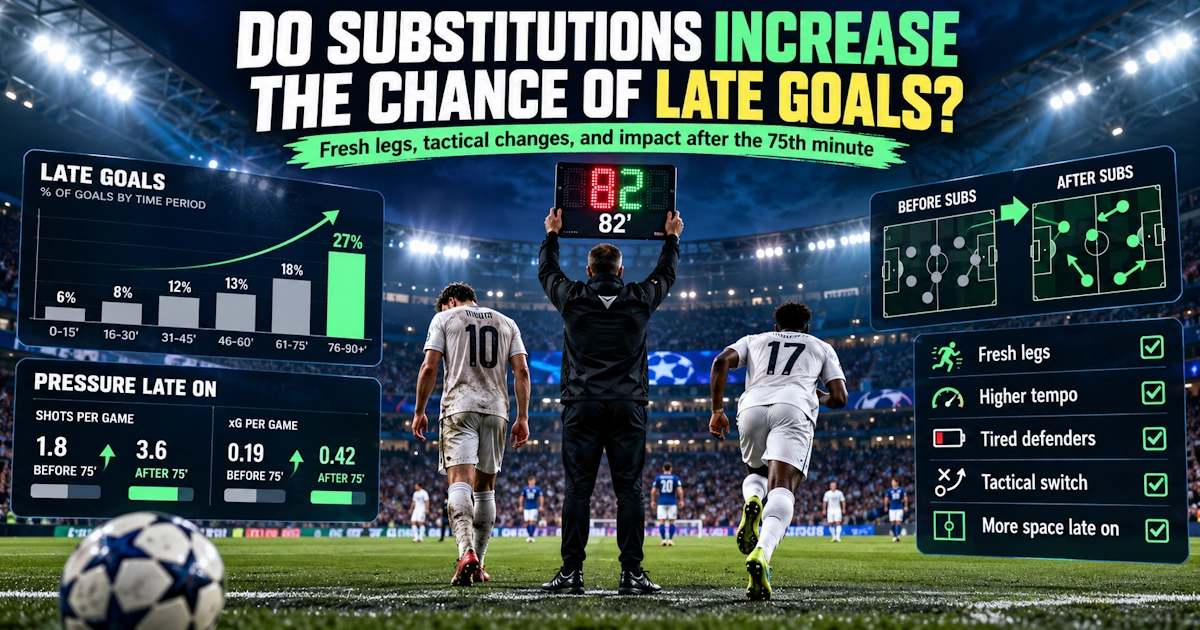
The 70th minute arrives and the manager sends on two fresh attackers. For football bettors, the reaction is often immediate: “This should increase the chance of a late goal.”
There is some logic behind that idea. Substitutes enter against players who may already have 60, 70 or 80 minutes in their legs.
An attacking substitution can change the formation, increase pressing intensity and add fresh pace against a tiring defence. Research also suggests that substitutions can be associated with increased goal-scoring probability.
But there is an important catch. Substitutions do not happen randomly.
Managers usually make attacking changes because they are losing or need a goal. Those same match situations are already more likely to become open.
So the useful question is not simply whether substitutions have been made. It is: What changed because of those substitutions?
That distinction makes substitutions much more useful for analysing late-goal markets.
Research Suggests Substitutions Can Increase Goal Threat
One of the most interesting sports science studies analysed 2,025 Champions League and Europa League matches. Researchers found that teams experienced an increased probability of scoring after their first and second substitutions.
The effect was stronger when the team was losing at the moment the change was made. That makes intuitive sense.
A losing team is more likely to replace:
A defensive midfielder with an attacker
A full-back with an attacking wing-back
One striker with a fresher forward
A midfielder with a creative player
The purpose is usually clear: change the score. However, the same research found that the effect was less obvious during approximately the first three minutes after a substitution.
A new player may need a short period to adapt to the pace and tactical situation of the match. So a substitution should not automatically make you expect a goal 30 seconds later.
Fresh Players Can Produce More High-Intensity Actions
There is also a physical reason substitutes can influence late matches. A 2026 study of elite professional football found that substitute players produced 61% to 93% more repeated high-intensity efforts than players who completed the full match or were later replaced.
The same research found substitutions were three to four times more likely to be followed by an improvement in the team’s score than a worsening of it. Changes made between approximately the 60th and 80th minutes were particularly relevant.
This does not mean every substitute will score. But it supports a simple idea.
A fresh player can attack tired opponents at an intensity that players already on the pitch may struggle to match.
Recent Champions League Numbers Show the Impact
The effect has also been visible at the highest level. During Champions League Matchday 2 in October 2026, substitutes contributed 18 goals and 19 assists during a record 78-goal matchweek.
UEFA reported that substitutes accounted for 23% of goals during that round, compared with 16% across the previous Champions League season. One matchweek is obviously not enough to establish a permanent statistical rule.
But it is a useful illustration of how strongly benches can affect modern football. Managers now have enough squad depth to introduce international-level attackers after an opponent has already defended for more than an hour.
Most Substitutions Naturally Happen Late
There is another reason substitutions and late goals often appear together. Most substitutions occur in the second half.
An analysis of six FIFA World Cups from 2002 to 2022 found that more than 92% of substitutions occurred at half-time or during the second half. Late goals also naturally have more opportunity to interact with substitutions because both become increasingly common as the match develops.
That creates an important statistical warning. Correlation does not automatically mean causation.
A goal after three substitutions does not prove the substitutions caused it. The same match may already have been becoming more open because one team desperately needed to score.
Game State Is Usually the Most Important Factor
Imagine a match is 0-0 after 70 minutes. There are two very different possibilities.
Situation A: Both teams accept the draw Both managers replace tired players with similar positional replacements. The tactical structures remain cautious.
The substitutions provide fresh legs but do not necessarily increase attacking risk.
Situation B: One team desperately needs a win The manager removes a defensive midfielder and introduces a second striker. The full-backs move higher.
The opponent suddenly has more counterattacking space. This situation is much more interesting for a late-goal prediction.
The number of substitutions may be the same, but the tactical meaning is completely different.
Losing Teams Tend to Make More Attacking Changes
Large-scale substitution research helps explain this behaviour. A study analysing 41,301 substitutions across 7,230 matches in four major European leagues found strong score-dependent patterns.
More than half of defensive substitutions were made when teams were winning, while more than half of offensive substitutions occurred when teams were losing. That matters enormously for betting analysis.
If a team is losing 0-1 and sends on two attackers, you are seeing both:
Fresh attacking players
A tactical need to take greater risks
That combination can increase the possibility of a late goal at either end.
Offensive Substitutions Can Help the Opponent Too
This is easy to overlook. Suppose a team changes from 4-2-3-1 to 4-2-4.
It now has an extra attacker, and its own scoring probability may increase. But it may also have:
Less midfield control
Fewer players protecting counterattacks
More space between defence and midfield
The opponent may suddenly receive better opportunities. That means attacking substitutions can strengthen markets such as:
Over 0.5 late goals
Over 1.5 second-half goals
Either team to score next
This can be more relevant than only looking at the goal probability of the team making the substitution.
Practical Example: Strong Late-Goal Situation
Imagine the score is 1-1 after 72 minutes, and Team A needs a win. Before the substitutions, it has produced 1.6 xG, six shots on target, and several dangerous attacks.
The manager then removes a defensive midfielder and introduces a striker. Team B is dangerous on the counterattack.
Now the match has:
Two attacking teams
A score that does not satisfy Team A
Fresh forwards and tired defenders
More transition space
That is a much stronger late-goal situation than simply saying it is the 72nd minute and substitutes have come on.
Practical Example: Substitutions Do Not Improve the Over
Now imagine another match where the home team leads 2-0 after 70 minutes. Both managers make substitutions.
The leading side removes its main striker and creative midfielder, introducing a defensive midfielder and a centre-back. The losing side also replaces tired attackers with similar-quality players.
The match may actually become less open. The substitutions have not increased goal expectation; they may have reduced it.
Substitute Quality Matters
A fresh player is not automatically a dangerous player. Imagine an elite club can introduce a fast international winger, a proven Champions League striker, and a creative midfielder after 65 minutes.
That can genuinely change the match. Now compare a smaller club whose substitutes have limited senior minutes, weak scoring records, and much lower technical quality.
Both teams made three substitutions, but their benches do not provide the same attacking impact. When analysing late goals, ask who came on, not simply how many substitutions were made.
Fresh Wingers Can Be Particularly Dangerous
Wide attackers can have a major advantage late in games. A full-back may already have spent 70 minutes sprinting, defending one-on-one, overlapping, and recovering into position.
Now a fresh winger enters. The substitute can repeatedly attack at full speed while the defender is working with accumulated fatigue.
This can produce:
Fouls
Crosses
Cutbacks
Corners
Penalties
Defensive mistakes
Fresh pace against tired full-backs is one of the most logical substitution patterns to monitor.
Fresh Strikers Change Penalty-Area Threat
A new striker can also alter the final 20 minutes. A tired centre-back may now have to deal with a forward making aggressive runs behind the defence.
The substitute may also provide a different style. For example, the starting striker was small and mobile, but the replacement is a strong target forward.
The team begins crossing more, which changes the type of chances being created. When analysing substitutions, do not only judge whether the new player is “better,” but ask whether the new player creates a different tactical problem.
Creative Midfield Substitutions Can Matter Too
Not every useful attacking substitution involves a striker. A creative midfielder entering against tired opponents may increase:
Through balls
Progressive passes
Final-third possession
Set-piece quality
Suppose a team has plenty of possession but has struggled to create clear chances. Introducing its main creator may matter more than simply adding another striker.
The key is whether the substitution fixes the problem that was preventing chances earlier.
Defensive Substitutions Can Reduce Late-Goal Probability
Managers protecting a lead often do the opposite. They may replace a winger with a full-back, an attacking midfielder with a holding midfielder, or a striker with a midfielder.
The team becomes more compact. This can reduce its own attacking threat.
But there is another possibility. Defending deeper may invite pressure.
A team that stops attacking and protects its penalty area for 20 minutes can still concede. So even defensive substitutions need context.
Ask: Is the team successfully controlling the match, or simply inviting pressure?
The 60th to 80th Minute Is Particularly Interesting
This is the period when several factors begin to overlap. Players on the pitch may be tiring, and managers still have enough time to influence the match.
Teams that need a result begin taking larger tactical risks, and fresh substitutes enter. Research has repeatedly identified substitution effects during this general period.
The recent elite-player study found score improvements were particularly associated with changes between the 60th and 80th minutes. For live goal predictions, this window deserves attention, but the match statistics still need to support the idea.
Look at the Match Before the Substitutions
Imagine a game reaches 65 minutes at 0-0. There have been two shots on target, 0.7 combined xG, and almost no penalty-area action.
Two attacking substitutes appear. That improves the situation slightly, but it does not automatically turn the game into a strong late Over.
Now compare a 0-0 score with 2.3 combined xG, nine shots on target, and several missed chances. Then both teams introduce fresh attackers.
That is much more interesting. The substitutions are adding energy to a match that was already producing opportunities.
xG Can Confirm Whether a Late Goal Is Deserved
Live xG is useful because the scoreboard can be misleading. Suppose it is 0-0 after 70 minutes, but the match has generated 2.5 combined xG.
The lack of goals may simply reflect poor finishing or strong goalkeeping. Fresh attackers could help convert the chances already being created.
Now imagine the game has only 0.6 combined xG. You need the substitutions to fundamentally transform the match, which is a much bigger assumption.
Shots on Target Add Another Useful Signal
A late-goal candidate becomes stronger when the goalkeepers are already busy. For example, in the 65th minute at 1-1, there are 5-5 shots on target.
Both teams introduce attacking substitutes. This suggests an already active match receiving new attacking energy.
Compare that with a 0-0 score and 1-1 shots on target. The same substitutions should not receive the same weight.
Watch What Happens Five to Ten Minutes Later
A Champions League study of 125 matches found that a team’s goal occurring around five to ten minutes after a substitution was strongly associated with winning outcomes. The researchers concluded that substitutions may need several minutes before their tactical impact becomes visible.
That fits with the larger 2,025-match study, which found substitution effects were less distinct immediately after the change. For live analysis, this means you can watch whether the substitution actually changes the match.
Look for:
Higher pressing
More penalty-area entries
Better shots
More corners
Faster transitions
Do not react to the substitution board alone.
Multiple Substitutions Can Change Match Intensity Quickly
Modern managers frequently introduce two or three players together. That can change the formation, pressing, pace, passing quality, and physical intensity.
A triple substitution after 65 minutes can effectively give a team a different attacking unit. But several changes can also temporarily reduce coordination.
New players need to understand the rhythm and tactical responsibilities immediately. That is another reason the effect may not appear in the first minute after they enter.
Late Goals Are Often About a Combination of Factors
The strongest late-goal situations normally include several elements at once:
One or both teams need a goal
Attacking substitutions have been made
The match is already creating chances
Defenders are tiring
The benches contain real quality
Tactical risk is increasing
There is still enough time remaining
No single factor guarantees a goal. Together, they can create a much stronger prediction.
A Simple Substitution Checklist for Late Goals
Before using substitutions as a reason to predict another goal, check:
What is the current score and does either team need to win?
Which players came off and which players came on?
Were the changes attacking or defensive, and did the formation change?
How strong are the substitutes and are defenders visibly tiring?
What is the current xG and how many shots on target have there been?
Are big chances being created and has the pace increased since the changes?
Is there counterattacking space and how much time remains?
Do the current live odds still offer value?
A substitute should strengthen an existing late-goal argument rather than become the entire argument.
Frequently Asked Questions
Do substitutions increase the chance of a late goal? Research suggests teams can experience higher goal-scoring probability after substitutions, particularly when they are losing. But game state and tactical changes are important parts of that relationship.
When are substitutions most important? The period from roughly the 60th to 80th minute can be particularly interesting because fresh players enter while fatigue and tactical urgency are increasing.
Do attacking substitutions also increase the opponent’s chances? They can. Adding attackers may reduce defensive protection and create more counterattacking space.
Should I predict a late goal whenever several substitutes come on? No. Check the quality of the substitutes, tactical changes, current score, xG and shots on target before making that conclusion.
Do substitutes score many Champions League goals? They can make a significant contribution. On Champions League Matchday 2 in October 2026, substitutes scored 18 of the round’s 78 goals, accounting for 23% of all goals that week. UEFA said the previous season’s overall share was 16%.
Final Thoughts
Substitutions can increase the chance of late goals. There is research supporting higher scoring probability after certain changes, and fresh players can produce considerably more high-intensity actions than footballers who have already spent most of the match on the pitch.
But the substitution itself is only part of the story. The best late-goal situations occur when fresh attacking quality combines with fatigue, tactical urgency, existing chance creation and a scoreline that forces someone to take risks.
A striker entering after 70 minutes is interesting. A striker entering while his team needs a win, the match already has 2.5 xG and the opponent’s defence is tiring is much more interesting.
So rather than watching the fourth official raise the substitution board and immediately backing another goal, watch what changes on the pitch. If the press becomes stronger, more players enter the box, chances increase and defensive space begins to appear, the substitution may genuinely have changed the goal probability.
That is the information that matters.
Responsible betting: Substitutions can influence match dynamics but cannot guarantee late goals. Use them alongside live statistics, game state and the available price, keep stakes controlled and never bet money you cannot afford to lose.