A casino CRM is a Customer Relationship Management system used by online gambling operators to organise player data, create customer segments, automate communication and manage different stages of the player lifecycle.
In traditional businesses, CRM software is often associated with sales teams, leads and customer accounts.
In iGaming, the emphasis is different. Casino CRM is commonly used to answer questions such as:
Has the player completed registration?
Has the player made a first deposit?
Which casino products do they use?
Which communication channels have they agreed to receive?
Is the player eligible for a campaign?
Has the account entered a restricted or responsible-gambling state?
The CRM can then use this information to build automated customer journeys across channels such as email, SMS, push notifications and on-site messages.
However, CRM should not be confused with the casino’s PAM, wallet or bonus engine.
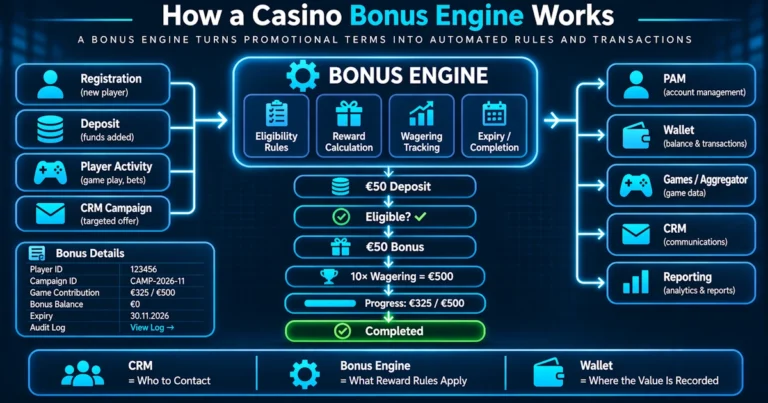
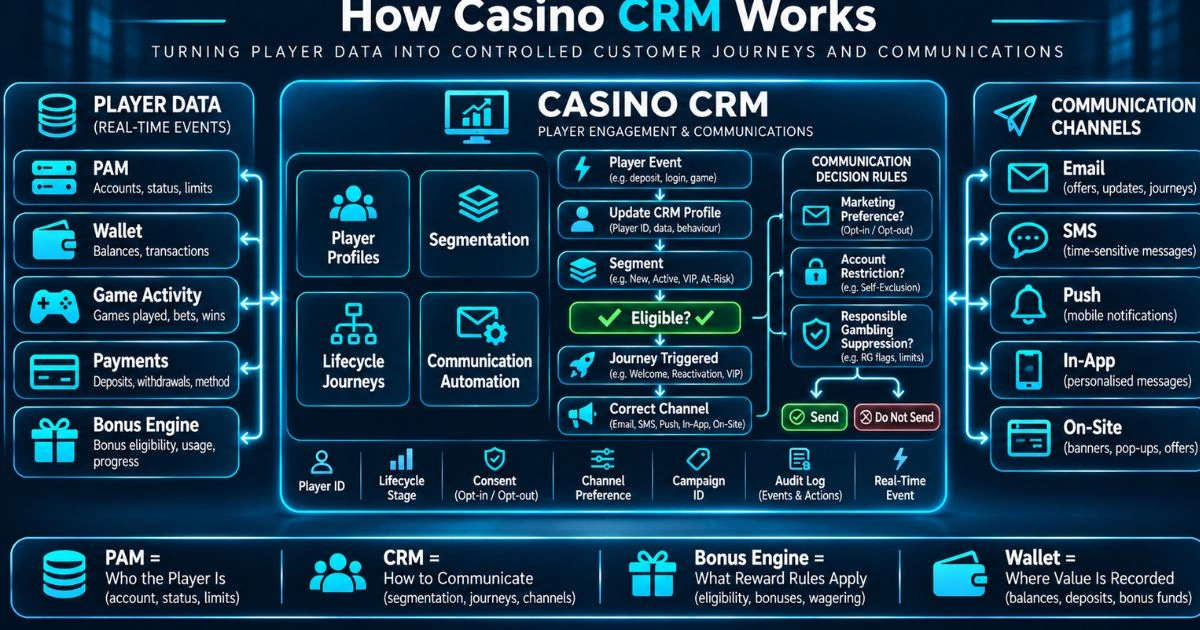
A useful distinction is:PAM = Who the player is and what state the account is in CRM = Which customer journey and communication should apply Bonus Engine = What promotional reward rules apply Wallet = Where financial value is recorded
Modern casino CRM therefore acts as a player engagement and communication layer around the core gambling platform.
What Does CRM Mean in iGaming?
CRM stands for Customer Relationship Management. But the term can mean different things in different industries.
A traditional sales CRM might focus on:
sales leads
companies
opportunities
account managers
sales pipelines
An iGaming CRM is generally more focused on:
registered players
behavioural data
segmentation
customer lifecycle
communication
retention workflows
promotion coordination
The customer already has an account. The main CRM question is not:“Can we convert this company into a sales customer?” It is more often:“What is the appropriate next communication or customer journey for this player?”
That makes casino CRM closer to a combination of: Customer Data + Marketing Automation + Segmentation + Journey Orchestration + Communication Management than a traditional sales pipeline.
Where Does CRM Sit in an Online Casino Platform?
A simplified architecture might look like:
Player ↓ Casino Website / App ↓ PAM / Wallet / Games ↓ Player Data and Events ↓ CASINO CRM ↓ Segments / Journeys / Communications ↓ Email / SMS / Push / In-App / On-Site
The CRM can also connect with:
Bonus Engine
KYC
Responsible Gambling
Data Warehouse
Analytics
Customer Support
The exact architecture differs between operators. Some casino platforms include CRM functionality directly. Others integrate a specialist external CRM platform through APIs or event streams.
What Data Does a Casino CRM Use?
A casino CRM can use several types of player information. Examples may include:
Account Data Such as:
Player ID
registration date
account status
country
language
Payment Data Such as:
first deposit completed
deposit frequency
withdrawal activity
Gaming Data Such as:
casino games played
activity frequency
recent sessions
preferred product categories
Bonus Data Such as:
campaign eligibility
bonus accepted
promotion completed
bonus expired
Communication Data Such as:
email delivered
message opened
link clicked
communication preference
Responsible Gambling and Restriction Data Where appropriate and legally permitted, CRM systems may also need account-level suppression information so that marketing or promotions are not sent where they should not be.
The CRM does not necessarily own every piece of this information. Much of it may come from other systems.
Where Does Casino CRM Data Come From?
A CRM can receive data from several sources. For example:PAM → Account Data Wallet → Financial Events Casino Platform → Gaming Activity Bonus Engine → Promotion Status Payment System → Deposit Events Website / App → Engagement Events
These inputs are combined to create a usable player profile.
Modern commercial iGaming CRM systems increasingly describe this as a real-time customer view in which behavioural events are processed as they occur rather than only through overnight batch files. Fast Track, for example, currently describes its CRM as operating on live player events and using one customer object for segmentation and lifecycle journeys.
The exact implementation is provider-specific.
What Is a Player Profile in CRM?
A CRM player profile is a marketing and engagement view of the customer.
A simplified profile might contain: Player ID: 12345 Language: English Market: UK Registration: Completed First Deposit: Yes Last Activity: Yesterday Preferred Product: Casino Marketing Email: Opted In Marketing SMS: Opted Out Current Journey: Active Player
The profile can be updated as new events occur. The CRM then uses those attributes to decide which segments or journeys apply.
What Is Player Segmentation?
Segmentation means grouping customers based on shared characteristics or behaviours.
For example:
Registered but Not Deposited
First-Time Depositors
Active Casino Players
Inactive Players
VIP Segment
Specific Market
Specific Language
Segmentation allows the operator to avoid sending exactly the same communication to every customer. Instead:Segment A → Message A Segment B → Message B
Commercial iGaming CRM platforms commonly use lifecycle stage, activity, game preferences and other behavioural attributes as segmentation inputs.
Why Is Segmentation Important?
Consider two players.
Player A Registered yesterday. Has never deposited.
Player B Has used the casino regularly for two years.
Sending both players:“Welcome to our casino!” would not make much sense.
The CRM allows the operator to treat them differently. For example:Player A → Registration / onboarding journey Player B → Existing-customer communication
Segmentation therefore helps make communications more relevant. It can also help operators apply suppression rules and jurisdiction-specific controls.
What Is a Player Lifecycle?
The player lifecycle describes stages of the customer relationship. There is no universal industry lifecycle model, but a simplified version might look like:
Registered ↓ Verified ↓ First Deposit ↓ Active ↓ Lower Activity ↓ Inactive
Different operators define these stages differently. A CRM can automatically move a player between lifecycle groups when their behaviour changes.
For example:No activity for 30 days might change:Active → Inactive
The CRM can then trigger an appropriate workflow, assuming marketing is permitted.
What Is a CRM Journey?
A journey is a sequence of automated actions based on customer events or conditions.
For example: Player Registers ↓ Wait for verification ↓ Verification Completed ↓ Check marketing preference ↓ Send Welcome Email ↓ Wait 24 hours ↓ Check whether first deposit occurred ↓ If yes → End Journey If no → Continue permitted onboarding communication
Modern iGaming CRM systems can support visual multi-stage journeys involving onboarding, engagement, retention and other customer lifecycle states.
The operator defines the rules. The CRM automates the workflow.
What Is a Trigger in Casino CRM?
A trigger is an event that starts or changes a journey.
Examples can include:
Registration Completed
KYC Completed
First Deposit Completed
Player Logged In
Player Entered Segment
Player Changed Marketing Preference
Account Restricted
The CRM listens for these events. When one occurs, it evaluates the relevant rules.
For example: FirstDepositCompleted ↓ Player opted into email marketing? ↓ Yes ↓ Enter qualifying lifecycle journey
This kind of automation can happen without staff manually exporting a player list.
Real-Time CRM vs Batch CRM
CRM systems can process data in different ways.
Batch Processing Data may be updated periodically. For example: Every Night at 02:00 The operator sends the day’s player activity into the CRM.
Real-Time Processing Events are sent when they happen. For example: 14:03 — Deposit Completed The CRM receives that event almost immediately.
Real-time processing can support faster journey changes. For example: Player completes first deposit and is immediately removed from:No Deposit Segment
This reduces the chance of sending irrelevant communication. Current specialist iGaming CRM vendors increasingly position real-time event processing as a core capability.
What Is CRM Automation?
CRM automation means predefined rules perform routine actions without staff manually running every campaign.
For example:IF Player registered AND Verification completed AND Email marketing permitted THEN Enter Welcome Journey
Another automation might say:IF Player opts out of email THEN Remove from all marketing email journeys
Automation can help operators manage very large customer bases consistently. But it also makes governance important. An automated mistake can affect thousands of players very quickly.
What Communication Channels Can Casino CRM Manage?
Depending on the system, CRM can coordinate channels such as:
email
SMS
push notification
in-app message
on-site message
web inbox
pop-up
phone campaign lists
Modern iGaming CRM platforms commonly provide multichannel orchestration from one customer profile.
Not every channel should automatically be used for every player. The operator needs to consider:
customer preference
regulatory requirements
communication purpose
frequency
market
What Is Multichannel CRM?
Multichannel CRM means using several communication channels within the same customer strategy.
For example:Email for one communication. Then:Push Notification for another. Then:In-App Message when the player next logs in.
The CRM coordinates these interactions around the same player profile. Without central orchestration, teams might accidentally send several overlapping messages from separate systems.
What Is Omnichannel CRM?
The terms multichannel and omnichannel are sometimes used interchangeably in marketing.
Generally:Multichannel means using several channels.
Omnichannel implies coordinating those channels around one customer journey.
For example: A player receives an email. Then opens the app. The CRM knows the email was already sent and chooses a different in-app message rather than repeating exactly the same content.
The practical implementation varies between platforms.
Casino CRM vs PAM
This is one of the most important distinctions.
PAM The Player Account Management system manages the operational player account. It may know: Name Player ID KYC Status Account Status Limits
CRM The CRM uses player information to manage: Segments Journeys Communications Campaign History
A simple comparison is: PAM = operational customer record CRM = engagement and communication layer
The CRM should not usually become the authoritative system for critical account states such as whether an account is legally permitted to gamble. That information should come from the appropriate core platform system.
Casino CRM vs Bonus Engine
These systems are also closely connected.
CRM Determines: Who should receive which communication?
Bonus Engine Determines: What promotional rules and rewards apply?
Suppose an operator creates: €50 Deposit Bonus
The CRM might identify: Eligible Segment: New Players and send: Promotional Email
The bonus engine then handles: Eligibility Validation Reward Calculation Wagering Tracking Expiry
The CRM communicates the offer. The bonus engine executes the promotional logic.
Casino CRM vs Wallet
The wallet manages financial value.
The CRM should not independently decide: Player balance = €500 unless that information comes from the authoritative wallet.
Instead, the CRM might receive an event such as: Deposit Completed or a derived marketing attribute.
A simple distinction is: Wallet = money CRM = customer engagement
Mixing those responsibilities unnecessarily can create reconciliation and governance problems.
Casino CRM vs Back Office
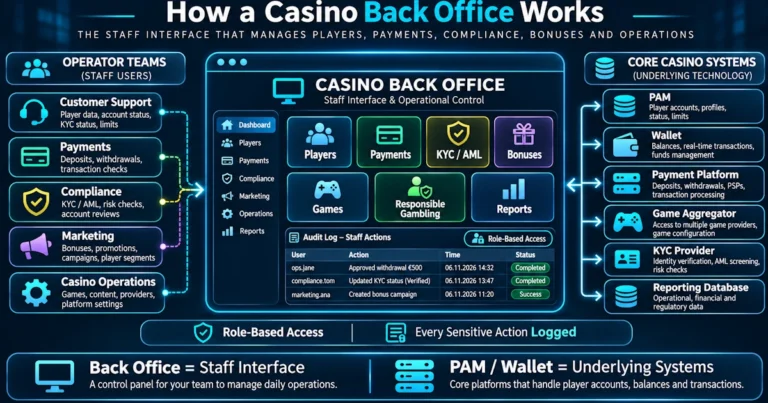
The back office is the staff-facing administrative environment used to run the casino.
CRM can be either: part of the back office or: a separate specialist system
The casino back office may show: Player account KYC Payments
while the CRM provides: Segments Campaigns Journeys Communications
Some platforms combine them into one interface. The underlying functions remain different.
Casino CRM vs Customer Support System
Customer-support software manages service conversations.
For example: Player asks why withdrawal is pending ↓ Support Ticket Created
CRM may still contribute useful context, such as:
communication history
segment
recent journey
But support-ticket management and CRM marketing are not identical functions. Some operators integrate the two so support staff have a more complete player view.
Casino CRM vs CDP
CDP means Customer Data Platform. The distinction has become less clear as products add more features.
A simplified model is:CDP Main focus: Collect and unify customer data CRM Main focus: Use customer data to manage engagement and communications
A modern iGaming CRM can include CDP-like capabilities. For example, it may:
ingest events
build unified player profiles
segment users
orchestrate journeys
The correct comparison should therefore focus on functionality rather than product names.
Casino CRM vs Marketing Automation
Marketing automation is one major part of CRM. But CRM can be broader.
Marketing automation may focus on:Send this message after this trigger
CRM may also handle:
segmentation
player profiles
campaign history
lifecycle logic
channel preferences
analytics
In practice, many modern products combine these capabilities.
What Is a Single Customer View?
A single customer view tries to bring relevant player information together around one identity.
For example:Player 123 might have data from: PAM Wallet Casino Games Email System Bonus Engine
The CRM links those events to the same customer profile. This allows the operator to avoid treating:email user 583 and:casino player 123 as completely unrelated people when they are actually the same account.
Commercial CRM platforms currently describe unified or single real-time customer views as a core part of their iGaming offering.
What Is Identity Resolution?
Identity resolution is the process of connecting different data records to the correct customer.
For an authenticated casino, the strongest identifier is often an internal: Player ID
That ID can be linked to:
account events
deposits
gaming sessions
campaign interactions
Operators need to be careful when combining identifiers such as:
email
device
cookie
phone number because multiple people can sometimes share devices or contact information can change.
The CRM should not assume every identifier always represents one unique individual without appropriate logic.
Why Is Player ID Important?
Names can change. Email addresses can change. Phone numbers can change.
An internal Player ID provides a more stable reference.
For example: Player ID: P-928432 can remain constant while: Email A → Email B
The CRM can continue linking activity to the same player account. This helps prevent duplicate customer profiles.
What Is a CRM Segment?
A segment is a group created using defined conditions.
For example: Market = UK AND: Product = Casino AND: Marketing Email = Yes
The resulting group could then be used for an appropriate campaign.
Segments can be: Static or: Dynamic
Static vs Dynamic Segments
Static Segment A fixed list. For example: 500 customers selected on Monday The list remains unchanged unless someone updates it.
Dynamic Segment The CRM continuously checks whether players still match the conditions. For example: Registered but Not Deposited As soon as a player deposits, they automatically leave the segment.
Dynamic segmentation can reduce manual list management.
What Is Personalisation?
Personalisation means adapting a communication using information about the customer.
A simple version might be:Hello Sarah
More advanced personalisation might consider:
language
product preference
lifecycle stage
available games
permitted promotion
For example: Player A prefers slots and: Player B uses live casino
The operator may show different content. However, personalisation should still respect:
data-protection rules
marketing preferences
safer-gambling controls
market restrictions
More data does not automatically mean every possible use of that data is appropriate.
What Is Next-Best-Action CRM?
Some CRM platforms use models that attempt to decide the most appropriate next action for a customer.
This could conceptually be: Send Message A Show Content B or: Send Nothing
The last option is important. A good CRM strategy is not simply about maximising the number of messages. Sometimes the correct decision is to suppress communication. This becomes particularly important in regulated gambling.
Why Marketing Preferences Matter in Casino CRM
Casino CRM cannot treat every player with an email address as someone who can automatically receive marketing.
Preferences and consent rules matter. In Great Britain, remote casino, betting and bingo operators must provide direct-marketing choices on a per-product and per-channel basis. Options must be set to opt-out by default, be offered during registration and remain updateable by the customer. Applicable channels include email, SMS and phone calls, while product categories include casino, betting and bingo as relevant.
These requirements have applied since 1 May 2025.
A casino CRM therefore needs more than one generic field saying: Marketing = Yes in markets with this type of requirement.
What Could Marketing Preferences Look Like?
A simplified preference profile might contain: Casino Email — Yes Casino SMS — No Casino Phone — No
If the operator also offers betting: Betting Email — No Betting SMS — No
The CRM should respect each preference. A customer who agreed to: Casino Email has not automatically agreed to: Casino SMS or: Sports Betting Email under the current Great Britain framework.
Why Is Consent Data So Important?
A CRM needs to know not only: what communication was sent but, where applicable: whether the operator had permission to send it
That can make consent and preference data operationally important. Useful records may include:
Channel
Product
Preference
Date Changed
Source
The exact legal requirements vary by jurisdiction. For electronic direct marketing in the UK more generally, ICO guidance explains that PECR restrictions apply to channels such as email and SMS and that consent, where relied upon, must be specific and involve positive action rather than pre-ticked boxes or inactivity.
Can a Player Change Marketing Preferences?
Yes. A CRM architecture should be able to respond when preferences change.
Suppose: 10:00 — Email Marketing = Yes Then: 10:05 — Player opts out
The CRM should update relevant campaigns. A campaign scheduled yesterday should not simply continue sending marketing based on stale data.
In Great Britain, marketing preferences must be updateable, and customers must not receive direct marketing that contradicts those preferences. This makes preference synchronisation a technical requirement as well as a marketing function.
What Is a Suppression List?
A suppression list prevents selected customers from receiving a communication.
For example: Email Campaign Audience: 50,000 Minus: Email Opt-Out Minus: Self-Excluded Accounts Minus: Restricted Accounts Minus: Other Relevant Suppression Rules equals: Final Sendable Audience
Suppression should generally happen before the communication is sent. Trying to repair a campaign after messages have already reached ineligible customers is too late.
How Does Self-Exclusion Affect CRM?
Self-exclusion should have a direct effect on marketing systems.
Under the current Great Britain remote self-exclusion code, operators must take reasonable steps to prevent marketing from being sent to self-excluded customers and must remove or appropriately flag their details in company or group marketing databases within two days of receiving the completed self-exclusion notification.
This makes CRM integration with account status critical.
A customer can exist technically in the CRM database while being: Marketing Suppressed The important thing is that the communication engine respects that status.
Responsible Gambling and CRM
Casino CRM is not only a marketing-efficiency tool. It also needs to work correctly with safer-gambling controls.
For Great Britain remote gambling operators, current customer-interaction requirements say operators must monitor activity for potential harm and take appropriate action. Where strong indicators of harm are identified, operators must prevent direct marketing and the take-up of new bonus offers.
This creates an important technology relationship: Safer Gambling System → Player Restriction ↓ CRM → Marketing Suppressed and: Bonus Engine → New Offers Restricted
A CRM that ignores account-risk states can create regulatory problems even if its campaign logic works perfectly.
Why Real-Time Suppression Matters
Imagine: 14:00 — Player is active 14:02 — Strong harm indicator triggers restriction 14:05 — Promotional SMS scheduled
If the CRM synchronises only once per day, the message might still be sent.
For sensitive account states, near-real-time or otherwise sufficiently timely suppression can therefore be important. The required technical design depends on the operator’s platform.
The principle is: Critical restrictions should reach communication systems quickly enough to prevent inappropriate marketing.
Marketing Message vs Service Message
Not every customer communication is marketing.
A casino may need to send operational messages such as:
Password Reset
Withdrawal Update
Account Security Notice
Terms Change
These can be different from promotional communication. ICO guidance distinguishes genuine service messages from direct marketing. A communication that is purely administrative may not be direct marketing, but adding significant promotional material can turn it into marketing.
This matters technically. A player who opts out of promotional email may still need to receive essential account or security information where legally appropriate.
The CRM architecture should distinguish: Service Communication from: Marketing Communication rather than simply blocking every outbound message.
Why Channel Classification Matters
Imagine the casino sends:“Your withdrawal has been processed.” That is primarily an operational message.
Now imagine:“Your withdrawal has been processed — claim 50 free spins tonight!” The second message contains promotional content.
Communication classification therefore cannot always be determined only by which system sends the message. The content and purpose matter. Operators should avoid using service-message channels as a way to bypass marketing preferences.
What Is Frequency Capping?
Frequency capping limits how many marketing communications a player can receive within a period.
For example:Maximum 2 promotional push notifications per day
This is mainly an operational marketing control rather than one universal gambling rule. It can help prevent overlapping campaigns from several teams.
Without central frequency management: Campaign A sends email Campaign B sends SMS Campaign C sends push all within a short period.
A central CRM can coordinate the overall communication load.
What Is Contact Policy?
A contact policy defines rules around how and when customers can be contacted.
It might consider:
channel
frequency
campaign priority
local time
marketing preference
player status
For example:Do not send promotional SMS when Email Journey already contacted player within X hours or:Safer-gambling suppression overrides all promotional campaigns
The exact policy depends on operator strategy and jurisdiction.
What Is Campaign Priority?
Several journeys can try to contact the same player at once.
For example: Welcome Journey Weekend Promotion VIP Campaign
The CRM may need rules such as: Priority 1 — Regulatory / Service Priority 2 — Account Journey Priority 3 — Marketing Promotion
This prevents conflicting communications. Without priority logic, the player might receive several messages that make little sense together.
How Does CRM Work With the Bonus Engine?
Consider this workflow: CRM Segment: Eligible New Depositors ↓ CRM triggers: Campaign 438 ↓ Bonus engine receives: Player ID + Campaign ID ↓ Bonus engine validates: Eligible? Yes ↓ Wallet receives: Casino Bonus €50
The CRM may then track communication and engagement. The bonus engine tracks: reward and wagering
This separation is important because marketing eligibility and financial reward execution are not exactly the same thing.
Can CRM Issue a Bonus Directly?
Some commercial platforms combine CRM and reward management tightly enough that a user can assign rewards from the CRM interface.
Architecturally, however, there should still be controlled logic determining:
entitlement
value
financial transaction
expiry
A marketing campaign should not be able to create unlimited financial value without appropriate controls. B2B buyers should therefore ask:
Where does the reward actually get created?
Which system is the source of truth?
What permissions apply?
How Does CRM Connect to the Casino Platform?
Common methods include:
APIs
event streams
message queues
data warehouse feeds
scheduled imports
A modern architecture might send events such as: PlayerRegistered KYCCompleted DepositCompleted GameSessionStarted BonusCompleted
The CRM receives those events and updates the player profile. It may then generate another event: CampaignMessageRequested or: RewardRequested
This creates a two-way ecosystem.
Why Are APIs Important?
APIs allow the CRM to retrieve or update information without direct access to underlying databases.
For example:CRM → PAM API Request: Current marketing preferences or:CRM → Bonus API Request: Assign campaign reward
Separating systems through controlled APIs can make permissions and integrations easier to manage than allowing every marketing tool direct database access.
What Are Webhooks Used For?
A webhook can notify the CRM when something changes.
For example:KYC Provider ↓ VerificationCompleted ↓ CRM
The CRM can then move the player to another journey.
Another example:PAM ↓ MarketingPreferenceChanged ↓ CRM ↓ Remove player from affected campaigns
This event-driven approach reduces the need for the CRM to repeatedly ask:“Has anything changed yet?”
What Is Data Latency?
Data latency is the delay between something happening in the casino and that information reaching the CRM.
Example: Player deposits at 14:00 CRM receives event at: 14:00:02 Latency: 2 seconds
In a batch system, it might receive the same information at midnight. The acceptable latency depends on the use case.
A weekly performance report can tolerate more delay. A critical marketing-suppression state may require much faster processing.
Why Does Data Quality Matter?
CRM automation depends on data being correct.
Imagine the CRM receives: KYC Status = Verified when the PAM actually says: KYC Status = Pending
or: Marketing SMS = Yes when the customer selected: No
The automation can then make the wrong decision. CRM teams therefore need confidence in:
field definitions
timestamps
source systems
identifiers
update frequency
Bad data plus automation creates automated mistakes.
What Is a Source of Truth?
A source of truth is the authoritative system for a particular type of information.
For example:PAM → Account Status Wallet → Financial Balance Bonus Engine → Campaign Requirement Status CRM → Campaign History
This is only one possible architecture. The important point is clarity.
CRM should not independently invent a different account status from the PAM. Each critical data field should have a known owner.
What Is CRM Reporting?
CRM reporting measures campaign and customer-journey activity. Possible metrics include:
Messages Sent
Messages Delivered
Open Rate
Click Rate
Journey Completion
Opt-Outs
Campaign Conversions
Operators can also connect CRM data with business outcomes. But attribution should be handled carefully.
For example:Player received email and later:Player deposited €100 does not automatically prove the email caused the deposit.
This is why more advanced operators use:
control groups
holdout groups
experiment design rather than assuming every post-campaign action was caused by the campaign.
What Is a Control Group?
A control group is a group of eligible customers that does not receive the campaign.
For example: 10,000 eligible players 9,000 receive campaign 1,000 control group
The operator then compares outcomes. If: Campaign Group Deposit Rate = 12% and: Control Group = 10% the campaign may have created incremental impact.
This is more informative than simply saying: 1,080 players deposited after the campaign.
Current specialist CRM products include control-group and uplift-testing capabilities as part of lifecycle campaign tooling.
What Is CRM Attribution?
Attribution tries to estimate which interaction contributed to an outcome.
Suppose a player receives: Email then: Push then sees: On-Site Banner and deposits.
Which communication gets credit? There is no universally correct attribution model. Operators can use:
last-touch
first-touch
multi-touch
experimental uplift
This is one reason CRM performance should not be evaluated using a single marketing metric.
What Is Player Retention?
Retention refers to customers continuing to use the service over time. CRM is often commercially associated with retention because it manages communication with existing customers rather than only acquisition.
However, in regulated gambling, retention should not mean:keep every player gambling more at any cost
The CRM also needs to respect:
marketing preferences
self-exclusion
safer-gambling restrictions
account status
In some cases, the correct outcome is less communication or no promotional communication at all.
What Is Reactivation?
Reactivation is the attempt to re-engage customers who have stopped or significantly reduced activity.
For example:No Activity for 60 Days may place a player into an inactive segment.
The CRM could potentially trigger an appropriate campaign if:
marketing is permitted
the account is eligible
there are no conflicting responsible-gambling restrictions
Reactivation should never override a self-exclusion or other relevant suppression status.
What Is Churn Prediction?
Some CRM systems use statistical or machine-learning models to estimate whether a customer is likely to stop engaging.
The model may consider historical patterns such as:
recency
frequency
session activity
The CRM can then create a segment such as:High Churn Probability
This is a prediction. It is not certainty. A model saying:70% churn probability does not mean the individual customer will definitely leave.
How Is AI Used in Casino CRM?
AI is increasingly being incorporated into commercial iGaming CRM products.
Current examples include systems that use AI to assist with:
segmentation
data analysis
journey creation
campaign optimisation
recommendations
Fast Track, for example, currently offers AI agents that can work with its CRM’s player data, segments, journeys and reporting while operating within permissions and audit controls. Xtremepush similarly markets governed AI-assisted CRM workflows for iGaming.
These are vendor implementations rather than universal standards.
Does AI Replace CRM Teams?
Not necessarily.
AI can automate or assist with:
analysis
segment creation
content suggestions
workflow setup
But operators still need:
strategy
compliance review
data governance
approvals
performance evaluation
This is particularly important in gambling because communication decisions can interact with responsible-gambling and regulatory obligations. Automation increases scale. Governance needs to scale with it.
Should AI Be Allowed to Send Campaigns Automatically?
This depends on the platform, risk framework and operator controls.
A system could technically move from: Data → Decision → Campaign without manual intervention.
But B2B operators should ask:
Which actions require approval?
Which rules cannot be overridden?
Are safer-gambling suppressions mandatory?
Are actions logged?
Can the system explain why a player entered a segment?
The more autonomy a CRM system receives, the more important permissions and auditability become.
What Is CRM Governance?
CRM governance defines who can:
create campaigns
approve campaigns
access player data
change consent rules
alter suppression logic
export data
For example:CRM Executive may create a campaign.CRM Manager may approve it.Compliance may review selected market rules.
Not every organisation needs exactly this workflow. The point is that high-impact actions should have defined ownership.
Why Are Permissions Important?
A junior marketing employee may need permission to: Edit Email Copy but not: Override Self-Exclusion Suppression
Similarly, a CRM administrator may configure technical integrations but not automatically need access to: full KYC documents
Role-based permissions reduce unnecessary exposure. This is especially important when CRM combines:
personal data
behavioural data
financial attributes
Should CRM Actions Be Logged?
Yes, particularly important configuration changes.
For example: User: CRM_Manager_4 Action: Changed Segment Rule Time: 14:35 or: User: Admin_2 Action: Imported 20,000 Players
Audit logs help investigate:
campaign mistakes
data-access issues
compliance incidents
Modern iGaming CRM products increasingly advertise permissions and audit logs as governance features, especially as automation becomes more sophisticated.
How Should CRM Handle Self-Excluded Players?
A self-excluded player’s profile may still need to exist for:
legal records
account history
suppression
Deleting the profile entirely is not necessarily the right technical solution.
Instead, the system might hold: Account Status: Self-Excluded Marketing Suppression: Mandatory
The key is ensuring the customer cannot re-enter promotional journeys improperly.
In Great Britain, remote operators must prevent marketing to self-excluded customers and remove or flag their details in marketing databases within the regulatory timeframe.
CRM and Strong Indicators of Harm
This is a particularly important iGaming-specific issue.
Under current UK Gambling Commission remote customer-interaction requirements, operators that identify strong indicators of gambling harm must prevent direct marketing and prevent the take-up of new bonus offers.
That means CRM architecture may need to support a state such as: Marketing Eligible = No even if: Customer Previously Opted In = Yes
A marketing opt-in is not necessarily the only condition determining whether communication should be sent. Responsible-gambling controls can override commercial campaign logic.
What Is a Marketing Eligibility Layer?
A strong architecture can evaluate several conditions before a promotional message is sent.
For example: Customer opted in? → Yes Account active? → Yes Self-excluded? → No Responsible-gambling marketing restriction? → No Correct product preference? → Yes Correct channel preference? → Yes Correct jurisdiction? → Yes Send
This is safer than treating:Email Opt-In = Yes as the only decision.
How Does Multi-Brand CRM Work?
An operator may manage several casino brands. A CRM could support: Brand A Brand B Brand C from one system.
But this creates important questions. For example: Does Brand A consent automatically apply to Brand B? Not necessarily.
Marketing permissions, data-sharing rules and regulatory structure need to be considered carefully. The CRM should be able to separate:
brands
campaigns
preferences
data access where required.
How Does Multi-Jurisdiction CRM Work?
A casino operating across several countries may need different CRM rules.
For example: Market A may require one marketing-consent structure. Market B may require another.
The CRM may therefore need to manage:
jurisdiction
legal entity
permitted channels
product preferences
suppression rules
This is one reason global operators should not hard-code one universal marketing workflow.
Can the Same Campaign Be Used Everywhere?
Technically, perhaps. Legally and operationally, not necessarily.
A promotion could have:
different bonus rules
different marketing requirements
different eligibility across markets.
The CRM should therefore support market-specific variants where needed. One global:SEND TO ALL ACTIVE USERS button is rarely a sufficient compliance strategy.
CRM and Data Protection
Casino CRM can process a large amount of personal information.
In the UK, where CRM activity involves personal data for direct marketing, UK GDPR and the Data Protection Act apply, while PECR also governs certain forms of electronic marketing such as email, text and phone communications.
This means CRM governance is not only about gambling regulation. It also involves privacy and electronic-marketing rules. Other jurisdictions have their own data-protection frameworks.
Does CRM Need Every Piece of Player Data?
No. A marketing system should not automatically receive every data field simply because the casino platform has it.
For example, a campaign may need: KYC Completed = Yes It may not need: copy of passport
A good architecture can expose the minimum necessary status rather than sensitive underlying documents. This reduces unnecessary data exposure.
What Is Data Minimisation?
Data minimisation is the idea that organisations should use only the personal information required for a particular purpose.
For CRM architecture, that can mean: Send status rather than document
For example: Age Verified = Yes instead of copying the customer’s identity document into the marketing platform.
This can reduce both:
privacy risk
security risk
What Happens When a Player Requests Data Changes?
Because CRM receives information from several systems, data corrections can become complicated.
Suppose a customer changes: Email Address
The authoritative update may happen in: PAM
The CRM then needs to receive the new value. Otherwise: PAM Email = New but: CRM Email = Old
This can lead to incorrect communications. Data synchronisation therefore matters throughout the customer lifecycle.
What Happens When a Player Closes an Account?
Account closure should normally flow into CRM status.
For example: Account Closed ↓ PAM Event ↓ CRM Updates Profile ↓ Relevant Journeys End
The exact treatment of future communications depends on:
reason for closure
applicable marketing preferences
legal requirements
regulatory status
A closed account and a self-excluded account should not automatically be treated as identical states.
What Is a CRM Campaign?
A campaign is a defined communication activity. It may contain:
Audience
Message
Channel
Timing
Objective
Tracking
For example: Audience: Verified casino players Channel: Email Market: Market A Send Time: Friday 18:00
Before launch, the CRM may apply suppression and preference rules.
Campaign vs Journey
These terms are sometimes used differently by vendors. A useful distinction is:
Campaign Usually one defined communication activity. For example: Friday Casino Newsletter
Journey A sequence of connected actions over time. For example: Registration → Verification → First Deposit → Onboarding
Modern CRM strategies often use both.
What Is A/B Testing?
A/B testing compares two variants.
For example: Group A → Subject Line A Group B → Subject Line B
The operator measures which performs better. Testing can also compare:
message timing
content
channel
However, test design needs enough data to avoid drawing conclusions from random variation. A small difference from a tiny sample does not necessarily prove one campaign is better.
What Is Uplift Testing?
Uplift testing attempts to measure the incremental effect created by the campaign.
Instead of asking:How many recipients deposited? it asks:How many additional deposits happened because of the campaign compared with what would likely have happened anyway?
This often uses control groups. It provides a stronger commercial measurement than simple conversion counts.
What Metrics Matter in Casino CRM?
Useful metrics can include:
Delivery Rate
Open Rate
Click Rate
Conversion
Opt-Out Rate
Journey Completion
Incremental Uplift
Promotional Cost
Different objectives require different metrics. For example: High open rate does not automatically mean: profitable campaign
And a profitable campaign is not automatically: appropriate campaign
Compliance and safer-gambling requirements remain relevant.
Should CRM Optimise Only for Revenue?
No. A purely revenue-maximising algorithm can create poor incentives if it ignores customer-protection requirements.
An iGaming CRM should be capable of considering:
suppression states
marketing preference
responsible-gambling rules
jurisdiction rules
The commercially highest-value customer may also be a customer who should not currently receive promotions. That is one of the biggest differences between gambling CRM and ordinary e-commerce marketing.
CRM and Bonus Offers
Bonus campaigns create another layer of control.
Before sending:“Claim €50 Bonus” the operator should know whether:
marketing communication is permitted
the player is eligible
the account can receive a new bonus
the offer is valid in that jurisdiction
Under current Great Britain customer-interaction rules, new bonus offers must be prevented where strong indicators of harm have been identified.
This makes the connection between: CRM and: Bonus Engine / Safer Gambling System particularly important.
What Is Campaign Orchestration?
Orchestration means coordinating several campaign elements around one customer state.
For example: Player enters Segment A ↓ Send Email ↓ Wait 48 hours ↓ If opened but no action: Send Push ↓ If action completed: Exit Journey ↓ If marketing preference changes: Stop Journey
The CRM handles these decisions automatically. This is more sophisticated than manually sending separate bulk email lists.
Why Is Journey Exit Logic Important?
Teams often focus on:How does a player enter the journey?
But equally important is:How do they leave?
For example: Welcome journey entry: Registered Exit: First Deposit Completed
Without correct exit logic, a player may continue receiving:“Make your first deposit” after already depositing.
CRM quality therefore depends as much on stopping irrelevant communication as starting it.
What Is a CRM Event Taxonomy?
An event taxonomy is a consistent naming system for player events.
For example: player_registered kyc_completed deposit_completed withdrawal_completed bonus_activated
Different teams need to understand exactly what each event means. For example: DepositInitiated is not the same as: DepositCompleted
If the CRM confuses them, it could trigger a campaign before money actually arrives. Clear event definitions are therefore important for automation.
Why Do Timestamps Matter?
Imagine: Deposit Completed: 17:01 but CRM receives: Event timestamp: 16:01 because one system uses the wrong timezone.
The player may enter the wrong journey or reports may become inaccurate.
Casino platforms can operate across several jurisdictions and time zones. CRM architecture should therefore define:
event time
timezone
processing time consistently.
What Is CRM Deduplication?
Deduplication prevents the same player from accidentally appearing as several customer records.
For example: Profile 1 — [email protected] Profile 2 — Player ID 4832
If these are actually the same customer, campaigns could be sent twice. Stable account identifiers and careful data integration reduce this risk.
Why Are Duplicate Messages a Problem?
Duplicate campaigns can create:
poor customer experience
inaccurate reporting
marketing preference problems
unnecessary promotional cost
A player might receive: Email 1: Welcome Bonus and two seconds later: Email 2: Welcome Bonus because two profiles exist.
Identity and campaign deduplication are therefore practical CRM requirements.
What Should Operators Look for in Casino CRM?
B2B buyers should evaluate much more than email design. Important areas include:
Data Integration Can the CRM receive reliable PAM, wallet, game and bonus data?
Real-Time Events How quickly are important player-state changes processed?
Segmentation Can teams create useful dynamic player groups?
Journey Automation Can multi-stage workflows be configured clearly?
Channel Support Which communication channels are available?
Preference Management Can marketing permissions be enforced by product and channel where required?
Suppression Controls Can self-excluded or restricted players be reliably blocked from marketing?
Bonus Integration Can CRM coordinate with the bonus engine without duplicating reward logic?
Multi-Brand Support Can data and campaigns be separated by brand?
Multi-Jurisdiction Support Can regulatory rules vary by market?
Permissions Who can access data and launch campaigns?
Audit Logs Are important changes traceable?
Experimentation Are control groups and testing supported?
Data Export Can the operator access its campaign and customer data?
The best CRM is not simply the one capable of sending the largest number of messages. It is the one that can send the appropriate communication to an eligible customer while reliably knowing when not to send anything at all.
What Should Operators Test Before Buying?
A practical CRM demonstration should use realistic workflows. Ask the vendor to show:
Create a dynamic Registered but Not Deposited segment
Remove a player immediately after first deposit
Configure separate casino email and SMS preferences
Opt a customer out and prove the next campaign is suppressed
Apply a self-exclusion state and confirm all promotional journeys stop
Apply a safer-gambling marketing restriction
Trigger a bonus through the bonus engine
Prevent duplicate reward requests
Build a multi-step onboarding journey
Run an A/B test with a control group
Show who changed campaign rules
Export the customer journey history
These tests reveal far more than a polished campaign dashboard.
Common Casino CRM Red Flags
Potential warning signs include:
One Global Marketing Consent Flag This can be inadequate where product and channel preferences need separate handling.
Daily-Only Suppression Updates This may be too slow for important account restrictions.
CRM Creates Financial Rewards Without Audit Controls Promotional value needs traceability.
No Journey Exit Rules Players can receive irrelevant communication.
No Brand Separation Multi-brand operations can create data-access problems.
No Audit Trail Campaign changes become difficult to investigate.
No Reliable Player ID Duplicate profiles become more likely.
No Data Export Vendor lock-in increases.
Responsible-Gambling Flags Are Only Marketing Tags Critical restrictions should come from authoritative platform controls, not informal campaign labels.
How Important Is Vendor Lock-In?
CRM can accumulate years of valuable information. This can include:
player segments
communication history
campaign results
journey logic
templates
consent records
Before choosing a supplier, operators should understand:
Can profiles be exported?
Can campaign history be exported?
Can consent history be migrated?
Can templates and journeys be recreated elsewhere?
Which APIs remain available during migration?
Replacing a CRM can be difficult even when the casino platform itself stays unchanged.
Cloud CRM vs Platform-Native CRM
Some operators use CRM built directly into their casino platform. Others use a specialist cloud product.
Platform-Native CRM Potential advantages:
simpler integration
shared player data
fewer vendors
Potential limitations:
fewer specialist features
greater platform dependency
Specialist CRM Potential advantages:
deeper segmentation
advanced journey tools
more communication capabilities
Potential limitations:
more integration work
additional data synchronization
Neither approach is universally better. The best choice depends on operator requirements.
Why CRM Architecture Matters as the Casino Grows
A small operator may begin with: One Brand One Country Email Only
Later it could have: Five Brands Ten Markets Email + SMS + Push + In-App Millions of Events
A manual CRM workflow that works at small scale can become unmanageable. The architecture therefore needs to support growth in:
player volume
event volume
brands
languages
jurisdictions
campaigns without losing governance.
Final Thoughts
So, what is casino CRM?
It is the technology used to turn player data into structured customer journeys and controlled communication.
The CRM can combine information from:
PAM
Wallet
Games
Payments
Bonus Engine
and use that information for:
Segmentation
Lifecycle Management
Automation
Email
SMS
Push
In-App Communication
A simplified architecture looks like:Casino Platform → Player Data → CRM → Segment → Journey → Communication
But an iGaming CRM has an important additional responsibility: It needs to know when communication should stop.
Marketing preference changes, self-exclusion and responsible-gambling restrictions can all affect whether a customer should receive promotional messages.
This makes the core systems distinct:PAM = Who the Player Is CRM = How the Relationship Is Managed Bonus Engine = What Reward Rules Apply Wallet = Where Financial Value Is Recorded
For B2B operators, a strong CRM therefore needs more than sophisticated campaign automation. It needs:
accurate data
reliable integrations
real-time or appropriately timely account updates
clear permissions
auditability
marketing preference controls
responsible-gambling suppression
The goal is not simply to communicate with more players. It is to make sure the right communication reaches the right eligible customer through the right permitted channel — and that inappropriate communication is prevented.
Frequently Asked Questions
What is casino CRM? Casino CRM is Customer Relationship Management software designed for iGaming. It uses player data to create segments, automate lifecycle journeys and manage customer communications across channels such as email, SMS, push and in-app messaging.
Is casino CRM the same as PAM? No. The PAM manages the operational player account. CRM uses player information to manage segmentation, communication and customer journeys.
What is the difference between CRM and a bonus engine? CRM manages audiences, journeys and communication. The bonus engine applies promotional rules, calculates rewards and tracks bonus conditions.
What data does casino CRM use? Depending on the system and legal basis, CRM can use account information, activity events, payment events, game preferences, bonus status, communication history and marketing preferences.
Can casino CRM automatically send promotions? Yes, CRM systems can automate campaigns based on triggers and player segments. However, operators must still apply marketing preferences, responsible-gambling restrictions, jurisdiction rules and other relevant controls.
Why is responsible gambling important in casino CRM? Because some account states should prevent promotional communication. In Great Britain, for example, operators must prevent direct marketing and new bonus offers when strong indicators of harm have been identified.