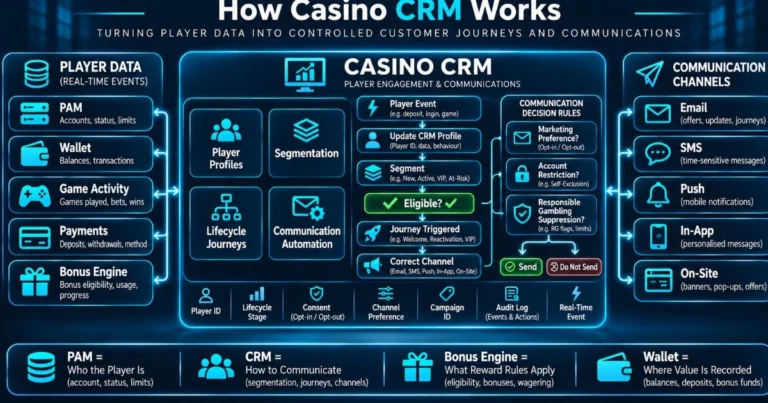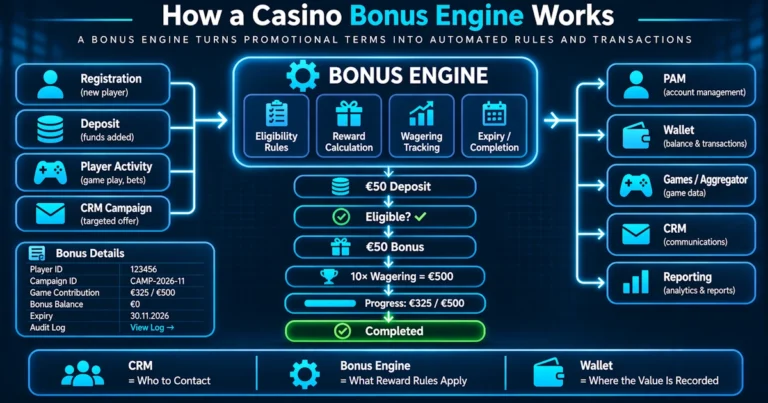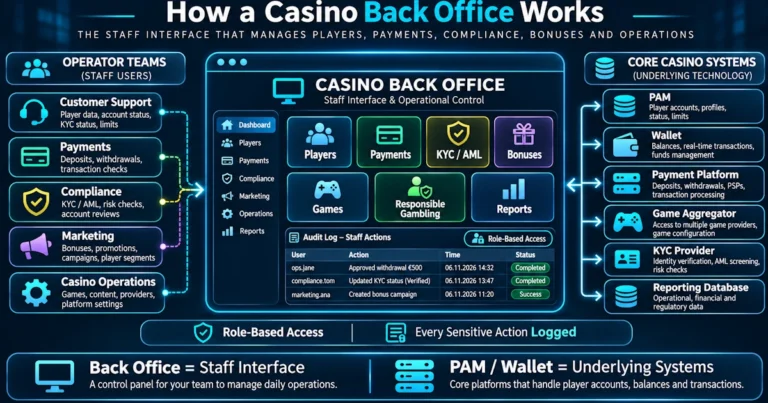
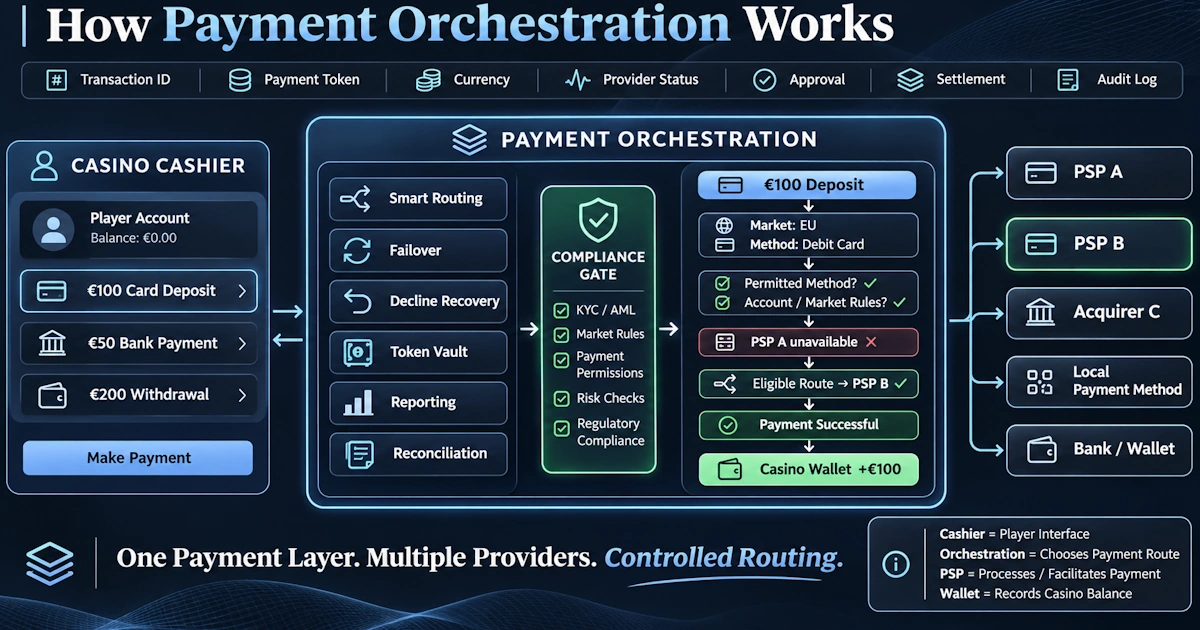
Payment orchestration in iGaming is a technology layer used to connect and manage multiple payment service providers, acquirers, payment methods and related payment services through one central integration.
Instead of building a separate technical connection for every payment provider, an online casino can connect its cashier or platform to a payment orchestration layer.
That layer can then decide where individual transactions should be sent.
A simplified architecture looks like this: Player ↓ Casino Cashier ↓ Payment Orchestration Platform ↙ ↓ ↘ PSP A — PSP B — PSP C ↓ Acquirers / Banks / Payment Methods
The orchestration layer can also manage functions such as routing, provider failover, tokenisation, transaction monitoring, reporting and reconciliation.
For international iGaming operators, this becomes increasingly useful as the number of countries, currencies, payment methods and providers grows.
The core idea is simple: Instead of the casino managing every payment connection separately, one orchestration layer manages the payment ecosystem.
What Is Payment Orchestration?
Payment orchestration is the process of coordinating different payment services through a central technology layer.
The payment industry commonly describes an orchestration platform as sitting between a merchant and multiple payment providers.
One integration can connect the merchant with:
PSPs
acquirers
payment gateways
local payment methods
fraud tools
token services
other payment infrastructure
The orchestration platform can then determine how each transaction should move through that ecosystem.
Current payment-industry analysis describes three core functions of orchestration: Connectivity Intelligent Routing Unified Payment Data
The Paypers reported in November 2026 that payment orchestration has increasingly moved beyond simple provider connectivity toward optimisation, routing and payment intelligence.
Why Is Payment Orchestration Important in iGaming?
Online gambling creates a complicated payment environment.
A casino can operate in: Country A Country B Country C
Each market can have different:
currencies
banks
payment habits
local payment methods
fraud patterns
regulatory requirements
One PSP may perform well in one market but poorly in another.
Another provider may support: Bank Transfers but not: E-Wallet A
A third provider may support a local payment method that is important only in one country.
As the casino expands, its payment architecture can become: Casino → PSP A Casino → PSP B Casino → PSP C Casino → PSP D Casino → PSP E
Each connection may require separate:
API development
credentials
reporting
monitoring
maintenance
Payment orchestration changes the architecture to: Casino → Orchestration Layer → Multiple Providers
This can reduce technical fragmentation.
How Does Payment Orchestration Work?
Consider a player who wants to deposit: €100
The casino does not necessarily send every €100 deposit to the same payment processor.
Instead, the orchestration system can evaluate information such as: Country Currency Payment Method Provider Availability Routing Rules
Then it chooses an appropriate route.
For example: Player Deposit €100 ↓ Payment Orchestration ↓ Check: Country = Spain Currency = EUR Method = Debit Card ↓ Route: PSP B ↓ Payment Processed ↓ Result Returned to Casino
The casino platform then updates the player’s account according to the confirmed payment result.
What Is a Payment Service Provider?
A Payment Service Provider, or PSP, provides payment-processing services that allow businesses to accept or send payments.
Depending on the provider and payment method, it may connect merchants with:
acquirers
card networks
banks
wallets
alternative payment methods
In a simple architecture: Casino → PSP → Payment Infrastructure
With orchestration: Casino → Orchestrator → PSP → Payment Infrastructure
The orchestrator therefore does not necessarily replace the PSP. It manages access to multiple PSPs.
Payment Orchestration vs PSP
This distinction is important.
PSP Processes or facilitates payment transactions.
Payment Orchestration Platform Coordinates how transactions are sent between multiple payment providers.
Think of it this way: PSP = Payment Route Orchestrator = Traffic Controller
An orchestrator can decide: Transaction A → PSP 1 Transaction B → PSP 2 Transaction C → PSP 3 depending on the configured rules.
Some payment companies provide both PSP and orchestration services, so commercial terminology can overlap. B2B buyers should therefore examine the actual architecture rather than relying only on product labels.
Payment Orchestration vs Payment Gateway
A payment gateway provides the technical connection used to pass payment information into the processing ecosystem.
A payment orchestration platform usually operates at a broader level.
A simple gateway setup could be: Casino → Gateway → Processor
An orchestration setup could be: Casino → Orchestrator then: Gateway A Gateway B PSP C Acquirer D
A gateway is therefore a connection point. The orchestration platform manages multiple possible connections and decides how they should be used.
However, some modern gateways also provide orchestration features. The boundaries between the categories are not always perfectly clear.
Payment Orchestration vs Casino Cashier
The casino cashier is primarily the player-facing payment interface.
The player might see: Deposit Withdraw Bank Transfer Debit Card E-Wallet
Behind that interface is the payment infrastructure.
A simplified model is: Player ↓ Casino Cashier ↓ Payment Orchestration ↓ Payment Providers
Therefore: Cashier = What the player interacts with Orchestration = How the payment is routed behind the scenes
Some vendors combine both functions in one product.
Payment Orchestration vs Casino Wallet
These are also different.
Casino Wallet Records the player’s internal casino balance. For example: Cash Balance: €150
Payment Orchestration Manages the external payment journey. For example: Route €100 deposit through PSP B
The wallet should only be updated according to the verified payment result.
A simplified flow is: Bank / PSP ↓ Payment Result ↓ Casino Platform ↓ Wallet Updated
The orchestration platform facilitates the external payment connection. It should not be confused with the player’s gambling-account ledger.
What Is Smart Payment Routing?
Smart routing means selecting a payment route according to defined rules or performance logic rather than sending every transaction to one provider.
For example: UK Debit Card → PSP A German Bank Transfer → PSP B Brazilian Local Method → PSP C
More advanced routing can also consider information such as:
currency
payment method
transaction size
provider status
provider performance
transaction cost
Some systems also use historical data or automated optimisation to influence routing decisions.
Current 2026 payment-industry analysis describes intelligent routing as one of the main areas where orchestration providers now compete, after multi-provider connectivity itself became more common.
Does Smart Routing Guarantee More Successful Deposits?
No.
Routing can improve how payment traffic is managed. It cannot guarantee that a payment will be approved.
A transaction can still fail because of:
issuer decision
insufficient funds
fraud controls
authentication failure
invalid payment details
regulatory restrictions
The correct B2B statement is: Routing can help optimise payment performance.
It should not be presented as: Routing makes every payment succeed.
What Is Rules-Based Routing?
Rules-based routing uses predefined instructions.
For example: IF Country = UK AND: Method = Debit Card THEN: Route to PSP A
Another rule could say: IF Currency = EUR AND: Country = Germany THEN: Route to PSP B
Operators can adjust these rules according to their commercial and operational strategy.
What Is Dynamic Routing?
Dynamic routing can use current payment data instead of relying only on fixed rules.
For example, the system may consider: PSP A approval performance today versus: PSP B approval performance today
If one provider experiences deteriorating performance, the system may shift eligible traffic.
Different vendors use terms such as: Smart Routing Intelligent Routing Dynamic Routing in different ways.
B2B buyers should therefore ask exactly how routing decisions are made.
What Is Payment Cascading?
Payment cascading means trying an alternative route when an initial payment attempt fails in a way that is appropriate for retry.
For example: Deposit → PSP A ↓ Eligible failure ↓ Retry → PSP B
The goal is to recover transactions that might succeed through another route.
But not every failed payment should automatically be retried.
For example: Insufficient Funds may require different treatment from: Provider Temporarily Unavailable
A strong orchestration system needs to understand the type of failure rather than blindly retrying every decline.
What Is Decline Recovery?
Decline recovery is the broader process of trying to recover payment attempts that did not succeed initially.
Depending on the system and circumstances, this could involve:
alternative provider
different routing path
alternative payment method
later retry
Commercial iGaming orchestration products currently offer cascading and decline-recovery features as part of their payment optimisation toolkits.
The exact recovery logic should be carefully controlled. A legitimate issuer decline should not simply be attacked with repeated payment attempts.
What Is Payment Failover?
Failover protects the operator when one payment provider becomes unavailable.
Imagine: PSP A Status: Offline
Without orchestration: Deposits → PSP A → Failure
With failover: PSP A unavailable ↓ Route eligible traffic to PSP B
This creates payment redundancy.
For a large casino, provider availability can directly affect revenue and customer experience. Using several providers can therefore reduce dependence on a single connection.
What Is Provider Health Monitoring?
The orchestration platform can monitor indicators such as: API Availability Response Time Error Rate Payment Performance
Suppose: PSP A error rate suddenly increases
The orchestration system can alert staff or modify routing according to configured rules. This allows payment teams to respond faster than waiting for large numbers of player complaints.
How Does a Casino Deposit Work With Payment Orchestration?
Consider a player depositing: €50
Step 1 — Player Opens Cashier The casino displays payment methods that are relevant and available.
Step 2 — Player Chooses Method For example: Debit Card
Step 3 — Orchestrator Receives Request The payment information and transaction context are sent into the orchestration layer.
Step 4 — Routing Decision The system considers: Market Currency Method Provider Rules Provider Availability
Step 5 — Transaction Is Sent For example: PSP B
Step 6 — Provider Processes Payment The provider returns a transaction result.
Step 7 — Casino Receives Confirmed Status For example: Payment Successful
Step 8 — Wallet Is Updated Cash Balance +€50
The important point is that the wallet should respond to the authoritative payment state rather than simply assuming every initiated deposit succeeds.
Payment Initiated vs Payment Successful
These states should never be confused.
Payment Initiated means: The player started the payment process.
It does not necessarily mean: The casino received the money.
Possible states can include: Initiated Pending Authorised Completed Failed Cancelled Reversed
The exact terminology varies between payment providers. A payment orchestration layer can help normalise different provider status models into a more consistent structure for the casino.
Why Does Payment Status Normalisation Matter?
Imagine: PSP A uses: APPROVED PSP B uses: SUCCESS PSP C uses: COMPLETED
All three may represent broadly similar outcomes. Without normalisation, the casino platform needs separate logic for every provider.
An orchestration platform can map them into one operator-side status such as: Successful
The same can be done for:
pending transactions
declines
refunds
errors
This reduces provider-specific complexity in the casino’s core platform.
How Do Withdrawals Work With Payment Orchestration?
Payment orchestration can also support payouts, although capabilities vary by provider.
A simplified casino withdrawal flow can be: Player Requests €200 Withdrawal ↓ Casino Platform ↓ Account / Compliance Checks ↓ Payment Orchestration ↓ Select Appropriate Payout Route ↓ PSP / Bank / Wallet ↓ Player Receives Funds
The important distinction is that the orchestration system does not automatically decide: “This withdrawal should be approved.”
That decision can depend on:
available balance
KYC
AML controls
bonus restrictions
operator procedures
Orchestration primarily manages the payment-routing stage after the relevant operator checks.
Why Are Payouts Different From Deposits?
A deposit brings money: into the casino system
A payout sends money: back to the customer
The available payment methods can be different. A method that supports deposits may not necessarily support withdrawals.
The system may also need to consider:
original deposit method
account verification
payout limits
provider availability
market rules
Therefore: Pay-in Orchestration and: Payout Orchestration should not automatically be assumed to have identical capabilities.
What Is Closed-Loop Payment Processing?
Closed-loop payment processing generally means returning funds to the same payment route or method used to fund the gambling account where appropriate.
For example: Deposit → Payment Method A and: Withdrawal → Payment Method A
The UK Gambling Commission has identified open-loop payment processes as an elevated money-laundering risk and strongly recommends closed-loop systems as best practice.
Its 2026 remote casino money-laundering risk assessment also highlights risks associated with multiple payment methods and open-loop payment structures.
This matters for orchestration because routing flexibility cannot ignore AML and withdrawal-control requirements.
Can Payment Orchestration Route a Withdrawal Anywhere?
Technically, a system might support many payout providers. Operationally and legally, that does not mean the operator should send funds to any available route.
The platform needs controls around:
account ownership
payment-method verification
deposit history
AML rules
market requirements
Payment optimisation should operate inside the operator’s compliance framework. It should not route around it.
What Is Tokenisation?
Tokenisation replaces sensitive payment data with another value called a token.
For example, instead of repeatedly using the underlying card number across internal systems, the platform may use: Token: TKN-739284
The PCI Security Standards Council describes tokenisation as replacing the primary account number with a surrogate value. Tokenisation can help reduce exposure of cardholder data, although it does not automatically eliminate PCI DSS obligations.
Why Is Tokenisation Useful in Payment Orchestration?
Suppose a player has previously used a payment card. The operator may want to route a future eligible transaction through another payment connection without exposing the raw payment credentials throughout its own systems.
A secure payment vault and tokenisation layer can support this type of architecture.
However, token portability matters.
A token created by: PSP A may not automatically work with: PSP B
Different tokenisation models behave differently.
B2B buyers should therefore ask: Who owns the payment token? Is it provider-specific? Can credentials be routed across multiple PSPs? What happens if we change orchestration provider?
These questions can materially affect vendor lock-in.
What Is a Payment Vault?
A payment vault securely stores or manages payment credentials so that other systems can use tokens rather than handling raw card data directly.
A simplified structure can look like: Player Card ↓ Secure Vault ↓ Token ↓ Casino / Orchestration Systems
Payment-industry analysis commonly identifies credential vaulting and tokenisation as functions that can sit alongside orchestration and multi-provider routing. The exact PCI scope depends on the implementation.
What Is PCI DSS?
PCI DSS stands for Payment Card Industry Data Security Standard.
It provides baseline technical and operational requirements for protecting payment account data. PCI DSS applies to relevant entities that store, process or transmit cardholder data or sensitive authentication data, as well as systems that can affect the security of the cardholder-data environment.
This matters when an iGaming operator or its payment providers handle card payments. Payment orchestration can help structure payment data securely, but using an orchestrator does not automatically make the casino PCI compliant.
Does Payment Orchestration Remove PCI DSS Requirements?
Not automatically.
Tokenisation and hosted payment components can potentially reduce the amount of sensitive card information handled directly by the casino environment. But the PCI Security Standards Council explicitly notes that tokenisation does not remove the need to maintain and validate applicable PCI DSS compliance.
The actual compliance scope depends on the payment architecture.
Operators should therefore evaluate: Where does card data enter? Who stores it? Who can retrieve it? Which systems can affect the payment environment?
What Is 3D Secure?
3D Secure, commonly called 3DS, is an authentication framework used in card payments.
Depending on the market and transaction, the player may need to complete additional authentication.
The orchestration layer can help pass:
authentication requests
transaction information
provider responses between systems.
However, the orchestrator does not simply decide that authentication rules no longer apply. Authentication requirements depend on payment regulation, issuers, PSPs and the specific transaction.
What Is Strong Customer Authentication?
Strong Customer Authentication, or SCA, is a European payment-security concept that requires qualifying electronic payments to use stronger authentication subject to applicable rules and exemptions.
A joint EBA/ECB payment-fraud report published in 2025 found that SCA had become standard across much of electronic payment activity and remained an important fraud-reduction mechanism.
For an iGaming orchestration architecture, this can mean supporting relevant authentication flows rather than simply optimising for the fewest possible steps.
Can Orchestration Choose Whether to Use Authentication?
Only within the legal and technical options available.
A sophisticated payments stack can help route transactions according to:
provider capabilities
authentication requirements
permitted exemptions
But an operator should not use orchestration as a way to bypass required payment-security controls. Optimisation has to operate within the applicable regulatory framework.
What Is Local Payment Routing?
Player payment preferences differ significantly between countries.
A payment method that is common in: Market A may be rarely used in: Market B
An orchestration platform can expose multiple local and international payment options through one integration.
The cashier might therefore display: Method A for one market and: Method B for another.
Behind the scenes, the orchestration system routes each method to its relevant provider.
Why Are Local Payment Methods Important?
Cards are not the only way customers pay online.
Depending on the market, players may prefer:
bank transfer
account-to-account payment
e-wallet
mobile payment
local payment service
Supporting those methods can require different PSPs. Without orchestration, every addition can become another separate integration.
With orchestration: One Operator Integration can potentially provide access to: Many Payment Integrations subject to commercial agreements and regulatory availability.
Does One Orchestration Integration Mean One Commercial Contract?
No. This is a major B2B distinction.
The orchestrator may provide the technical connector. But the casino may still need separate commercial approval or contracts with:
PSPs
acquirers
alternative payment methods
A provider appearing inside the orchestration dashboard does not necessarily mean: the casino is automatically approved to use it.
Technical availability and commercial onboarding are different things.
Does Payment Orchestration Make the Casino a Merchant Automatically?
No. Payment orchestration is a technical architecture.
It does not automatically determine:
merchant-of-record structure
settlement entity
acquirer relationship
regulatory responsibility
Those depend on the commercial and legal payment setup.
B2B buyers should ask: Who is the merchant? Who holds the PSP contract? Where are funds settled? Who carries chargeback liability? Who performs payment underwriting?
These questions matter more than whether a dashboard shows a particular payment logo.
What Is Payment Reconciliation?
Reconciliation means comparing records from different systems to make sure the numbers agree.
For example: Casino Wallet says: €1,000,000 successful deposits
PSP reports say: €1,000,000 successful deposits The records match.
Now suppose: Casino Wallet: €1,000,000 Provider Reports: €999,800 There is a: €200 difference
The operator needs to find the affected transactions.
How Can Orchestration Help Reconciliation?
Without orchestration, the finance team might need to work with: PSP A Report PSP B Report PSP C Report all using different fields and statuses.
The orchestration layer can help normalise transaction data into one environment.
Industry analysis continues to identify unified payment-data visibility and reconciliation as major payment-orchestration objectives, although the quality and completeness of this functionality differs across providers.
This can reduce operational work. It does not remove the need to reconcile with actual settlements and accounting records.
Payment Transaction vs Settlement
A successful payment status and actual settlement are related but different concepts.
For example: Deposit Successful means the player transaction has been successfully processed according to the payment flow.
Settlement refers to funds being financially transferred according to the payment-provider arrangement.
Finance teams need visibility into both.
A strong payment architecture should therefore support: Transaction Reporting and: Settlement Reconciliation rather than treating them as the same event.
What Is Unified Payment Reporting?
Unified reporting brings transaction data from several payment providers into one dashboard or data structure.
For example: Provider / Attempts / Successful / Failed PSP A / 10,000 / 8,500 / 1,500 PSP B / 7,000 / 6,100 / 900 PSP C / 5,000 / 4,000 / 1,000
The operator can then compare payment performance.
More sophisticated reporting may break results down by:
market
currency
payment method
issuer
provider
decline reason
The exact data available depends on provider integrations.
What Is Payment Approval Rate?
Approval rate generally measures how many payment attempts receive a successful approval.
A simplified formula is: Approved Transactions ÷ Relevant Attempts × 100
For example: 900 approvals from: 1,000 attempts would produce: 90% under that simplified definition.
However, operators need consistent definitions.
Should: customer cancellation count as a failed attempt?
What about: duplicate requests?
Different systems can calculate performance metrics differently. B2B comparisons should therefore check the underlying methodology.
What Is First-Attempt Success Rate?
First-attempt success focuses on whether the original payment route succeeds.
This can be useful because a transaction eventually recovered through three retries creates a different customer experience from one that succeeded immediately.
For example: PSP A First-attempt success: 92% while: PSP B is: 85%
The operator might prefer PSP A for qualifying traffic even if final recovered payment rates are closer.
What Is Payment Latency?
Latency is the time required to process a payment request and return a response.
For players, excessive latency can feel like: Deposit button spinning forever or: Payment status unclear
Orchestration adds another technology layer, so it needs to process transactions efficiently. A sophisticated routing system that takes too long to make a routing decision can still create poor payment experience.
What Is Payment Method Availability?
Not every payment provider is available at all times.
A method could be: temporarily unavailable or unavailable for: Market A
A cashier integrated with orchestration can potentially use provider-status information to hide or disable unavailable options. This is better than letting the player repeatedly select a route known to be broken.
What Is Fraud Orchestration?
Fraud tooling can also be connected around the payment flow.
A transaction might pass through: Payment Request ↓ Fraud / Risk Check ↓ Payment Routing ↓ PSP
The fraud service could return: Allow Review Decline
Some payment orchestration platforms integrate these services directly. Others focus only on payment routing and rely on separate fraud infrastructure.
Payment-industry analysis describes fraud and identity tools as an increasingly important adjacent area for orchestration platforms.
Is Fraud Orchestration the Same as Payment Orchestration?
Not exactly.
Payment Orchestration Focus: How and where should the payment be processed?
Fraud Orchestration Focus: Which fraud and risk checks should be applied?
The systems can interact closely.
For example: High-Risk Transaction could require:Additional Verification before the payment route is selected.
Some products combine both functions.
Why Is Payment Fraud Important in iGaming?
Remote gambling processes financial transactions involving accounts that can deposit, gamble and withdraw money.
This creates risks involving:
stolen payment credentials
mule accounts
third-party funding
account takeover
money laundering
The UK Gambling Commission’s 2026 money-laundering risk assessment for remote casinos highlights risks involving multiple payment methods, prepaid methods, e-wallets and open-loop financial flows.
Payment orchestration therefore needs to work with the operator’s fraud and AML controls rather than optimise transactions independently of them.
Can Orchestration Route Around a Compliance Block?
It should not.
Suppose a payment is blocked because: Payment Method Prohibited or: Account Restricted
The system should not simply send the transaction to another PSP in an attempt to get it approved.
A payment failure caused by: Provider Technical Outage is different from: Regulatory or Risk Rejection
This distinction is fundamental. Failover should recover infrastructure problems. It should not bypass legitimate compliance controls.
Why Decline Codes Matter
Payment providers return information explaining why a transaction failed. Different providers may use different decline codes.
The orchestration layer can help map them into categories such as: Technical Error Insufficient Funds Authentication Failed Suspected Fraud Unsupported Method
The category influences what should happen next.
For example: Technical Error → Alternative Route May Be Appropriate while: Suspected Fraud → Automatic Retry May Be Inappropriate
Good orchestration is therefore not simply: Retry everything somewhere else.
What Is a Hard Decline vs Soft Decline?
Payment teams sometimes classify failures as:
Soft Decline A failure that may potentially succeed after another appropriate action.
Hard Decline A failure that generally should not simply be retried.
The exact classification depends on the payment network, provider and reason code. An orchestration platform can use this information when applying retry logic.
Blind retries can increase:
processing cost
fraud concerns
poor customer experience and should be avoided.
Can Payment Orchestration Reduce Payment Costs?
Potentially.
If an operator has several eligible routes, it may be able to consider:
provider fees
acquiring costs
transaction performance when routing payments.
For example, two providers may both support the same transaction. If performance is comparable, the operator might prefer the more cost-effective route.
However: cheapest route is not automatically: best route
A cheaper provider with much lower approval performance can produce worse overall economics. Cost optimisation therefore needs to consider performance as well as price.
What Is Cost-Based Routing?
Cost-based routing includes transaction economics in the routing decision.
For example: Route A Cost = €0.20 Route B Cost = €0.35
But the system might also know: Route A Approval Performance = Lower
So the real decision becomes: Cost + Performance + Risk + Availability rather than price alone.
Why Multi-Currency Support Matters
International casinos may accept: EUR GBP USD and other currencies.
The orchestration layer needs to understand which payment providers support:
transaction currency
settlement currency
payment method
market
Currency support should be evaluated carefully because: player-facing currency and: merchant settlement currency are not always the same thing.
FX costs can therefore become part of the commercial analysis.
What Is Payment Localisation?
Payment localisation means adapting the cashier and payment setup to the player’s market.
This can include: Local Currency Local Payment Methods Local Banks Relevant Language Market-Specific Routing
For an international iGaming operator, localisation can become as important as the number of providers connected.
A cashier containing 100 payment methods is not useful if none of them are preferred by customers in the target country.
What Does Payment Orchestration Do for Market Expansion?
Without orchestration, entering a new market may require: New PSP Integration New Local Payment Integration New Reporting Connection
With orchestration, some of these providers may already be available through the existing API.
The operator can potentially activate new connections with less development work, once the relevant commercial and compliance arrangements are in place.
This can reduce technology lead time.
It does not remove market-entry requirements such as:
PSP underwriting
commercial contracts
local compliance
What Is Provider-Agnostic Orchestration?
A provider-agnostic orchestrator is designed to work across several independent payment providers rather than pushing every transaction through one processor’s own ecosystem.
This can give the operator more flexibility. However, complete neutrality should not simply be assumed from marketing language.
B2B buyers should ask: Can I connect my existing PSPs? Can I route between competitors? Are some routes commercially preferred? Can I export my payment data? Who controls the vault?
This reveals how independent the orchestration layer really is.
PSP-Owned vs Independent Orchestration
Some orchestration services are offered by companies that also provide payment processing. Others are specialist orchestration companies.
PSP-Owned Orchestration Potential advantages:
integrated payment infrastructure
simpler commercial setup Potential consideration:
routing independence
Independent Orchestration Potential advantages:
broader provider neutrality
ability to keep multiple PSP relationships Potential consideration:
additional commercial and technical layer
Neither model is automatically better. The operator needs to understand incentives and dependencies.
What Is Build vs Buy in Payment Orchestration?
Large operators can choose to: Build Orchestration Internally or: Buy an External Platform
Current 2026 payment-industry analysis frames this decision mainly around merchant scale, payment complexity and strategic importance. International merchants using many PSPs, currencies and markets are generally stronger candidates for orchestration than simple single-provider businesses.
Build Potential advantages:
complete routing control
custom architecture Potential disadvantages:
engineering cost
maintenance
provider integrations
Buy Potential advantages:
existing connectors
quicker deployment
vendor-maintained infrastructure Potential disadvantages:
platform fees
vendor dependency
migration complexity
The correct choice depends on operator scale.
Does Every Casino Need Payment Orchestration?
No.
Consider: Casino A operates in one market using one reliable PSP and two payment methods. A complex orchestration layer may add unnecessary overhead.
Now consider: Casino B operates in 15 markets using: 8 PSPs 4 acquirers 20 local payment methods
The orchestration value can be much greater. Payment orchestration becomes more useful as the payment ecosystem becomes more fragmented.
What Is Vendor Lock-In in Payment Orchestration?
An operator can become dependent on:
orchestrator API
token vault
provider connectors
routing rules
transaction history
reconciliation data
If changing platform means: rebuilding every payment connection and: losing stored tokens migration becomes difficult.
Before choosing an orchestrator, operators should therefore ask: Can payment tokens be migrated? Can historical transaction data be exported? Can routing rules be exported? Who owns the PSP contracts? What happens during termination? How long is transition support available?
Exit architecture matters before the first transaction is processed.
Why Token Portability Matters
Suppose an operator stores millions of recurring payment credentials through an orchestration provider.
If those tokens work only inside that provider’s environment, switching can become difficult. Token portability depends on the underlying tokenisation model.
This should be evaluated early rather than after years of payment history accumulate. A provider-neutral architecture can be valuable when long-term payment independence matters.
What Should Operators Measure?
A B2B payments team can monitor metrics such as: Approval Rate First-Attempt Success Deposit Conversion Payout Success Rate Payment Latency Provider Error Rate Cost per Successful Transaction Fraud Rate Chargebacks Reconciliation Differences Provider Uptime
No single metric should be evaluated in isolation.
For example: higher approval rate is not necessarily positive if it also creates: much higher fraud losses.
What Is Payment Conversion?
Payment conversion usually refers to the proportion of payment journeys that result in a successful transaction.
But the calculation can differ. For example, does the denominator include: Players who opened cashier but never selected a method? or only: Actual payment attempts?
B2B teams should define metrics consistently before comparing providers. Otherwise two dashboards can show different “conversion rates” for the same payment activity.
What Is a Payment Dashboard?
Payment orchestration platforms often provide a central dashboard containing information such as: Transaction Volume Provider Performance Payment Methods Approval Rates Decline Reasons Market Performance Payout Status
The value is not simply another dashboard. The goal is to remove the need to switch constantly between several disconnected PSP portals.
What Is Payment Reconciliation Automation?
Manual reconciliation can involve downloading provider files and comparing them with internal transaction records.
Automation can match records using information such as: Transaction ID Provider ID Amount Currency Status
Exceptions are then sent for review.
For example: 99,950 transactions matched 50 exceptions
Finance staff can focus on those 50 rather than manually checking all 100,000 records.
Why Are Unique Transaction IDs Important?
Every payment needs reliable identifiers.
For example: Casino Transaction ID: CAS-492831 Orchestrator ID: ORC-88211 PSP ID: PSP-553923
The systems need a way to map those records together. Without this, investigating one failed €100 deposit across several systems can become unnecessarily difficult.
What Happens During an Orchestrator Outage?
Payment orchestration can reduce dependency on individual PSPs. But it can also create a new dependency: the orchestration layer itself.
If: Orchestrator Offline then: PSP A PSP B and: PSP C may all become inaccessible through that integration.
B2B buyers should therefore evaluate:
uptime
redundancy
disaster recovery
regional infrastructure
incident management
An orchestration platform should not become an unexamined single point of failure.
Why Are Service-Level Agreements Important?
The payment system directly affects: deposits and potentially: withdrawals
A serious outage can therefore stop core financial operations.
An SLA may cover:
uptime
incident response
support availability
recovery expectations
The exact contractual guarantees vary.
Operators should also understand: what happens if a downstream PSP fails versus: what happens if the orchestration platform itself fails.
Does Payment Orchestration Improve Compliance?
It can help operators implement controls consistently.
For example: Blocked Market could be excluded from specific routes.
Or: Restricted Payment Method could be disabled centrally.
But technology cannot automatically guarantee compliance.
The operator still needs to understand:
gambling rules
payment regulations
AML controls
PSP conditions
Orchestration centralises control. It does not replace regulatory responsibility.
Great Britain: Payment Providers Must Meet Regulatory Requirements
Great Britain provides a useful example of why the orchestration layer needs market-aware configuration.
UK Gambling Commission Licence Condition 5.1.2 requires relevant remote operators using payment services to accept those payments only where the service provider meets the applicable definition of a payment service provider under UK payment-services legislation.
An orchestrator therefore cannot simply connect an operator with any payment business and assume the route is suitable for British gambling. The underlying provider still matters.
Great Britain: Credit Card Gambling Ban
The UK Gambling Commission also prohibits relevant gambling operators from accepting payments by credit card, including where credit card funds are routed through certain money service businesses.
This is an excellent example of why: technical routing capability does not equal: regulatory permission
An orchestration platform might technically know how to process a particular payment route. The casino must still prevent prohibited routes from being used.
Can Orchestration Automatically Apply Market Rules?
It can help.
For example: Market = Great Britain could trigger: Credit Card Route Disabled
The system may also apply different:
PSP availability
payment methods
currencies according to the market.
But these rules need accurate configuration and ongoing governance. A wrongly configured routing rule can affect thousands of transactions.
Why Change Management Matters
Suppose a payment manager changes: UK Cards → PSP A to: UK Cards → PSP B
That can immediately affect large transaction volumes.
High-impact routing changes should therefore be:
permission controlled
tested
logged
monitored
A strong orchestration back office system should answer: Who changed the rule? When? What was the previous route?
What Is a Routing Simulator?
Some sophisticated systems can allow payment teams to test how routing rules would affect historical or test transactions before publishing them.
For example: New Rule would route: 70% to PSP A 30% to PSP B
This helps teams identify unintended effects before affecting real player deposits. Not all orchestration platforms provide this capability. It is a useful feature to investigate during B2B evaluation.
What Is Payment A/B Testing?
Operators can potentially test different eligible payment routes.
For example: 50% of qualifying traffic → PSP A 50% → PSP B
Then compare:
approval rate
latency
cost
fraud performance
This can provide better evidence than routing every transaction based only on assumptions.
However, payment experiments must remain inside:
contractual requirements
risk rules
regulatory controls
How Does AI Fit Into Payment Orchestration?
Some providers increasingly use AI or machine-learning models to assist with:
routing
anomaly detection
performance optimisation
payment recovery
Current 2026 industry commentary describes this shift from basic connectivity toward more intelligent payment decisioning. But the phrase: AI Routing does not tell a B2B buyer very much by itself.
Operators should ask: Which data does the model use? Can rules override the model? Are compliance restrictions absolute? Can decisions be explained? How is performance measured?
Automation should remain governed.
What Should Operators Look for in a Payment Orchestration Platform?
B2B buyers should evaluate several areas.
Provider Connectivity Which PSPs, acquirers and payment methods are available?
Existing Provider Support Can the operator connect PSP contracts it already has?
Routing Can transactions be routed according to market, method, currency and performance?
Failover What happens when a provider becomes unavailable?
Decline Recovery Which failures can be retried and how?
Pay-Ins and Payouts Does the platform support both?
Tokenisation How are payment credentials protected?
Token Portability What happens if the operator changes provider?
Fraud Integration Can external risk tools be integrated?
Reporting Can transaction performance be compared centrally?
Reconciliation Can financial records from multiple providers be matched?
Security How is payment information protected?
PCI Scope How does the architecture affect card-data responsibilities?
Multi-Market Rules Can payment methods be controlled by jurisdiction?
APIs Can the casino integrate its existing cashier and systems?
Audit Logs Are routing and configuration changes traceable?
SLA How is an orchestration outage handled?
The strongest system is not simply the one advertising the largest number of payment connectors. It is the one that gives the operator reliable control over a complex payment ecosystem.
What Should Operators Test Before Buying?
A practical demonstration should include realistic scenarios.
Ask the provider to show: Route UK debit-card traffic to PSP A Route another market to PSP B Take PSP A offline Show automatic failover Trigger a technical decline Show eligible retry logic Trigger a non-retryable decline Show that the system does not cascade it blindly Process a payout Show the payment token and vault architecture Reconcile transactions from two PSPs Export payment data Show the audit log after changing a routing rule Show how a prohibited payment method is disabled for one market
These tests reveal much more than a list claiming: 500+ payment integrations.
Common Payment Orchestration Red Flags
Potential warning signs include:
Every Decline Is Automatically Retried This can create poor risk and payment behaviour.
No Clear Source of Truth Payment statuses can become inconsistent with the casino wallet.
Provider-Specific Tokens With No Exit Plan Vendor lock-in can increase.
No Payout Orchestration The product may solve deposits only.
No Reconciliation Tools Finance teams remain stuck with manual provider reports.
No Audit Logs Routing changes become difficult to investigate.
No Market-Level Payment Restrictions Regulatory configuration becomes harder.
One Dashboard but No Real Routing Control The product may be payment aggregation rather than meaningful orchestration.
No Exportable Transaction Data Migration and independent analysis become difficult.
Payment Orchestration vs Simple PSP Integration
A simple architecture looks like: Casino ↓ One PSP
This can be perfectly suitable for a smaller operation. Payment orchestration becomes more valuable when complexity increases:
Casino ↓ Orchestrator ↓ PSP A PSP B PSP C Local Method D Acquirer E
The value therefore comes from managing complexity, not from adding another technology layer for its own sake.
Payment Orchestration vs Payment Aggregation
The terms can sometimes overlap.
A basic payment aggregation service may mainly provide: one integration to several payment methods
Orchestration usually implies additional management logic such as: Routing Failover Optimisation Unified Reporting Reconciliation
However, vendor terminology varies. The correct B2B question is: What can the platform actually control after the transaction reaches it?
Payment Orchestration vs Payment Processing: Simple Comparison
System | Main Role Casino Cashier | Player-facing deposit and withdrawal interface Casino Wallet | Records internal player balances Payment Orchestrator | Chooses and manages payment routes PSP / Gateway | Connects and facilitates payment processing Acquirer / Bank | Participates in underlying payment processing and settlement Fraud Tool | Evaluates payment risk Reconciliation System | Matches payment and financial records
One company can provide several of these services. The functions are still conceptually different.
A Simple End-to-End iGaming Payment Flow
Consider a player depositing: €100
Cashier Player selects: Debit Card ↓ Orchestration System checks: Country Currency Payment Method Provider Status Routing Rules ↓ Routing Decision PSP B Selected ↓ Authentication / Processing Relevant payment checks occur. ↓ Result Payment Successful ↓ Casino Platform Transaction confirmed. ↓ Wallet +€100 ↓ Reporting Orchestrator records: Provider Transaction ID Result Latency ↓ Reconciliation Casino and provider records are later matched.
This demonstrates the core role of orchestration: It manages the payment journey between the casino and several possible payment services.
Final Thoughts
So, what is payment orchestration in iGaming technology?
It is a central technology layer that allows an online casino to manage multiple payment providers and payment methods without hard-wiring every one of them separately into the core casino platform.
A simplified architecture is: Player → Cashier → Payment Orchestration → PSP / Acquirer / Payment Method
The orchestration layer can manage: Provider Connectivity Smart Routing Failover Decline Recovery Tokenisation Payment Monitoring Reporting Reconciliation and, depending on the platform: Payout Routing Fraud Integrations
For international operators, the main benefit is control. Instead of maintaining a fragmented payment environment across many providers, the business can manage more of its payment logic from one layer.
But orchestration should not be confused with payment permission.
A route can be: technically available while still being: commercially unavailable or: regulatorily prohibited
The strongest payment-orchestration architecture therefore balances: Payment Performance Cost Redundancy Security Fraud Controls AML Market Rules Reconciliation
The goal is not simply to make more payment attempts succeed. It is to send each legitimate transaction through an appropriate, permitted and reliable payment route while keeping the casino’s financial records accurate across the entire process.
Frequently Asked Questions
What is payment orchestration in iGaming? Payment orchestration is a technology layer that connects an online casino with multiple PSPs, acquirers and payment methods and manages how deposits and, where supported, withdrawals are routed between them.
Is payment orchestration the same as a payment gateway? No. A gateway provides a payment connection, while an orchestration platform can manage multiple gateways, PSPs and payment routes through one control layer.
What is smart payment routing? Smart routing chooses an eligible payment provider according to rules or data such as market, currency, payment method, provider availability and historical performance.
What is payment cascading? Payment cascading sends an eligible failed transaction to another payment route. It should be used selectively because not every decline should be retried.
Can payment orchestration manage withdrawals? Yes, some orchestration platforms support both pay-ins and payouts. However, payout routing must still respect account verification, AML controls, payment-method rules and operator procedures.
Does payment orchestration guarantee higher approval rates? No. It can improve routing and payment resilience, but transaction approval still depends on issuers, payment providers, fraud controls, authentication and other factors.