Some football matches look easy to predict. A Champions League giant faces a much smaller club. A league leader plays a relegation candidate. One squad is worth hundreds of millions more than the other.
The natural reaction is: The favourite will win. And it may.
But that does not automatically mean backing the favourite is a good prediction—or a good bet. There is an important distinction between the team most likely to win and the outcome offering the best value at the available odds.
A favourite can have a 70% chance of winning and still be overpriced. An underdog can have only a 15% chance and still be unattractive if its odds do not compensate for that low probability. That is why uneven football matchups require more analysis than simply identifying the stronger team.
The useful question is not: “Who is better?” It is: “How large is the real gap between these teams, how does the matchup work tactically, and has the bookmaker already priced that gap correctly?”
Start by Accepting That the Favourite Usually Is Better
Do not overcomplicate the obvious. If a Real Madrid-type team faces a much weaker opponent, it probably does have a greater chance of winning. The mistake is not recognising the favourite. The mistake is moving directly from “They are clearly stronger” to “Therefore I should bet on them.”
Suppose the favourite’s true win probability is 70%. Fair odds would be: 1 ÷ 0.70 = 1.43. Now imagine the bookmaker offers 1.22. Those odds imply a raw probability of: 1 ÷ 1.22 = 82.0%.
You can believe the favourite is by far the better team while simultaneously believing that 1.22 is too short. That distinction is the foundation of good analysis.
Stronger Team Does Not Mean Good Price
Imagine a favourite with an estimated win probability of 75% (Fair odds: 1.33). But the available odds are 1.18.
The team is still very likely to win. But at 1.18, you are being asked to accept an implied probability of approximately 84.7%. That is a very different claim. The bet is no longer “Is this team better?” It is “Does this team win more than about 85% of the time in this situation?” That is a much harder standard.
Betting-Market Research Makes This More Complicated
One temptation is to solve the problem by always backing the underdog instead. That does not work either.
A large study examined 163,992 football odds from 41,003 matches across ten European leagues and found evidence consistent with the well-known favourite–longshot bias, where longshots can produce larger average betting losses than shorter-priced selections.
Another study covering 33,060 matches across 11 European leagues also examined favourite–longshot effects and market efficiency. More recent research published in the International Journal of Forecasting found a strong favourite–longshot bias in traditional 1X2 markets, while Asian handicap prices produced more efficient probability forecasts in the same match sample.
So the answer is not “always back favourites” or “always oppose favourites.” The answer is compare probability with price.
Begin With the Size of the Quality Gap
Not all favourites are equally dominant. A team priced at 1.80 is very different from one priced at 1.15.
Start by comparing squad quality, recent xG difference, domestic league strength, home-away performance, injuries, and likely starting XI. Then decide whether the visible reputation gap matches the actual football gap. A famous badge can exaggerate perception. A smaller club can also be much stronger than casual bettors assume.
League Strength Matters in European Matchups
Uneven European fixtures can be particularly difficult. Imagine Team A is third in a major European league and Team B is first in a smaller domestic competition.
Looking only at league position makes Team B appear equally impressive. It probably is not. Team A may face high-quality opposition almost every weekend; Team B may dominate possession against much weaker domestic opponents. That means statistics such as 2.1 xG per match cannot always be transferred directly from one league to another without accounting for the strength of schedule. Competition strength needs to be considered.
But Do Not Automatically Disrespect the Smaller-League Team
The opposite mistake is also common. A club from a smaller league may have excellent tactical organisation, strong set pieces, fast counterattacks, significant home advantage, and a settled starting XI.
The famous favourite may still be stronger. But perhaps the real win probability is 65% rather than 80%. At the correct odds, that difference matters enormously.
xG Difference Can Help Measure the Real Gap
A useful starting statistic is xG difference (xG created − xGA conceded).
Imagine:
Favourite: 1.9 xG, 1.3 xGA (Difference: +0.6)
Underdog: 1.5 xG, 1.2 xGA (Difference: +0.3)
The favourite is better, but perhaps not overwhelmingly better.
Now compare:
Favourite: 2.3 xG, 0.8 xGA (Difference: +1.5)
Underdog: 0.9 xG, 1.9 xGA (Difference: -1.0)
That represents a much larger underlying gap. Do not treat every “big favourite” as the same type of favourite.
Adjust xG for Opponent Strength
Suppose the favourite averages 2.2 Expected Goals (xG), but most of those numbers came against weak domestic opponents. The underdog averages 1.4 xG while regularly facing stronger opposition.
The gap may be smaller than the raw averages suggest. Ask: Who produced these statistics against whom? A 1.6 xG performance against an elite defence may be more impressive than 2.2 against one of the weakest teams in the league.
Recent Scorelines Can Exaggerate the Favourite
Imagine the favourite’s last three matches: 4-0, 5-1, 3-0. The market becomes excited.
But the underlying numbers show 12 goals from 7.0 xG. That is substantial finishing overperformance. Now the favourite is priced at 1.20 because everyone expects another comfortable victory. The team may still win, but you could be paying for goals that have already happened. Always check expected goals vs actual goals before reacting to a blowout score.
The Underdog’s Scoring Route Is Crucial
When analysing an uneven matchup, ask: How can the underdog realistically score?
Possible routes include counterattacks, corners, free kicks, penalties, high pressing, or long balls behind aggressive full-backs. If there is no credible scoring route, markets such as Favourite to Win to Nil or Underdog Under 0.5 Goals may deserve attention. If there is a credible route, BTTS can become much more interesting than the 1X2 market.
Practical Example: Favourite Is Strong, but BTTS May Be Better
Imagine:
Favourite: 2.2 xG, Strong attack, High defensive line
Underdog: 1.1 xG, Fast forwards, Excellent transition attack
The favourite deserves to win. But its aggressive defensive positioning gives the underdog a realistic route to score. Possible results: 2-1, 3-1, 3-2. Instead of taking the favourite at 1.25, you might investigate BTTS or Favourite Win + BTTS depending on price and risk. The strongest team remains the favourite; you simply choose a market that reflects the actual matchup better.
Team Totals Can Be Cleaner Than Match Winner
Suppose you strongly believe the favourite will dominate offensively, but its price to win is extremely short. You might analyse Favourite Over 1.5 Team Goals instead.
Why? Because your real prediction may not be “The underdog definitely loses.” It may be “The favourite creates enough chances to score at least twice.” Those are different predictions. Choose the market that matches your strongest evidence. This perfectly illustrates exactly how Team Total Goals are explained in a practical betting context.
Practical Example: Team Total Instead of 1.20 Favourite
Favourite: 2.4 xG, 6.3 shots on target, Strong home attack
Underdog: 1.8 xGA, Allows several big chances
If the favourite win price is 1.20 and Team Over 1.5 Goals is 1.55, and your analysis is mainly about attacking superiority, the team-total market may be more logical than simply adding the short favourite to an accumulator.
Handicap Markets Can Test How Strong Your Opinion Really Is
Suppose the favourite is 1.18 to win. Very short. You expect genuine domination.
Then ask: Would you still like the favourite at -1 Asian Handicap or -1.5 goals? If the answer is no, perhaps your confidence is mainly based on the team being famous rather than your expectation of a convincing performance. Handicap markets force you to estimate the size of superiority, not merely who is more likely to win.
A Favourite Can Win and Still Be Overrated
This is one of the hardest ideas psychologically. Suppose you decide 1.20 is too short. The favourite wins 4-0. Was your analysis automatically wrong?
No. A probability decision cannot be judged from one result. A team with a genuine 70% win probability will still win most individual matches. The question was whether the odds implied a probability significantly higher than your estimate. Good analysis can lose. Poor analysis can win. That is why price matters.
Home Advantage Can Narrow the Gap
Suppose the smaller team plays at home. Now add a familiar pitch, a full stadium, difficult travel for the visitor, and aggressive home pressing.
The favourite may remain better. But perhaps its probability drops from 78% on a neutral field to 68% away. That can be enough to turn very short odds into poor value. Home advantage should therefore be built into your probability rather than treated as a decorative statistic.
Artificial Surfaces and Unfamiliar Conditions Can Matter
Some European underdogs play under conditions the favourite encounters rarely: artificial turf, extreme weather, long travel, a small stadium, or an unusual tactical style.
None of these factors automatically produces an upset, but several together can narrow the performance gap. A technically superior team may require time to adapt. That can be particularly relevant for First-Half Draw or Favourite Under Team Total markets.
Rotation Can Completely Change an Uneven Matchup
This is one of the biggest traps in European football. On paper, Elite Club vs Smaller Club looks extremely uneven. Then the lineup arrives.
The favourite rests its main striker, creative midfielder, two defenders, and first-choice goalkeeper. Suddenly the difference between the actual starting XIs is smaller. The famous club may still win, but the original odds may have been based partly on reputation. Always check lineups before backing very short favourites where rotation is plausible, as squad rotation changes football predictions drastically.
Rotation in Defence Can Be More Important Than Rotation in Attack
Suppose the favourite rests its striker. That may reduce scoring potential. Now suppose instead it rests its goalkeeper and two centre-backs. The underdog’s scoring probability may rise significantly. That can improve BTTS or Underdog Over 0.5 Goals even if you still expect the favourite to win. The number of changes matters less than where those changes occur.
Look at the Favourite’s Schedule
A strong team may have a Champions League match on Wednesday, a league match on Saturday, and a cup match next Tuesday. Now it faces a weaker domestic opponent.
Will the manager need maximum intensity for 90 minutes? Maybe not. The favourite may score early and manage the game. That can produce 2-0 rather than 5-0. The favourite wins comfortably, but the high goal line loses. Understanding schedule priorities helps distinguish winning probability from expected margin of victory.
The Underdog May Value the Draw Much More
Uneven matches also create asymmetric incentives. Suppose the smaller team would be delighted with 0-0 or 1-1. It may defend with five defenders, a deep midfield block, and minimal attacking commitment.
That can make the first goal difficult. Once the favourite scores, the match may change. But before that happens, the underdog’s primary objective is often simply surviving. This asymmetry is key when deciding whether Draw No Bet vs Goal Markets carries less risk.
Practical Example: Strong Favourite, Slow Start
Favourite: 70% possession expected, Strong attack
Underdog: Very deep defensive block, Little counterattacking threat
Possible match pattern: HT 0-0 or 1-0, FT 2-0 or 3-0. Instead of Favourite -2.5, you might investigate First Half Under 1.5 or wait for live opportunities. Uneven does not always mean immediate goals.
The First Goal Is Especially Important
If the favourite scores after eight minutes, the underdog’s plan can collapse. It now needs to move slightly higher. Spaces appear. The favourite can score again.
But if the game stays 0-0 after 60 minutes, the pressure can move towards the favourite. It may start forcing passes. The underdog gains confidence. This is why live analysis can be particularly useful in uneven matchups.
Do Not Automatically Assume an Upset Because the Favourite Struggles Early
A 0-0 score after 30 minutes does not suddenly make the teams equal. Strong favourites often need time to break down low blocks.
Instead, check xG, shots on target, big chances, and penalty-area pressure. If the favourite has 1.4 xG after 35 minutes but no goal, the underlying dominance remains obvious. If it has 0.2 xG, the matchup may genuinely be more difficult than expected.
Set Pieces Can Make Underdogs Dangerous
Set pieces reduce the need for sustained possession. A team can have 30% possession and still score from one corner, one wide free kick, or one long throw.
That is why you should check underdog set-piece strength, favourite aerial defence, the main delivery taker, and tall attacking targets. A smaller team with a strong dead-ball threat may have a better scoring probability than its open-play statistics suggest.
The Draw Is Often Forgotten
When people see a very strong favourite vs an obvious underdog, they think only about a favourite win or a shock underdog win.
The draw can be the most realistic way the favourite fails. A well-organised underdog may not need to outplay the favourite. It may simply need to defend well, avoid mistakes, survive set pieces, and take one chance. Possible scores: 0-0 or 1-1. Before backing a favourite at very short odds, ask how often the draw occurs in your estimated probability distribution.
Do Not Build Accumulators From “Safe” Favourites
Four favourites each have a 75% win probability. Individually, each looks strong. But assuming independence for a simple illustration: 0.75 × 0.75 × 0.75 × 0.75 = 31.6%.
Your four “safe” selections now have only around a one-in-three chance of all winning. This is why short favourites can become deceptive inside accumulators. A single draw ruins everything. Adding more obvious favourites does not automatically make a bet safer.
Public Reputation Can Affect Perception
Famous teams attract attention. Bettors know their players. They watch their Champions League games. That familiarity can make the favourite feel safer than it actually is.
The betting market is generally sophisticated, however. One study of more than 16,000 English football matches and odds from 51 online bookmakers found that match-result odds were generally well calibrated and did not show a simple exploitable favourite or outcome bias in that sample. So do not assume you have discovered value merely because “Everyone loves the big club.” You still need evidence.
Research Also Shows Why Blindly Backing Longshots Is Not the Answer
More recent studies have again found favourite–longshot effects in large football datasets, including evidence that traditional 1X2 prices can penalise extreme longshot selections more heavily.
That means opposing famous favourites by automatically betting huge underdogs can be just as poor a strategy as blindly backing the favourite. A 12.00 outsider can still be terrible value. Big odds do not mean generous odds.
Convert Odds Into Probabilities
This is one of the easiest ways to think more clearly.
Favourite at 1.25: 1 ÷ 1.25 = 80%
Favourite at 1.50: 1 ÷ 1.50 = 66.7%
Favourite at 1.80: 1 ÷ 1.80 = 55.6%
Ignore bookmaker margin for the moment. Now ask: Would I really give this team an 80% chance? That question is much more useful than: “Do I think they will win?” You might think a team probably wins while estimating only 70%. If the market requires 80%, you do not have to back it.
Practical Example: Favourite Looks Obvious but Price Is Too Short
Imagine the favourite has a much stronger squad, home advantage, and positive xG difference. But their main striker is missing, they played a European game three days earlier, the opponent defends deep, and the underdog is strong from set pieces.
Your estimate: 72% win probability. Bookmaker price: 1.22 (Implied probability: 82%). You can still predict the favourite to win. You simply do not have to bet the 1X2 price. Possible alternatives: No bet, team total, live market, or a different handicap. Sometimes the best analysis concludes that there is no attractive bet.
Practical Example: Underdog Does Not Need to Win
Suppose the Favourite is 1.30 and the Underdog is 9.50. You think the favourite is slightly overpriced.
That does not mean you need to bet the underdog to win. You might instead investigate Underdog +1.5 Asian Handicap or Underdog +2.0 because your real prediction is “This match should be closer than the odds suggest.” That is different from predicting a shock victory.
Practical Example: Favourite Is Actually Worth Backing
Avoid becoming anti-favourite for the sake of it.
Favourite: 2.4 xG, 0.8 xGA, Strongest available XI, Excellent home record
Underdog: 0.8 xG, 2.0 xGA, Missing two defenders, Poor away form
Market: Favourite 1.55. Your estimated win probability: 72%. Fair odds: 1 ÷ 0.72 = 1.39. Now the favourite may genuinely offer value. The point of deeper analysis is not to avoid favourites. It is to avoid backing them automatically.
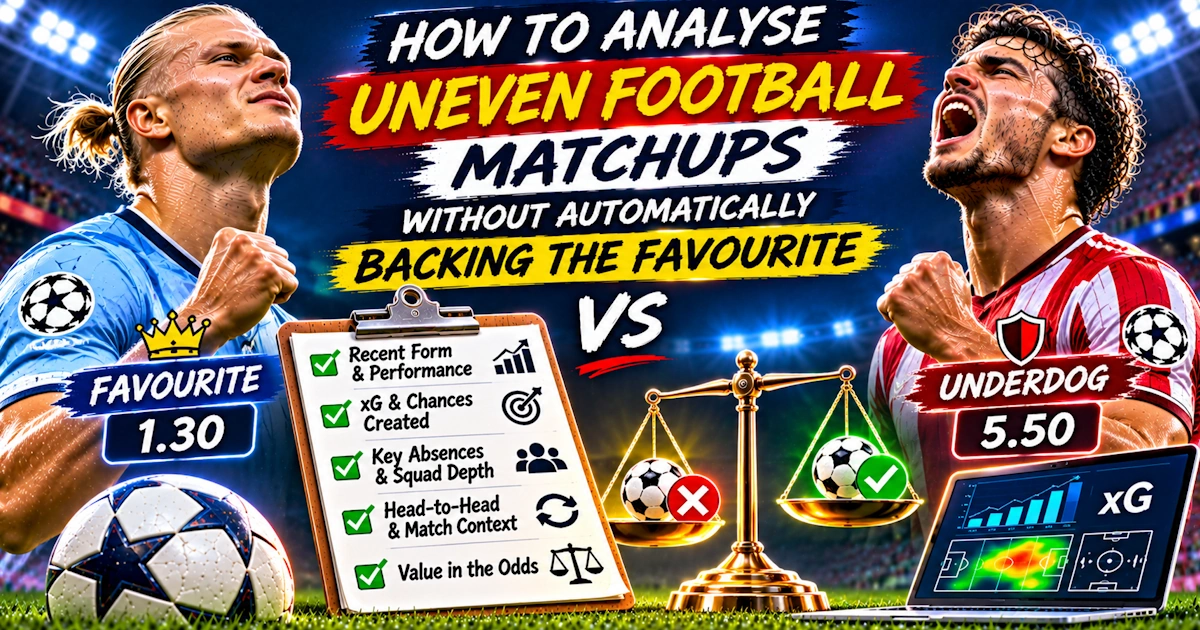
A Simple Uneven-Matchup Checklist
Before backing a heavy favourite, check:
How large is the actual quality gap?
What does xG difference say?
How strong were the opponents producing those statistics?
Is the favourite home or away?
Is rotation expected, or are important attackers/defenders missing?
Does the underdog have a counterattacking route or strong set pieces?
Is the underdog likely to defend very deep?
Is the favourite’s recent scoring sustainable?
Could the favourite manage the match after taking the lead?
What does the schedule look like?
What probability do the odds imply?
Would a team total or handicap express your view better?
Are you backing the team—or simply the famous name?
If you cannot answer the last question confidently, reconsider the selection.
Frequently Asked Questions
Should I avoid betting on heavy favourites? No. Heavy favourites are favourites for a reason and often win. The important question is whether their available odds are higher or lower than your estimate of their true probability.
Are underdogs automatically better value? No. Research on football betting markets has frequently found favourite–longshot bias, meaning extreme outsiders can sometimes offer worse average returns than favourites.
Which statistics are most useful in uneven matchups? xG difference, xGA, shots on target, big chances, opponent strength, home-away performance and confirmed lineups are particularly useful.
Is Over 2.5 always good when a strong favourite faces a weak team? No. A favourite may dominate but win only 2-0, particularly if the underdog offers little attacking threat. Team totals or win-to-nil markets may fit the matchup better.
What should I do if the favourite looks likely to win but the price is too short? You do not have to bet the 1X2 market. Consider team totals, handicaps, live betting or simply passing on the match if none offers sufficient value.
Final Thoughts
Uneven football matchups often look easier than they really are. Yes, the stronger club will usually have the higher probability of winning. But that is information the bookmaker already knows.
The challenge is determining whether the market has correctly priced how much stronger the favourite really is. Start with team quality. Then look deeper. Compare xG and xGA. Adjust for strength of schedule, venue and competition level. Check rotation, injuries and the actual starting XI.
Then ask how the underdog can realistically score or survive. Can it counterattack? Is it dangerous from set pieces? Will it defend with a deep block? Could the favourite reduce intensity after taking the lead?
Finally, look at the odds. If a favourite is priced at 1.20, you are not merely predicting that it will probably win. You are accepting a probability close to 83% before bookmaker margin. That is a much stronger claim. Large football-market studies also show why there is no simple shortcut: bookmaker prices contain substantial information, while favourite–longshot effects can vary between markets and datasets.
So do not automatically back the favourite. But do not automatically oppose it either. Ask one question instead: Is the probability implied by this price lower or higher than the probability suggested by the football evidence?
If the favourite is genuinely underpriced, back it. If the favourite is too short, look for a better market—or leave the match alone. That is how an apparently obvious mismatch becomes a real football prediction rather than simply a guess based on the badge.
Responsible betting: A strong favourite can still lose or draw, and large odds do not automatically make an underdog good value. Compare estimated probabilities with available prices, keep stakes controlled and never bet money you cannot afford to lose.