A casino payment gateway is the technology layer that connects an online casino’s payment interface with external payment-processing infrastructure.
When a player enters a payment method and requests a deposit, the gateway helps securely capture or transmit the required payment information, sends the transaction towards the appropriate processor or payment service provider, and returns the resulting transaction status to the casino.
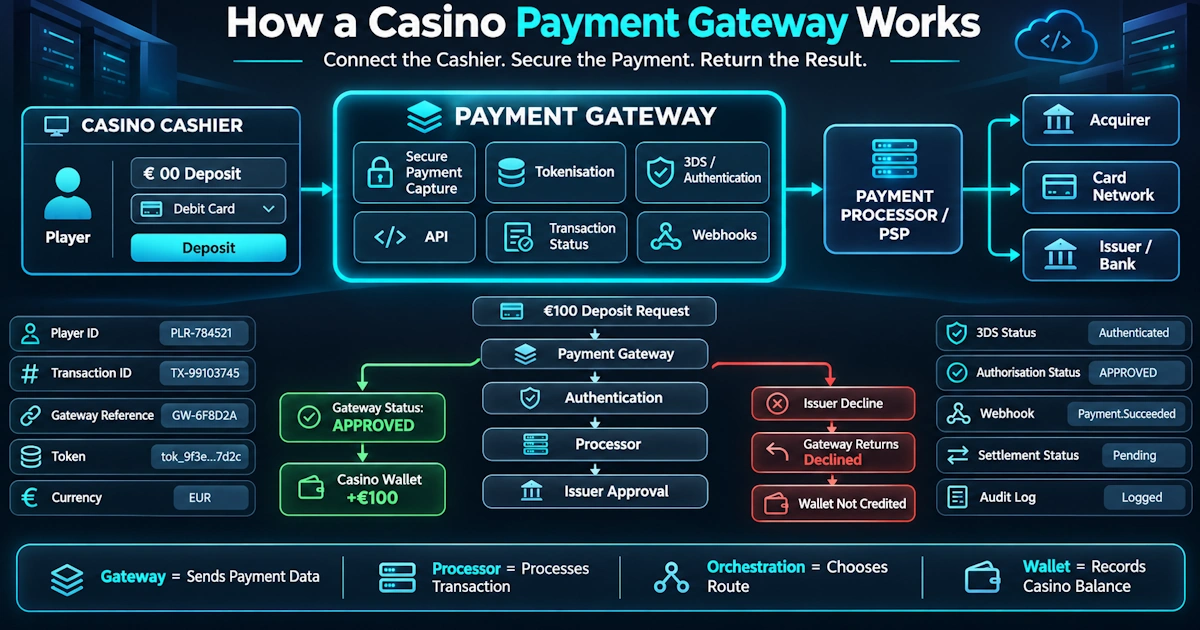
A simplified card-deposit flow looks like:
Player ↓ Casino Cashier ↓ Payment Gateway ↓ Payment Processor / PSP ↓ Card Network / Acquirer / Issuer ↓ Approved or Declined ↓ Casino Platform
The gateway is therefore an important connection between the player-facing cashier and the external payments ecosystem.
But it should not be confused with:
Payment Processor
PSP
Payment Orchestration
Casino Wallet
These components can be supplied by one company, but they perform different technical roles.
What Is a Payment Gateway?
A payment gateway is a service that helps transmit payment information between a merchant’s website or application and the systems responsible for processing the transaction.
In an online casino, that normally means connecting the Casino Cashier with the Payment Provider. The gateway can support functions such as:
Payment Data Capture
Secure Transmission
Tokenisation
Authentication Flows
Transaction Status Handling
Callbacks / Webhooks
The precise feature set varies between suppliers. Some providers offer a gateway only, while others combine Gateway, Processing, Acquiring, Fraud Tools and other payment services into one platform.
Why Do Online Casinos Need a Payment Gateway?
A casino platform should not need to build direct low-level payment connectivity for every card network, bank or payment method. The gateway creates a technical interface between the Casino and Payments Infrastructure.
For example, if a player (P-48291) wants to deposit €100 using a debit card, the payment ecosystem needs Payment Credentials, Amount, Currency, Merchant Information and Authentication Data. The gateway helps move the relevant information securely between those environments.
Where Does the Gateway Sit in the iGaming Stack?
A simplified architecture can look like:
PLAYER ↓ CASINO CASHIER ↓ PAYMENT GATEWAY ↓ PROCESSOR / PSP ↓ ACQUIRER / PAYMENT NETWORK ↓ ISSUER / BANK
The casino platform may also connect the payment flow with PAM, Wallet, Fraud Detection, AML Software and Payment Orchestration. The gateway is therefore part of a broader payment architecture.
Key Distinctions: Gateway vs Related Components
Casino Payment Gateway vs Casino Cashier
Casino Cashier: Usually the player-facing payment interface displaying Deposit, Withdrawal, Payment Methods, Amounts and Transaction History.
Payment Gateway: Provides the technical connection used to transmit payment information and transaction requests.
In short: Cashier = What the Player Sees; Gateway = How the Payment Request Enters the External Payment Infrastructure.
Payment Gateway vs Payment Processor
Payment Gateway: Primarily handles secure collection and transmission of payment information.
Payment Processor: Handles the payment-processing network and communicates with relevant financial institutions to process the transaction (
Casino → Gateway → Processor → Card Network → Issuer).
Commercial payment providers increasingly bundle these functions, but for technical architecture the distinction remains useful.
Payment Gateway vs PSP
PSP stands for Payment Service Provider. A PSP can provide several payment capabilities together, including Gateway, Processing, Acquiring Connectivity, Payment Methods, Tokenisation and Risk Tools. A gateway is usually one payment function, while a PSP represents a wider commercial and technical service.
Payment Gateway vs Payment Orchestration
Payment Gateway: Provides the technical connection that sends and receives payment transaction information.
Payment Orchestration: Controls how payments are routed across multiple PSPs, acquirers or payment methods (
Casino Cashier → Payment Orchestration → Gateway / PSP A or B).
The orchestration layer decides which route handles the payment; the gateway handles how the request is communicated through the selected connection.
Payment Gateway vs Casino Wallet
Payment Gateway: Handles communication with external payment systems.
Casino Wallet: Records financial value inside the gambling platform (
External Card → €100 Deposit → Gateway / Processor → Approved → Casino Wallet +€100).
The gateway does not normally hold the player’s gambling balance.
What Happens During a Casino Deposit?
Consider a player depositing €100 using a debit card:
Player Opens Cashier: The casino displays Debit Card.
Player Enters Payment Information: Entered into a Hosted Payment Page, Embedded Payment Form or another secure payment component.
Payment Request Is Created: Includes Amount (€100), Currency (EUR), Transaction ID, Merchant Information and required payment data.
Gateway Sends the Request: Transmits the transaction to the relevant processor or PSP.
Payment Is Authorised or Declined: The processing chain reaches the financial institution and returns Approved or Declined.
Gateway Returns the Result: The casino receives Payment Status, Provider Reference and Transaction Reference.
Wallet Is Updated: If the payment reaches the required successful state, the Casino Wallet is credited
+€100.
Authorisation, Capture, Settlement & Transaction States
What Is Payment Authorisation?
Authorisation asks whether the payment can proceed. For a card transaction, the issuer considers card validity, available funds, security controls and risk, returning Authorised or Declined. Authorisation does not necessarily mean final settlement has occurred.
Authorisation vs Capture vs Settlement
Authorisation: Reserves or approves the transaction.
Capture: Moves the authorised transaction towards financial settlement (can occur together with authorisation or separately).
Settlement: Refers to the later financial movement and accounting process between relevant payment parties.
Why Transaction States and Status Normalisation Matter
A transaction may move through states such as Created, Pending, Authentication Required, Authorised, Captured, Completed, Declined, Cancelled, Reversed and Refunded. Pending should never automatically be treated as a successful deposit.
With Status Normalisation, different provider codes (SUCCESS, CAPTURED, COMPLETED) are mapped into consistent internal casino statuses (Successful, Failed, Declined)—essential when multiple payment providers are connected.
Payment Transaction IDs & Idempotency Keys
Each payment needs a unique reference (e.g., PAY-8492041) linked to Gateway, Processor and Acquirer references for support and reconciliation. Idempotency keys ensure that if a casino retries a request after a lost response, the provider does not accidentally process the same €100 deposit twice.
Integration Methods & PCI DSS
Hosted Payment Page vs Embedded Payment Form
Hosted Payment Page: Redirects the customer temporarily to the payment provider’s page. Offers simpler payment-data handling and clear provider isolation, but a less seamless user experience.
Embedded Payment Form: Embeds secure provider-hosted card fields directly inside the casino cashier. Offers better visual continuity, with more integration and webpage-security considerations.
Direct API Card Processing: Involves the merchant environment more directly in collecting or transmitting card data, significantly increasing PCI DSS scope and security responsibility.
What Is PCI DSS?
PCI DSS (Payment Card Industry Data Security Standard) is the security standard used to protect payment-card account data across merchants, processors, gateways and service providers.
Using a third-party gateway reduces exposure to card data, but does not eliminate PCI DSS responsibilities. Even under SAQ A (a self-assessment pathway for merchants outsourcing account-data functions via redirected pages or provider-hosted embedded forms), current PCI requirements still impose security expectations on merchant e-commerce pages to prevent malicious tampering or redirects.
Tokenisation & Card-on-File
PAN (Primary Account Number): The sensitive card number associated with a payment card.
Tokenisation: Replaces the raw PAN with a substitute value (e.g.,
Token T-849294) stored in a secure Token Vault, reducing card-data exposure. However, tokenisation does not automatically eliminate PCI DSS obligations.Token Portability & Models: Provider-specific Gateway Tokens are often not portable when switching providers (creating vendor lock-in), whereas Network Tokens issued by card networks have different lifecycle and portability characteristics.
Card-on-File: Allows players to see a saved method (e.g., Debit Card ending 1234) without re-entering the full card number, subject to security, consent, authentication and regulatory controls.
3-D Secure (3DS) & Strong Customer Authentication (SCA)
3-D Secure (3DS): A card-payment authentication framework allowing the issuer to authenticate the cardholder during an online transaction via a Frictionless Flow (no extra visible step) or a 3DS Challenge (e.g., bank app or biometric approval).
Strong Customer Authentication (SCA): A European payment-security concept relying on at least two independent elements: Knowledge (something the customer knows), Possession (something they have) and Inherence (something they are). Scope rules, exclusions and exemptions apply.
Gateway vs 3DS: The gateway integrates 3DS into the payment flow (
Casino → Gateway → 3DS Authentication → Processor), but does not replace the issuer’s authentication decision.
Callbacks, Webhooks & Crediting Rules
Gateway Callbacks & Webhooks: HTTP-based event notifications (e.g.,
payment.completed,payment.failed) sent from the gateway to a casino backend endpoint.Never Trust Browser Redirects Alone: The backend must confirm payment status via signed callbacks, webhooks or API verification—not just the player reaching a “Deposit Successful” page.
Webhook Verification & Replay Protection: Cryptographic signatures or shared secrets verify authenticity, while unique Event IDs and idempotent processing prevent duplicate wallet credits if a webhook is resent.
When to Credit the Wallet: Under GLI-19 v4.0, deposited funds should not become available for wagering until funds have been received from the payment provider or an authorisation/approval has been supplied. Deposit Started ≠ Funds Available.
Reversals, Refunds, Chargebacks & Basic Risk Signals
Payment Reversal: Cancels or reverses a previous transaction state (e.g., before final completion).
Refund: Returns money to the customer after a completed payment, linked to the original Transaction ID.
Chargeback: A card-payment dispute process reversed through the processor, acquirer and card network.
Fraud & Card Checks: Some gateways bundle fraud scoring, velocity checks, AVS (Address Verification Service) and CVV (card security code, which has strict non-storage rules), though gateway connectivity and dedicated fraud engines remain conceptually separate.
Payment Ecosystem Roles & Localisation
Payment Method Localisation & Merchant Approval: Gateways support cards, bank transfers, e-wallets and open banking, but technical support does not guarantee commercial approval for gambling. Operators must confirm merchant eligibility, jurisdictions and acquiring support before integration.
Acquirer, Issuer & Card Network: The Acquirer supports merchant card acceptance; the Card Network connects acquirers and issuers; the Issuer (player’s bank) makes the final Approved/Declined decision.
MCC (Merchant Category Code): Categorises gambling merchants so payment providers and banks can apply appropriate risk, acceptance and regulatory controls.
Routing, Declines, Performance & Reconciliation
Smart Routing & Failover: Advanced gateways or orchestration layers select routes by market, currency, cost or availability, and fail over during technical outages. However, failover should never blindly retry regulatory, fraud or insufficient-funds declines.
Soft vs Hard Declines & Normalisation: Soft declines may succeed after corrective action (e.g., authentication); hard declines should not be retried unchanged. Normalising raw codes (
05,DO_NOT_HONOR→Issuer Decline) improves analytics and lets the casino show clear, non-sensitive messages to players.Performance, Timeouts & Status Querying: High latency or timeouts hurt deposit conversion. After a timeout, the casino must query transaction status using the existing Transaction ID rather than blindly resending the request.
Reconciliation: Matching casino records against gateway reporting (authorisations, declines) and settlement reporting (gross transactions minus refunds, chargebacks and fees = net settlement) catches missing callbacks, reversals and duplicates.
Withdrawals & Compliance Connections
How Casino Withdrawals Work
Some gateways also support payouts via API:
Player Requests €200 → Casino Checks Eligibility → Wallet Reserves/Deducts Funds → Payment Gateway → Payment Provider → Player Account → Status Returned
Gateway vs Withdrawal Approval: The casino and compliance team decide should we pay? (checking KYC, AML, fraud, payment ownership and account restrictions); the gateway executes the payment instruction.
Closed-Loop vs Open-Loop: Closed-loop returns funds to the same payment method used to deposit (reducing third-party funding risk); open-loop pays out via a different method and requires stronger risk controls.
Connections to KYC, Fraud, AML & Orchestration
The gateway moves payment information and generates transaction data, while dedicated systems handle KYC (identity verification), Fraud Detection (allow/challenge/block), AML (financial-crime risk) and Payment Orchestration (multi-provider routing).
Availability, Testing, APIs & Observability
Downtime, SLAs & Redundancy: A gateway outage stops deposits immediately. Operators need clear SLAs, escalation paths and multi-provider redundancy to avoid a single point of failure.
Sandbox Testing & Launch Checklist: Test both happy paths and failure scenarios: issuer declines, insufficient funds, 3DS challenges/failures, timeouts, duplicate API requests/webhooks, missing webhooks, pending states, refunds, reversals, withdrawal failures, downtime, status queries, tokenised repeat deposits and reconciliation.
API & Webhook Versioning: Confirm schema stability, deprecation timelines and backward compatibility.
Observability, Logging & Audit Logs: Monitor approval/decline rates, latency, timeouts and webhook failures. Technical logs must never store raw card numbers or CVV, while audit logs must trace refunds, withdrawal approvals and route changes.
Regulatory Examples
Great Britain (PSPs & Credit Card Ban): Remote gambling licensees must use regulated payment service providers that satisfy the UK payments framework and are prohibited from accepting credit-card payments for gambling (including via money-service businesses funded by credit cards). Technical Acceptance ≠ Regulatory Permission—configurable payment-method controls by jurisdiction and licence are essential.
GLI-19 Financial Transactions: Treats deposits and withdrawals as auditable player-account records requiring unique transaction IDs, timestamps, types, amounts, methods, statuses and EFT fraud controls.
What Should Operators Look for in a Casino Payment Gateway?
Gambling Merchant Support & Markets: Explicit iGaming approval in target jurisdictions and currencies.
Deposits & Withdrawals: Reliable support for both pay-ins and payouts across cards, bank methods, e-wallets and local methods.
Integration, Tokenisation & 3DS/SCA: Hosted/embedded options, secure tokenisation with clear token portability, and compliant 3DS/SCA flows.
APIs, Webhooks & States: Well-documented APIs, signed/idempotent webhooks, clear transaction states and normalised decline codes.
PCI, Reporting & Support: Clear PCI responsibility, reconciliation tools, high availability, 24/7 critical support and transparent pricing (gateway, processing, acquiring, FX, refund and chargeback fees).
Common Red Flags
Provider does not explicitly support gambling merchants.
Deposit success relies only on browser redirects rather than authenticated backend webhooks.
Duplicate requests or webhooks can create duplicate deposits.
Pendingstatus is treated asSuccessful.No reconciliation tools, withdrawal support or clear 3DS/SCA handling.
Non-portable tokens creating vendor lock-in.
PCI responsibility is marketed as “zero”.
Single gateway with no redundancy, or indiscriminate automatic retries on hard declines.
Casino Payment Gateway vs Related Payment Systems
| System | Main Role |
| Casino Cashier | Player-facing deposit and withdrawal interface |
| Payment Gateway | Securely connects casino payment requests with external processing infrastructure |
| Payment Processor | Processes transaction messages through the payment ecosystem |
| PSP | Provides one or more payment services, potentially including gateway and processing |
| Payment Orchestration | Selects and manages routes across multiple payment providers |
| Acquirer | Supports merchant acceptance in the card ecosystem |
| Casino Wallet | Records the player’s internal gambling balance |
| Fraud Detection | Evaluates whether payment/account activity appears abusive |
| AML Software | Monitors wider financial-crime risk |
A Simple End-to-End Casino Payment Gateway Flow
Player: Selects Deposit €100.
Casino Cashier: Creates Transaction
PAY-48291.Payment Gateway: Securely receives the required payment information.
Authentication: Runs 3DS / SCA flow if required.
Processor: Moves the transaction through the processing chain.
Issuer Decision: Returns
APPROVED.Gateway Response: Returns
Authorisedand Provider Reference.Casino Backend: Verifies the authoritative payment result.
Wallet: Credits
+€100.Reconciliation: Matches the transaction against provider and settlement records.
Final Thoughts
A casino payment gateway is the technology layer connecting an online casino’s cashier and backend systems with external payment-processing infrastructure. Keeping the core roles distinct is essential:
Gateway = Payment Connection
Processor = Payment Processing
Orchestration = Payment Route Selection
Wallet = Casino Balance
A good payment gateway cannot guarantee that every deposit succeeds—issuers can decline transactions and regulations can restrict payment routes. Its job is to transmit every payment request securely, process it through an appropriate external connection and return a trustworthy status that the casino platform can act upon accurately.
Frequently Asked Questions
What is a casino payment gateway? A casino payment gateway is technology that connects an online casino’s cashier with external payment processors or PSPs and securely transmits payment requests and transaction results.
Is a payment gateway the same as a payment processor? No. The gateway primarily handles secure payment-data communication, while the processor handles the payment-processing network and communicates with financial institutions. Many providers bundle both functions.
What is the difference between a payment gateway and payment orchestration? A gateway provides a payment connection. Payment orchestration manages several payment connections and can decide which provider or route should handle a particular transaction.
Does a payment gateway hold the player’s casino balance? No. The casino wallet or PAM-linked wallet normally records the player’s gambling balance. The gateway handles external payment communication.
Does tokenisation remove PCI DSS requirements? No. Tokenisation can reduce card-data exposure and potentially reduce PCI DSS scope, but it does not automatically eliminate all PCI DSS responsibilities.
Can a casino payment gateway process withdrawals? Some modern gateway and payment platforms support both deposits and payouts. Operators should verify withdrawal capabilities separately because deposit acceptance does not automatically mean equivalent payout support.