
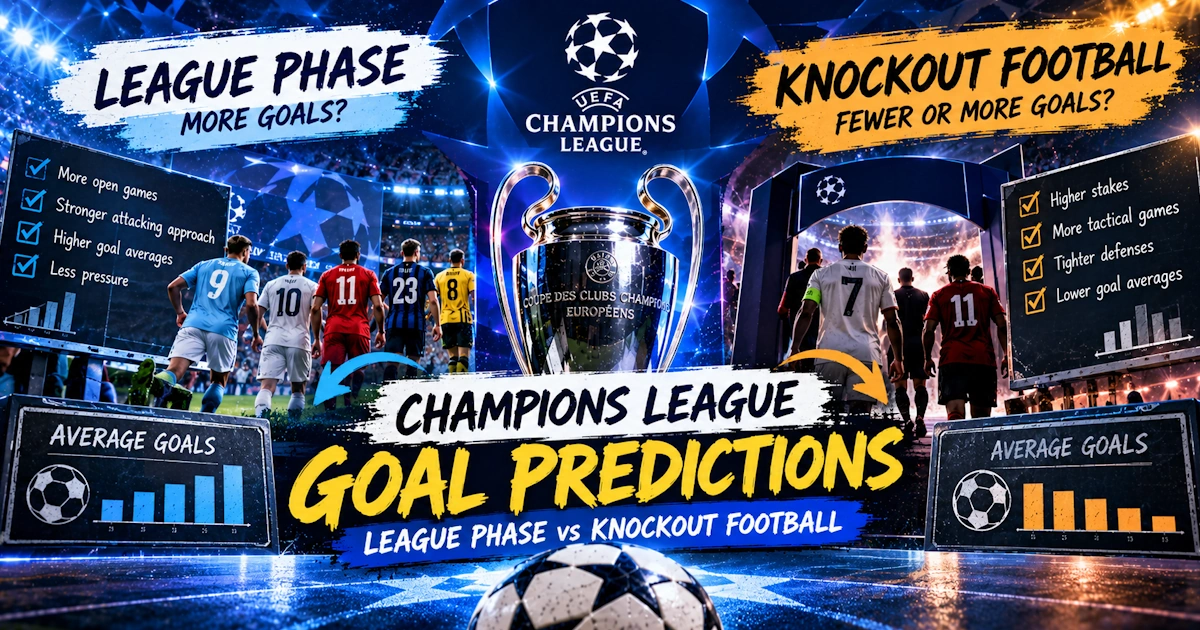
A Champions League match in October should not always be analysed in the same way as a quarter-final in April.
The teams may be equally strong. The players may be similar. Even the bookmaker’s goal line may look familiar.
But the competitive situation is completely different.
During the league phase, clubs collect points across eight matches against eight different opponents. A defeat is damaging, but there is usually time to recover. In the knockout rounds, almost every match except the final forms part of a two-legged tie, and the aggregate score can completely change how both teams approach the game.
For goal predictions, this means the question is not simply whether two teams are attacking or defensive.
You also need to ask: What result does each team actually need from this particular match?
That becomes increasingly important as the Champions League moves from league football to elimination football.
The League Phase Creates More Room for Risk
The current Champions League league phase contains 36 clubs. Each team plays eight different opponents, four at home and four away. The top eight advance directly to the round of 16, positions nine to 24 enter the knockout phase play-offs, and teams finishing 25th to 36th are eliminated.
This structure gives teams some room for recovery.
Losing Matchday 2 does not end the campaign. Even after a disappointing start, several fixtures remain.
That can encourage teams to play more naturally rather than treating every goal as potentially decisive for elimination.
The completed 2025/26 league phase produced 487 goals across 144 matches, an average of 3.38 goals per game. That was higher than the 470 goals recorded in the previous league phase.
This provides a useful scoring baseline, but it should never become a reason to back Over 2.5 blindly.
The individual matchup still matters far more.
League-Phase Matches Can Produce Large Quality Gaps
One feature of the league phase is the wide variety of opponents.
Every club faces teams from different seeding pots, including one home and one away opponent from each pot.
That can create matches where one side is considerably stronger.
Imagine an elite home team averaging:
- 2.2 home xG
- 6.3 shots on target
- 2.4 home goals
against a visitor that allows:
- 1.9 away xGA
- 5.8 shots on target
This may be an excellent Over 2.5 fixture even if the weaker side contributes nothing.
Likely scores might include 3-0, 4-0 or 3-1.
In situations like this, the favourite’s team total can sometimes be more logical than BTTS.
League-Phase Table Position Becomes More Important Later
Matchday 2 and Matchday 7 should not be analysed identically.
Early in the league phase, teams still have time.
By Matchdays 7 and 8, the table can completely change motivation.
A club may need a win to reach the top eight. Another may need points simply to stay inside the top 24. Goal difference can also matter when teams finish level on points.
This can create late-match situations where a draw is not enough.
A 1-1 score after 75 minutes may become much more open if both teams need three points.
For live goal predictions, table position becomes increasingly useful as the league phase approaches its conclusion.
Knockout Football Changes the Calculation
Once the knockout phase begins, the logic changes.
With the exception of the final, knockout ties are normally played over two legs. The team scoring more goals across the two matches advances. If the aggregate score is level after the second leg, extra time and potentially penalties decide the winner.
This makes the aggregate score one of the most important statistics in Champions League goal prediction.
A first leg starting at 0-0 is completely different from a second leg starting effectively at 0-2.
The teams no longer care only about winning tonight’s match.
They care about winning the tie.
First Legs Can Encourage More Control
A first leg often gives both teams another 90 minutes to work with.
That can encourage some managers to avoid unnecessary risk, particularly when the teams are closely matched.
Imagine two elite clubs.
Both create around 1.7 xG domestically and both have excellent attackers.
In a league-phase meeting, you might expect a relatively open game.
In the first leg of a quarter-final, the tactical priority may be different.
The away team may accept 0-0 or 1-1. The home side may attack but remain careful not to concede a transition goal.
That does not mean every first leg should be backed Under.
It means tactical risk deserves more weight.
Second Legs Are Controlled by the Aggregate Score
This is where knockout football becomes particularly interesting for goal markets.
Imagine Team A won the first leg 2-0.
In the second leg, Team B must attack.
If it remains 0-0 after an hour, Team B may begin committing more players forward.
That can produce:
- More pressing
- More attackers
- Higher full-backs
- Larger spaces behind midfield
- Counterattacks for Team A
One goal can then completely change the match.
If Team B scores to make the aggregate 2-1, pressure increases further.
If Team A scores instead and makes it 3-0 on aggregate, the tie may become effectively finished.
For second-leg predictions, the first-leg score is often more important than the teams’ normal Over 2.5 percentages.
Practical Example: First-Leg Under Candidate
Imagine a quarter-final first leg between two evenly matched sides.
The home team has: 1.6 xG per match
The visitors: 1.5 xG
Both have strong defences and experienced goalkeepers.
The tactical expectation is cautious because neither manager wants to expose the team before the second leg.
Possible scores include: 0-0, 1-0 or 1-1
Even though both teams have strong attacking players, Under 3.5 may fit the situation better than an aggressive Over.
The competition stage changes the interpretation of the same statistics.
Practical Example: Second-Leg Over Candidate
Now imagine the first match ended: Team A 3-1 Team B
Team B hosts the return match.
It needs goals.
A normal cautious approach is almost useless.
Suppose Team B already averages five home shots on target and plays aggressively at home.
Team A is dangerous on the counterattack.
The second leg can naturally produce scorelines such as: 2-1, 2-2 or 3-1
In this situation, Over 2.5 may have stronger tactical support than it would have had in the first leg.
The aggregate deficit forces risk into the match.
A 0-0 First Leg Can Produce a Different Second Leg
A scoreless first leg does not necessarily mean the matchup is poor for goals.
Suppose the first game finishes 0-0 but produces:
- 2.4 combined xG
- Nine shots on target
- Three big chances
The return leg begins level.
But now there is no third match.
Eventually, somebody must advance.
If the second leg remains level late, both managers have to decide whether to chase the winner or accept the possibility of extra time.
This is why reviewing the first-leg performance is more useful than simply seeing 0-0.
BTTS Also Changes Between Stages
During the league phase, BTTS can work well when both teams consistently create chances and neither keeps many clean sheets.
During knockout football, aggregate context becomes another filter.
Suppose the home team leads 2-0 from the first leg.
It may defend more deeply.
The visitor will have possession and attack.
Does that improve BTTS?
Possibly—but only if the leading team still has a strong counterattacking threat.
If the home side simply protects its advantage and creates little, the match could finish 0-1.
BTTS analysis must therefore ask whether both teams still need or are likely to attack.
Team Totals Can Be Better Than Full-Match Totals
Knockout situations sometimes make team totals particularly useful.
Suppose a team trails 3-0 on aggregate.
You expect it to attack aggressively at home.
The opponent may sit deeper.
Instead of predicting total match goals, you could focus on whether the trailing team is likely to score once or twice.
Similarly, an elite favourite playing the second leg at home after a 1-1 first leg may have a strong Team Over 1.5 profile.
The best market depends on which side the tactical situation benefits.
Extra Time Creates Another Important Detail
In most standard football betting markets, the listed 90-minute result is what counts unless the bookmaker specifically states otherwise.
That matters in knockout matches.
A second leg can finish 1-1 after 90 minutes and then produce two goals in extra time.
Those extra-time goals may not count towards a normal Over 2.5 market.
Always check the market rules.
The final is different structurally as well: it is a single match at a neutral venue, with extra time and penalties used if needed.
League Phase vs Knockout Prediction Checklist
Before choosing a Champions League goal market, check:
- Competition stage
- Current league position or aggregate score
- Whether a draw helps either team
- Home and away xG
- Shots on target
- Big chances
- Clean-sheet and failure-to-score rates
- First-leg performance
- Tactical approach when leading or trailing
- Defensive injuries
- Goalkeeper availability
- Counterattacking strength
- Expected line-ups
- Whether one or both teams need to provide the goals
- Whether the price reflects the tactical situation
The later the competition gets, the more game state and qualification mathematics should influence the prediction.
Frequently Asked Questions
Are Champions League league-phase matches higher-scoring than knockout matches?
There is no rule that every league-phase game will be higher-scoring. However, the 2025/26 league phase produced 487 goals in 144 matches, averaging 3.38 per game. Knockout matches need more tie-specific analysis because aggregate scores affect tactics.
Are first legs usually good for Under bets?
Not automatically. Some first legs are very open. The important question is whether both teams are comfortable taking risks while another leg remains.
Why are second legs different?
The aggregate score can force one team to attack. A side trailing by two goals has very different tactical needs from one protecting a lead.
Is BTTS useful in knockout football?
Yes, particularly when both teams have realistic attacking routes. But aggregate context can make one side much more defensive than usual.
Should I use domestic statistics in Champions League knockouts?
Yes. Domestic xG, shots and home-away form remain useful, but they should be adjusted for opponent strength and the specific aggregate situation.
Final Thoughts
Champions League goal predictions change as the competition changes.
During the league phase, teams have eight matches to collect points, and individual defeats can still be recovered from. The wider range of opponents can also create significant quality gaps and one-sided scoring opportunities.
Knockout football is different.
The first leg becomes part of a 180-minute contest. The second leg begins with an existing aggregate score. A team protecting a two-goal advantage has different priorities from one that desperately needs to score twice.
That means the best knockout analysis should go beyond xG, shots and recent goal percentages (data widely tracked by platforms like Opta Analyst).
Ask: Who needs to attack? Who can afford to wait? And what happens to the match if the first goal changes the aggregate situation?
Once those questions are combined with current attacking and defensive statistics, it becomes much easier to decide whether the right market is Over, Under, BTTS or a team goal total.
Responsible betting: Competition stage and aggregate score can improve your analysis but cannot remove uncertainty. Use several indicators together, compare probability with price, keep stakes controlled and never bet money you cannot afford to lose.