
Champions League Matchday 2 is one of the most interesting rounds for football predictions.
Unlike Matchday 1, we now have at least one competitive European performance from every team. We can see how a club handled the level of opposition, whether its domestic form transferred into Europe and how the manager approached the new league-phase campaign.
But there is also a major trap.
One Champions League match is still a tiny sample.
A team that won 4-0 on Matchday 1 is not automatically an Over 2.5 machine. Another that lost 0-2 may have created enough chances to deserve a completely different result.
The current Champions League league phase contains 36 clubs, with each playing eight different opponents—four at home and four away. The top eight qualify directly for the round of 16, while teams finishing ninth to 24th enter the knockout phase play-offs. That makes every point important, but Matchday 2 is still early enough that teams have room to recover.
For bettors, the challenge is to use Matchday 1 as new evidence, without allowing one result to overpower the larger statistical picture.
1. Review Matchday 1 Properly
Do not begin with the score.
Begin with the performance.
Suppose Team A won its opening Champions League match 3-0.
That looks excellent.
But perhaps the statistics were:
- 1.2 xG
- Four shots on target
- One penalty
- Opponent missed two big chances
The result may flatter the performance.
Now imagine Team B lost 1-0 but produced:
- 1.8 xG
- Six shots on target
- Three big chances
Team B’s underlying performance may actually have been stronger.
For Matchday 2, review:
- xG and xGA
- Shots on target
- Big chances
- Possession in dangerous areas
- Set-piece threat
- Red cards or penalties
- Whether the final score reflected the match
One European result is useful. The process behind it is more useful than the score.
2. Do Not Abandon Domestic Form
Matchday 1 should be added to the analysis, not used to replace domestic statistics.
Suppose a club has played seven domestic matches and one Champions League match.
That gives you eight current competitive performances.
Why would you ignore seven of them because one happened in Europe?
Domestic numbers can reveal:
- Attacking consistency
- Defensive weaknesses
- Home-away performance
- Shot volume
- Conversion rate
- Clean-sheet patterns
The important adjustment is opponent quality.
Scoring three goals every week against weaker domestic opponents does not guarantee the same performance against an elite Champions League defence.
3. Compare Opponent Strength Between Matchdays
Not all Champions League fixtures are equally difficult.
A team may have looked outstanding on Matchday 1 because it faced one of the weaker clubs in the competition.
Matchday 2 may bring a completely different challenge.
For example:Matchday 1
- Home against a weaker opponent
- 65% possession
- 2.2 xG
- Six shots on target
Matchday 2
- Away against an elite pressing team
You should not simply transfer the first-match numbers into the second fixture.
Ask: Was Matchday 1 performance strong because of the team—or because of the opponent?
This is particularly important under the league-phase system because every club faces eight different opponents rather than playing the same three teams home and away.
4. Check the Home-Away Change
Venue can dramatically alter a team’s goal profile.
A club may be excellent at home but much more cautious away.
Suppose:Home
- 2.1 goals
- 1.9 xG
- 6 shots on target
Away
- 1.2 goals
- 1.1 xG
- 3.4 shots on target
If Matchday 1 was at home and Matchday 2 is away, blindly using the opening performance can exaggerate the attacking expectation.
UEFA’s regulations state that, in principle, each club plays one home and one away game across the opening two matchdays.
That makes the venue switch particularly relevant when reviewing early Champions League data.
5. Use xG to Test Early Goal Trends
The Champions League can produce plenty of goals.
The completed 2025/26 league phase delivered 487 goals in 144 matches, an average of 3.38 goals per game. UEFA also reported that the previous season’s league phase produced 470 goals.
But that competition-wide average does not mean every Matchday 2 fixture should be backed Over 2.5.
Use xG to identify which individual teams are creating enough.
A useful comparison is:Goals scored vs xG
Suppose a team has:
- 8 goals
- 4.8 xG
That finishing may be running hot.
Another has:
- 4 goals
- 7.0 xG
The results look weaker, but the attacking process may be stronger.
Matchday 2 is exactly where early-season finishing streaks can tempt bettors into overrating recent scorelines.
6. Check Shots on Target
Shots on target are especially useful when analysing Champions League goal markets.
A team taking 18 shots sounds dangerous.
But if only three reach the target, the attacking quality may not be as impressive as the raw number suggests.
Compare:Team A
- 15 shots
- 3 on target
- 0.9 xG
Team B
- 11 shots
- 6 on target
- 1.7 xG
Team B looks much more dangerous despite attempting fewer shots.
For Over 2.5 and BTTS, ideally you want strong chance creation supported by accurate attempts.
7. Decide Who Is Expected to Score
This is one of the most useful questions in goal betting.
Do not simply say: “This looks like an Over match.”
Ask: Where are the three goals supposed to come from?
Imagine a strong home favourite against a weak visitor.
Likely scores:
- 3-0
- 4-0
- 3-1
Over 2.5 may make sense.
BTTS may not.
Now imagine two balanced attacking teams.
Possible scores:
- 1-1
- 2-1
- 1-2
- 2-2
BTTS may be more attractive because the 1-1 result is enough.
Choosing the correct market starts with understanding the expected scoring distribution.
8. Check Whether Matchday 1 Changed the Tactics
Managers sometimes approach European football differently from domestic matches.
A team that presses aggressively in its domestic league may defend much deeper against Champions League opponents.
Another may discover after Matchday 1 that its cautious approach created too little.
Look for changes in:
- Formation
- Defensive line
- Pressing intensity
- Number of attackers
- Full-back positioning
- Counterattacking approach
Matchday 2 can reveal whether the opening strategy was deliberate or whether the manager is already adjusting.
9. Do Not Ignore Defensive Performance
Goal predictions often focus too heavily on attacks.
For Matchday 2, check how well each team prevents chances.
Useful defensive indicators include:
- xGA
- Shots on target allowed
- Big chances conceded
- Clean sheets
- Defensive injuries
- Goalkeeper performance
Suppose a team kept a clean sheet on Matchday 1 but allowed:
- 1.9 xGA
- Six shots on target
- Three big chances
The clean sheet may be less trustworthy than it appears.
Against a stronger Matchday 2 attack, that defensive vulnerability may become important.
10. Check Goalkeeper Performance
An outstanding goalkeeper can hide defensive problems.
Suppose Team A has conceded only two goals in five matches.
Excellent.
But the keeper has faced many high-quality shots and consistently saved above expectation.
That record may be less sustainable than a team conceding the same number while barely allowing opponents into dangerous areas.
For BTTS and team totals, distinguish:strong defence from strong goalkeeping protecting a vulnerable defence.
11. Team News Can Change Everything
Never rely entirely on statistics before checking the current squad.
Important absences include:
- Main striker
- Creative midfielder
- Defensive midfielder
- Centre-back
- First-choice goalkeeper
For example, a team with excellent defensive numbers may become much less reliable if both starting centre-backs are unavailable.
Likewise, a returning striker can materially improve a side that struggled to finish on Matchday 1.
Confirmed line-ups become especially important when clubs are balancing Champions League football with difficult domestic schedules.
12. Consider Rest and Fixture Congestion
Champions League teams are usually dealing with busy calendars.
Check what happened before Matchday 2.
Did the team play:
- A major domestic derby?
- An away game three days earlier?
- Extra time in a cup match?
- A difficult long-distance trip?
Fatigue does not automatically mean more or fewer goals.
A tired attack may lose sharpness.
A tired defence may lose concentration.
Use recovery information to adjust an existing prediction rather than treating fatigue as a standalone betting system.
13. Pay Attention to Motivation—but Do Not Exaggerate It
Matchday 2 matters, but nobody is automatically eliminated after two games.
A team that lost Matchday 1 needs points, but it still has six league-phase fixtures remaining after Matchday 2.
That means you should be careful with claims such as: “They must win, so the match will have goals.”
Need does not automatically create attacking football.
Sometimes a team desperate to avoid a second defeat becomes more cautious.
Look at how the manager normally handles pressure.
Practical Example: Strong Over 2.5 Candidate
Imagine the home side has:
- 1.9 home xG
- 5.8 shots on target
- Scored in nine consecutive home matches
Its Matchday 1 performance also produced 2.0 xG.
The visitors:
- Average 1.5 away xG
- Score regularly
- Allow around five shots on target
- Use an aggressive high defensive line
Neither side has major attacking absences.
Possible scores include: 2-1, 3-1 and 2-2
Over 2.5 has several independent reasons supporting it.
Practical Example: BTTS Better Than Over 2.5
Now imagine:
Home side
- Scores consistently
- Rarely keeps clean sheets
Away side
- Strong counterattack
- Scores in most away matches
- Moderate rather than high total xG
The likely score range is:
- 1-1
- 2-1
- 1-2
BTTS – Yes may be more suitable than Over 2.5 because 1-1 is included.
The same general goal analysis can lead to a different market.
Practical Example: Matchday 1 Overreaction
Suppose a team won 4-0 on Matchday 1.
The market now prices Team Over 1.5 very short.
But closer analysis shows:
- Only 1.4 xG
- One penalty
- Opponent red card
- Exceptionally high conversion rate
The Matchday 2 opponent is much stronger defensively.
The four-goal result may be encouraging, but it should not automatically justify another high team total.
This is exactly where Matchday 2 analysis requires discipline.
Champions League Matchday 2 Checklist
Before making a prediction, check:
- Matchday 1 score and performance
- Domestic form
- xG and xGA
- Shots on target
- Big chances
- Home-away splits
- Matchday 1 opponent strength
- Matchday 2 opponent strength
- Tactical changes
- Clean sheets
- Goalkeeper form
- Injuries and suspensions
- Confirmed line-ups
- Rest and travel
- Set-piece strength
- Which team is expected to provide the goals
- Whether current odds still offer value
A strong selection should have several of these indicators pointing in the same direction.
Frequently Asked Questions
Should Matchday 1 statistics be trusted?
They are useful, but one Champions League match is a very small sample. Combine them with domestic data and current-season underlying statistics.
Is Champions League Matchday 2 good for Over 2.5?
It can be, but do not rely on the competition reputation alone. The 2025/26 league phase averaged 3.38 goals per match, yet individual matchups still require separate analysis.
Should I use H2H statistics?
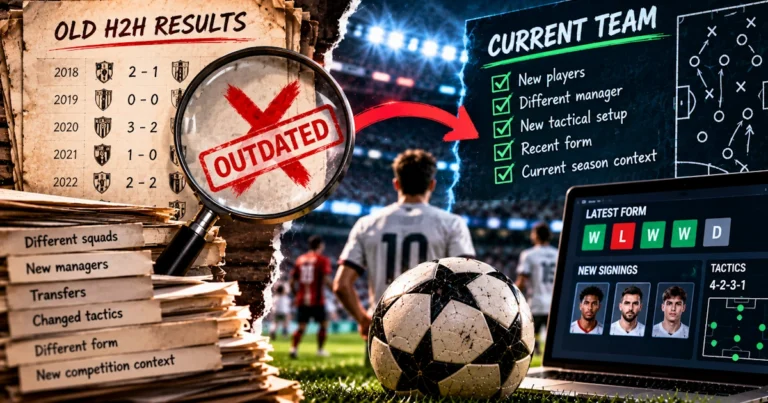
Recent H2H can provide tactical context, but current squads, managers, xG and team news are usually more important than old meetings.
Is BTTS better than Over 2.5?
It depends on the expected score pattern. If 1-1 is highly realistic, BTTS may be preferable. If one favourite can score three goals alone, Over 2.5 may fit better.
Should I wait for confirmed line-ups?
For close decisions, yes. A missing goalkeeper, centre-back or striker can significantly change the expected goal environment.
Final Thoughts
Champions League Matchday 2 gives bettors more information than Matchday 1—but not enough to abandon caution.
The first European result provides useful evidence about tactics, chance creation and how domestic form transfers to Champions League level.
But one match can still be distorted by penalties, red cards, exceptional finishing or poor goalkeeping.
Start with the larger picture.
Use domestic form, home-away splits, xG, shots on target and defensive data (often available on official platforms like UEFA.com). Then add what Matchday 1 taught you. Check the new opponent, current team news and whether the venue has changed.
Most importantly, do not predict simply that there will be goals.
Work out who is likely to score them and why.
That will usually tell you whether the better market is Over 2.5, BTTS, a team total—or no bet at all.
Responsible betting: Champions League matches contain high-quality teams but also plenty of uncertainty. Use several indicators together, compare probability with price, keep stakes controlled and never bet money you cannot afford to lose.