League-phase standings can completely change the way a European football match is played. A team sitting comfortably inside the top eight may approach a match very differently from a club fighting to stay inside the top 24.
A draw might be useful for one side but almost worthless for the other. That matters when making football predictions.
Many bettors look at form, xG, shots on target and injuries but forget to ask a simpler question. What does each team actually need from this match?
Under the current Champions League and Europa League formats, 36 clubs compete in one league table. Each team plays eight league-phase matches.
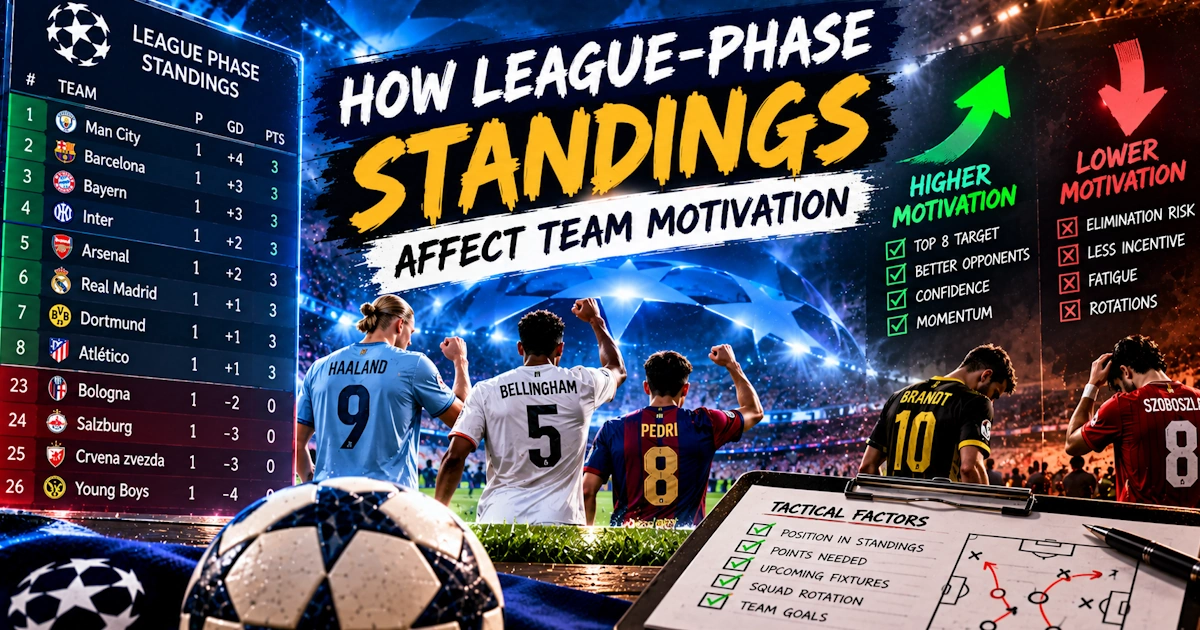
The top eight qualify directly for the round of 16, positions nine to 24 enter the knockout phase play-offs, and teams finishing 25th to 36th are eliminated. Because there are several different targets inside one table, motivation is not simply about winning or losing.
Position can affect risk, rotation, attacking intensity and even how teams react to the score during a match.
The Table Creates Three Main Battles
The league phase is not one simple race. There are three important areas.
Top Eight
Teams finishing first to eighth qualify directly for the round of 16. That is a major advantage because they avoid the additional knockout play-off round.
A club sitting seventh or eighth late in the league phase may therefore have strong motivation to protect or improve its position.
Positions 9 to 24
These teams remain alive but must play an extra knockout phase play-off. A club in 10th may still push hard to reach the top eight.
A club in 23rd may be fighting simply to avoid elimination. The same section of the table can therefore contain very different motivations.
Positions 25 to 36
These clubs are eliminated. A team sitting 26th before the final matchday may have much greater urgency than a club already safe in 15th.
For prediction purposes, understanding which battle a team is involved in is more useful than simply saying they need points. Almost everyone needs points.
The important question is why.
Motivation Changes as the League Phase Progresses
League position matters differently on Matchday 2 than on Matchday 8. Early in the competition, the table is still unstable.
A team with three points after two games still has six matches remaining. That means an early defeat is not necessarily a disaster.
By Matchday 7 or 8, the situation becomes much clearer. A team may know:
A win almost guarantees a top-eight position
A draw is enough for the top 24
Only a win keeps qualification hopes alive
Goal difference could decide its final ranking
This is why league-phase motivation becomes increasingly valuable for live betting analysis later in the competition.
Goal Difference Can Matter
Points are the first ranking factor, but teams level on points are separated first by goal difference, followed by goals scored and other criteria. That creates an important difference from competitions where qualification is based only on points.
A team leading 2-0 may still have a reason to attack. Imagine two clubs fighting for eighth position.
Both have 14 points, but Team A has a goal difference of +6 and Team B has +4. If Team B is leading its final match 2-0, another goal could become extremely valuable.
The team is not simply protecting three points. It may also be trying to improve its position through goal difference.
This can be relevant for:
Over 3.5
Team totals
The Format Can Encourage Attacking Football
The completed 2025/26 Champions League league phase produced 487 goals across 144 matches, an average of 3.38 goals per game. UEFA noted that the total was higher than the previous league phase, which produced 470 goals.
That does not prove that standings automatically create goals. But it shows that the league phase has supported a strong attacking environment.
UEFA also reported that the average winning margin in the 2025/26 league phase fell to 1.78 goals, compared with 1.92 the previous season, suggesting many matches remained competitive even while overall scoring increased. For bettors, the lesson is useful.
High motivation does not always mean cautious football. Sometimes the structure gives teams a reason to continue attacking.
A Draw Can Have Different Value for Each Team
One of the most important things to analyse is whether both teams would accept a draw. Imagine a late league-phase situation where Team A is in 7th place and needs one point to remain comfortably inside the top eight.
Meanwhile, Team B is in 25th place and needs a win to move towards the play-off positions. At 1-1 after 70 minutes, the teams have completely different incentives.
Team A may become more cautious, while Team B cannot afford to. The match may begin balanced but become increasingly open as Team B commits more players forward.
That can create opportunities for:
Late goals
Team A counterattacks
Over markets
Second-half goals
This is why live betting analysis should include the current standings.
“Must Win” Does Not Automatically Mean Over
This is a common mistake. A bettor sees a team must win, and then concludes Over 2.5 Goals.
The logic is incomplete. A team needing a win may attack aggressively, but it may also begin very cautiously because conceding first would make qualification even harder.
Suppose a club needs three points but usually plays a low defensive block with slow possession and few early risks. The manager may still keep that structure for 50 or 60 minutes before becoming more aggressive.
Motivation tells you what the team needs. Tactics tell you how it will try to get it, and you need both.
Practical Example: Team Needs Only a Draw
Imagine Team A is eighth before the final matchday, and a draw almost certainly keeps it inside the top eight. Its opponent is an attacking team but also needs a win.
Team A may:
Keep more players behind the ball
Slow the game down
Avoid committing both full-backs
Accept long periods without possession
That can reduce the initial goal expectation. But if the opponent scores first, everything changes.
Team A now needs to respond. A match that looked cautious before kick-off can become an excellent live Over candidate after the first goal.
Practical Example: Both Teams Need a Win
Now imagine Team A is 24th and Team B is 26th, and both need three points. At 0-0 after 65 minutes, a draw does little for either side.
The final 25 minutes could become much more aggressive. You may see:
More attackers introduced
Full-backs pushed higher
Less midfield protection
More direct football
Counterattacks at both ends
This does not guarantee a late goal. But the standings provide a logical reason for the game to open up.
Practical Example: Goal Difference Matters
Suppose a strong favourite enters Matchday 8 level on points with several clubs around eighth position. It leads a weaker opponent 2-0 after 70 minutes.
In a normal domestic league match, the manager might slow the game down. But if goal difference may determine whether the club finishes eighth or ninth, the third goal still has considerable value.
That can make Team Over 2.5 Goals or a late Over market more interesting than the score alone suggests. Always check whether improving the winning margin still matters.
Teams Near the Top Can Still Have Motivation
Do not assume a team is relaxed simply because it has already qualified. Finishing inside the top eight avoids the knockout phase play-offs.
That is a meaningful incentive. A team in sixth place may therefore still take Matchday 8 seriously if a defeat could push it outside the top eight.
The difference between 8th and 9th is much bigger than the difference between two ordinary mid-table league positions. One receives direct qualification, while the other has to play another knockout tie.
But Rotation Can Still Appear
Standings can also reduce motivation. Suppose a team enters the final matchday comfortably inside the top eight with little realistic chance of moving significantly.
The manager may think about:
Domestic league fixtures
Player fatigue
Injury risk
Giving substitutes minutes
That can create rotation. However, rotation does not automatically mean Under.
A weakened attack may produce less, but a rotated defence can also concede more. When line-ups change, examine which positions have been rotated.
Five changes involving defenders and midfielders may affect the match differently from five attacking changes.
Already-Eliminated Teams Are Difficult to Read
A club with no realistic qualification chance creates another problem. Some eliminated teams play with less intensity, while others become more dangerous because the pressure disappears.
Without qualification pressure, players may:
Attack more freely
Take more risks
Give young players minutes
Defend less cautiously
So do not automatically assume nothing to play for means poor performance. Sometimes reduced pressure produces open football.
Look at the manager’s style, expected line-up and how the team behaved in similar situations.
Matchday 8 Is Special
The final league-phase matchday deserves extra attention because all matches can directly affect final positions. In the 2025/26 Champions League league phase, UEFA described the competition as remaining highly competitive through the final Matchday 8, with ranking positions continuing to matter deep into the last round.
This creates situations where information from other matches can influence tactical behaviour. Imagine Team A starts the evening needing a win.
After 70 minutes, results elsewhere mean a draw could now be enough, and its approach may suddenly change. The reverse can also happen.
A team expecting a draw to qualify may discover it now needs a goal because another competitor has taken the lead. For live predictions on the final matchday, the whole table can matter—not only the match you are watching.
Use Motivation Together With xG
Standings should never replace football statistics. Suppose a team desperately needs a win but averages 0.9 xG, 2.5 shots on target, and few big chances.
Motivation does not magically turn it into an elite attack. Now imagine another must-win team averages 1.9 xG, 5.8 shots on target, and strong home scoring numbers.
The standings give an already dangerous attack another reason to be aggressive. That is much stronger.
A useful prediction combines ability, opportunity, and motivation. If one of those is missing, be cautious.
Home and Away Form Still Matter
A team needing three points at home may be very different from the same team needing three points away. Suppose a home team averages 2.0 xG and 2.1 goals scored, while the away team averages 1.0 xG and 0.9 goals.
The standings may create urgency, but venue still affects how effectively the team can respond. Use motivation to modify the statistical picture rather than overwrite it. (Read more on home and away form)
Standings Can Help With BTTS Predictions
Table position can also improve BTTS analysis. Imagine both teams need a win, normally score regularly but have weak clean-sheet records.
This creates a useful combination where both have attacking ability and neither can settle comfortably for a draw. Conceding may force even more attacking risk.
Possible scores include 1-1 becoming 2-1, 1-2, 2-2, or 3-1. BTTS becomes more interesting when the standings support attacking behaviour from both sides.
But if only one team needs the win and the other has an elite defence, the case is weaker.
Standings Can Help With Under Predictions Too
Motivation is not always an Over signal. Suppose two teams enter Matchday 7 knowing a draw would significantly improve both qualification chances.
Neither needs to chase. Both also have low xGA, strong goalkeepers, and conservative tactical systems.
That situation may support a controlled match. Likely scores could include 0-0, 1-0, or 1-1.
The table can therefore strengthen an Under prediction just as easily as an Over.
Do Not Use League Position Without Context
Being 20th after Matchday 3 does not mean the same thing as being 20th after Matchday 7. Early standings can move dramatically.
Later standings have much more predictive value because fewer points remain available. So always ask how many matches are left.
A club five points outside the top eight with six games remaining is not in the same situation as one five points behind with only one match left. Urgency grows as mathematical possibilities disappear.
A Simple Motivation Checklist
Before making a European goal prediction, check:
Current league-phase position and points total
Number of matches remaining
Distance from the top eight and 24th place
Whether a draw is useful or only a win is enough
Goal difference and goals scored
Results needed elsewhere and risk of rotation
Current xG, xGA, and home-away performance
Expected tactical approach
What happens if the team scores or concedes first
The best motivation analysis asks not only what a team needs before kick-off, but also how its needs change during the match.
Frequently Asked Questions
How do league-phase standings work? In both the Champions League and Europa League, 36 clubs compete in one table. The top eight qualify directly for the round of 16, positions nine to 24 enter the knockout play-offs, and positions 25 to 36 are eliminated.
Does a must-win match usually produce more goals? Not automatically. A team may attack more aggressively, but some managers remain cautious until later in the match. Tactical style and attacking quality still matter.
Why is goal difference important? Goal difference is the first tiebreaker when teams finish level on points, so teams may have a reason to continue attacking even after establishing a comfortable lead.
Are later league-phase matchdays better for motivation analysis? Usually, yes. By Matchdays 7 and 8, qualification scenarios are clearer and fewer points remain available.
Can standings help predict Under 2.5? Yes. If a draw suits both teams and both already have conservative statistical profiles, the standings can strengthen the case for a lower-scoring match.
Final Thoughts
League-phase standings can add an important layer to football predictions. They tell you more than who is first and who is 25th.
They can reveal who needs to attack, who can accept a draw, who needs goal difference, who may rotate, and who could become more aggressive late in the game. But motivation should never be analysed alone.
A team can desperately need three goals and still lack the attacking quality to create them. The strongest predictions combine the standings with xG, shots on target, home-away performance, tactical style and current team news.
And as the league phase progresses, motivation becomes increasingly important. On Matchday 2, there is plenty of time to recover.
On Matchday 8, one goal can be the difference between direct qualification, an extra knockout round or elimination. That is when the table stops being background information and becomes part of the match itself.
Responsible betting: Motivation and standings can improve your understanding of a match but cannot guarantee the result. Use them alongside current performance data, keep stakes controlled and never bet money you cannot afford to lose.