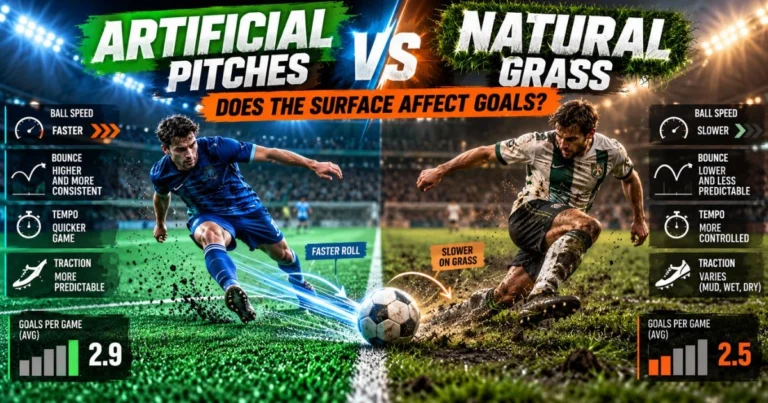
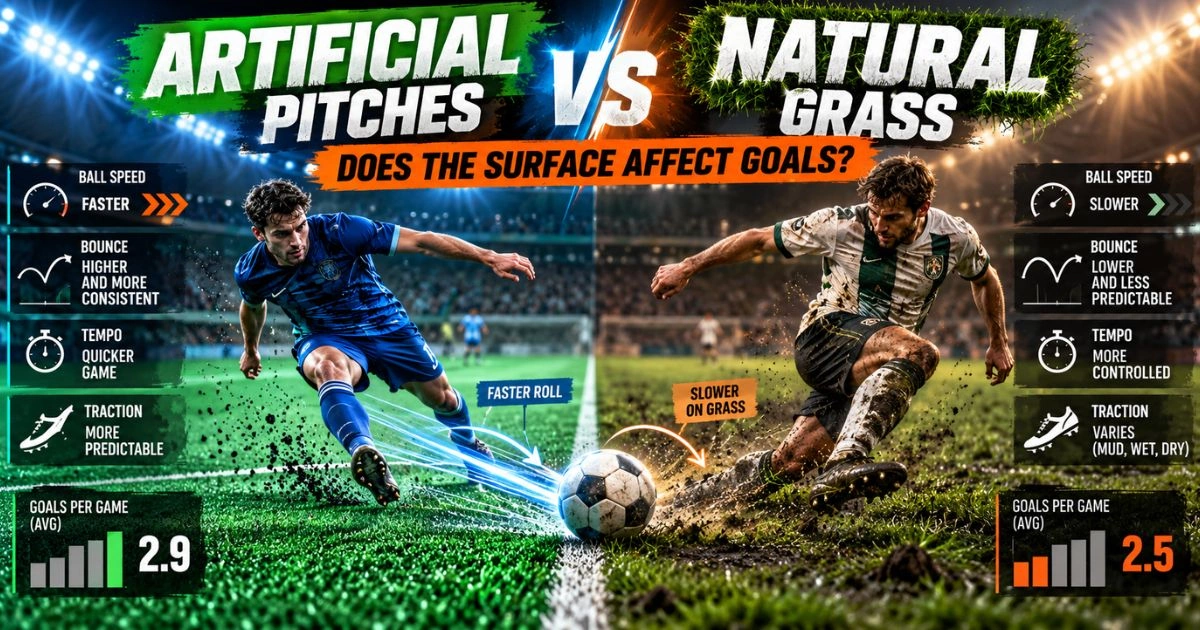
When a football match is played on artificial turf, bettors often react immediately. You may hear: “The ball moves faster, so there should be more goals.”
Or: “The away team is not used to the pitch, so the home side has a big advantage.” There can be some truth behind these ideas.
Artificial surfaces can influence passing patterns, running demands, traction and the way players interact with the ball. Teams that regularly train and play on artificial turf may also be more familiar with its characteristics than visiting opponents.
But the evidence does not support a simple rule such as artificial pitch equals Over 2.5 Goals. A major 2026 study covering 3,383 MLS matches from 2017 to 2024 found no statistically significant relationship between playing surface and overall match outcomes.
Researchers did identify some differences in attacking performance and modest differences in goal scoring, but the surface alone did not strongly determine who won or lost. For football predictions, the surface is therefore best treated as another contextual factor.
It is important in certain matches, but rarely strong enough to replace xG, team quality, tactics and current form.
What Is the Difference Between Artificial Turf and Natural Grass?
Natural grass is exactly what the name suggests: a living grass surface grown on a soil or sand-based root zone. Artificial football turf uses synthetic fibres designed to reproduce many of the playing characteristics of natural grass.
Modern professional artificial pitches are very different from the hard synthetic surfaces used several decades ago. FIFA recognises three main categories of football pitch:
Natural grass
Hybrid grass, where natural grass is reinforced with synthetic fibres
Fully artificial turf
FIFA also operates quality standards for artificial football turf. Pitches meeting its professional-level requirements can receive the FIFA Quality Pro certification.
That distinction matters. You should not treat every artificial pitch as identical.
The quality, age, maintenance and moisture of the surface can all affect how it plays.
Does Artificial Turf Produce More Goals?
There is no strong universal evidence that artificial turf automatically creates significantly more goals. The recent MLS research is particularly useful because of its size.
Researchers analysed 6,764 team-match observations from 3,383 matches played on grass, turf and hybrid surfaces. Surface type was not significantly associated with match outcomes, and home advantage did not differ significantly between natural grass and artificial turf.
There were some differences in attacking performance and modest differences in scoring, but not enough to justify treating turf as an automatic goal-betting signal. That gives us a useful starting principle.
The pitch may influence how football is played without completely changing the expected result or goal total.
Artificial Turf Can Change Passing Style
One of the more consistent findings concerns passing. An elite football study comparing matches on artificial and natural grass found significantly more short passes on artificial turf.
Players averaged approximately 218 short passes on artificial turf compared with 167 on natural grass. The study also found more midfield-to-midfield passes on artificial turf, with around 148 compared with 107 on natural grass.
Interestingly, overall running activity was very similar. Total distance covered was approximately 10.19 km on artificial turf versus 10.33 km on natural grass.
High-intensity running was also almost identical. So artificial turf did not simply make football faster in every possible way.
Instead, it appeared to influence how teams moved the ball.
Why Short Passing May Increase on Artificial Turf
A consistent artificial surface can make short passing relatively predictable. The ball may:
Travel smoothly
Bounce consistently
Maintain speed
Be less affected by damaged grass
Teams comfortable on the surface may therefore be willing to circulate possession quickly. That can help clubs whose attacking style depends on:
Short combinations
One-touch football
Quick passing through midfield
Low cutbacks
But more passes do not automatically equal more goals. A team can complete hundreds of safe passes without creating many chances.
For prediction purposes, the important question remains: Are those passes producing xG, shots on target and penalty-area entries?
More Passing Does Not Automatically Mean More Attacking Quality
This is an important distinction. Imagine Team A makes 600 passes, but most are between centre-backs and midfielders.
Team B makes 380 passes but creates six shots on target and 2.0 xG. Team B has the more dangerous attacking performance.
The same applies when comparing pitch surfaces. Artificial turf may encourage more short passing, but bettors should still prioritise:
xG
Big chances
Shots on target
Touches in the box
Progressive passes
Surface-related passing statistics should support the analysis, not replace it.
Artificial Turf Can Increase Physical Demands
Some studies have found higher running demands on artificial turf. A 2023 professional-football study found that artificial turf was associated with increased total distance and higher-intensity running for several positions, particularly central defenders, central midfielders and full-backs.
The researchers concluded that artificial turf placed greater physical demands on defensive and midfield players than natural grass in their sample. This is interesting for goal predictions because physical demands can potentially affect:
Pressing
Defensive recovery
Late-match fatigue
Transition defending
But this still does not create a simple late-goal rule. Another controlled match simulation found no meaningful difference between artificial and natural surfaces in heart rate, blood lactate or the decline in sprint and agility performance.
The research is therefore mixed.
Familiarity With the Surface May Matter More Than the Surface Itself
Suppose Team A plays every home match on artificial turf. Its players train there regularly and understand:
How quickly the ball travels
How strongly it bounces
Which boots provide the best traction
How passes react when the surface is wet
Now Team B arrives after playing almost exclusively on natural grass. There may be an adaptation period, which can potentially create an extra home advantage.
But again, the evidence suggests caution. The large MLS study found that home advantage was strong overall but did not differ significantly between grass and artificial turf.
So surface familiarity may matter in individual situations without producing a reliable league-wide betting rule.
Practical Example: Artificial Turf Could Help the Home Attack
Imagine the home side regularly plays on artificial turf and uses fast short passing, aggressive pressing, and quick combinations around the box. At home it averages 1.9 xG and 5.8 shots on target.
The visitors normally play on natural grass and defend with a high line. The home team’s familiarity with the surface may slightly strengthen the attacking case.
If your original prediction already supported Home Team Over 1.5 Goals, the pitch can become another positive factor. But the selection should still be based primarily on attacking and defensive statistics.
Practical Example: Do Not Back Over Just Because It Is Artificial
Now imagine another artificial-pitch fixture where both teams average around 1.0 xG, fewer than three shots on target, and few big chances. Both also play cautiously.
The pitch may allow smooth passing, but that does not suddenly create four goals. Possible results remain 0-0, 1-0, or 1-1.
Artificial turf cannot compensate for weak attacking quality.
Natural Grass Can Vary More With Conditions
One advantage of artificial turf is consistency. Natural grass depends on:
Weather
Drainage
Maintenance
Temperature
Usage
Stadium sunlight
FIFA notes that natural surfaces can vary because of local climatic conditions and heavy usage, potentially affecting footing and ball bounce. This means the phrase “natural grass” can describe very different playing conditions.
A perfect Champions League pitch and a heavily worn winter surface are both natural grass. They should not be analysed as if they are identical.
A Poor Natural Pitch May Matter More Than a Good Artificial One
Suppose a natural pitch is muddy, uneven, and heavily damaged. That can make:
Short passing harder
Ball control less predictable
Quick combinations more difficult
Now compare it with a high-quality FIFA-certified artificial surface. The artificial pitch may actually provide the more consistent football environment.
So the useful distinction is not simply artificial vs natural. It is: What is the actual quality of today’s surface?
Rain Can Change Both Surfaces
Weather and pitch type also interact. A well-maintained artificial surface can remain relatively consistent in poor weather.
Natural grass may become slower, softer, or more uneven depending on drainage and rainfall. But artificial turf can also behave differently when wet.
That means weather should be considered alongside the surface rather than separately. A wet artificial pitch may create different ball speed and traction than the same pitch when dry.
Footwear and Traction Matter
Players also need appropriate boots for the surface. A systematic review of 23 studies found that the interaction between footwear and pitch type can influence performance measures such as changes of direction, kicking and traction.
Professional clubs prepare carefully for this. That reduces the chance that elite players will be completely surprised by the surface.
But an unfamiliar pitch can still require adaptation, especially for players who rarely compete on artificial turf.
What About Injury Risk?
Artificial turf is sometimes associated with claims of dramatically higher injury risk. The evidence is more complicated.
A prospective study involving elite European footballers found no significant overall difference in training or match injury incidence between artificial turf and natural grass within teams that regularly used artificial turf. There were differences in specific injury categories—for example, ankle sprains were more common on artificial turf in that dataset—but overall injury severity did not differ.
For match predictions, this is mainly relevant before kick-off if players or managers have expressed concerns about the surface. It should not automatically be converted into an Over or Under prediction.
Hybrid Pitches Should Not Be Confused With Artificial Turf
Many major stadiums now use hybrid surfaces. These contain natural grass reinforced with synthetic fibres.
They are designed to provide:
Greater durability
More consistent footing
Better resistance to heavy use
Hybrid does not mean the match is being played on a fully artificial pitch. That distinction matters when researching team statistics.
If a database labels surfaces loosely, check what type of pitch is actually installed.
Does Artificial Turf Help Technical Teams?
Potentially. A consistent surface can suit teams that rely heavily on short passes, quick combinations, and positional possession.
The older elite-football research found substantially more short passing on artificial turf, while more recent technical work has also reported higher passing volume and accuracy on artificial surfaces in some samples. But this should be interpreted carefully.
Teams that play on artificial turf regularly may already have developed styles suited to it, so the surface may not be the sole cause.
Does Natural Grass Help Direct Teams?
Again, sometimes. Some research has found more direct actions on natural grass, including more long passes or duels in particular datasets.
But team style remains the bigger factor. A direct team will not suddenly become Barcelona because it plays on artificial turf.
And a possession team will not automatically start launching long balls simply because the match is on natural grass. Think of the surface as influencing the execution of the style rather than completely creating the style.
Surface Changes Can Matter More Than Permanent Surface Type
One useful angle is whether the visiting team is changing from the surface it normally uses. A club accustomed to artificial turf playing another artificial-turf team may experience little difference.
A natural-grass team travelling to a less familiar artificial surface may need more adaptation. A review of research on switching football surfaces concluded that the physical and physiological demands can differ, although the overall evidence is not consistent enough to support simple universal rules.
For predictions, switching surfaces deserves more attention than merely noting that the match is on turf.
Practical Example: Potential BTTS Match
Imagine a home team that is a regular artificial-turf side with 1.8 home xG, scores in 9 of 10 matches, and concedes regularly. The away team has a strong counterattack, 1.4 away xG, and a weak clean-sheet rate.
Both teams produce good shot numbers. The home side’s surface familiarity adds another small advantage.
Possible results are 2-1, 2-2, and 3-1. BTTS or Over 2.5 may already have a strong statistical case, making the pitch a supporting factor.
Practical Example: Visiting Favourite
Now imagine an elite visiting team normally plays on natural grass but faces a smaller club on artificial turf. The market assumes the favourite will dominate easily.
Before taking a large handicap or high team total, check:
Has the favourite recently played on artificial surfaces?
Is rotation expected?
Does the home team have strong artificial-turf results?
Is the visitor’s style dependent on particular passing patterns?
Are the odds already reflecting the unfamiliar conditions?
The pitch may not overturn the quality gap. But it can justify a small adjustment to your expectations.
Surface Should Not Replace Home-Away Data
If a team has played 30 home matches on the same artificial pitch, its home statistics already include much of the surface effect. That is important.
Do not count a strong artificial-turf record, a strong home record, and surface familiarity as three completely independent advantages. They may describe the same underlying factor.
This prevents you from double-counting evidence.
Artificial vs Natural Grass Prediction Checklist
Before changing a goal prediction because of the surface, check:
Is the pitch fully artificial, hybrid or natural?
What is the quality of the surface and does the home team regularly play on it?
Is the visitor familiar with artificial turf and how does the home side perform there?
What are current xG and xGA numbers, and how many shots on target do the teams create?
Does either team rely heavily on short passing?
Is the natural surface unusually poor or is rain likely to change playing conditions?
Are players changing footwear or adapting to traction?
Is the surface already reflected in the team’s home statistics?
Has the bookmaker already adjusted the price?
The surface should make you refine the prediction rather than build one from nothing.
Frequently Asked Questions
Do artificial pitches produce more football goals? Not consistently. A large 2026 MLS study found only modest differences in scoring between surfaces and no significant overall relationship between surface type and match outcomes.
Does the ball move faster on artificial turf? Modern artificial surfaces can provide consistent ball movement and may encourage short passing, but the exact speed depends on the pitch, maintenance and moisture.
Do teams pass more on artificial pitches? Some studies suggest they do. One elite-football study recorded around 218 short passes per match on artificial turf compared with 167 on natural grass.
Do artificial pitches give the home team a bigger advantage? Not necessarily. The recent MLS study found strong home advantage overall but no significant difference in home advantage between grass and turf.
Should I use the surface when predicting Over 2.5? Yes, but only as a supporting factor. xG, shots on target, defensive quality, team news and tactics should normally receive much more weight.
Final Thoughts
Artificial turf can change the way football is played. Some research suggests more short passing, different running demands and changes in certain attacking actions compared with natural grass.
But the evidence does not support a simple conclusion that artificial pitches automatically produce more goals. Modern high-quality artificial surfaces are specifically designed to provide consistent professional football conditions, while natural grass can itself vary enormously depending on weather, maintenance and usage.
For predictions, the more useful questions are: Is the home team accustomed to the surface? Is the visiting team changing from a surface it normally uses?
Does the pitch suit either team’s tactical style, and do the actual xG and shot numbers support the goal prediction? If an artificial pitch helps an already strong attacking case, it can be a useful extra factor.
If the attacking statistics are poor, the surface alone is unlikely to turn the match into a goal fest. In other words, predict the teams first, and adjust for the pitch second.
That is far more reliable than assuming artificial turf automatically means faster football and more goals.
Responsible betting: Playing surface can influence match dynamics but does not guarantee a particular goal total or result. Use it alongside current team data and tactics, keep stakes controlled and never bet money you cannot afford to lose.