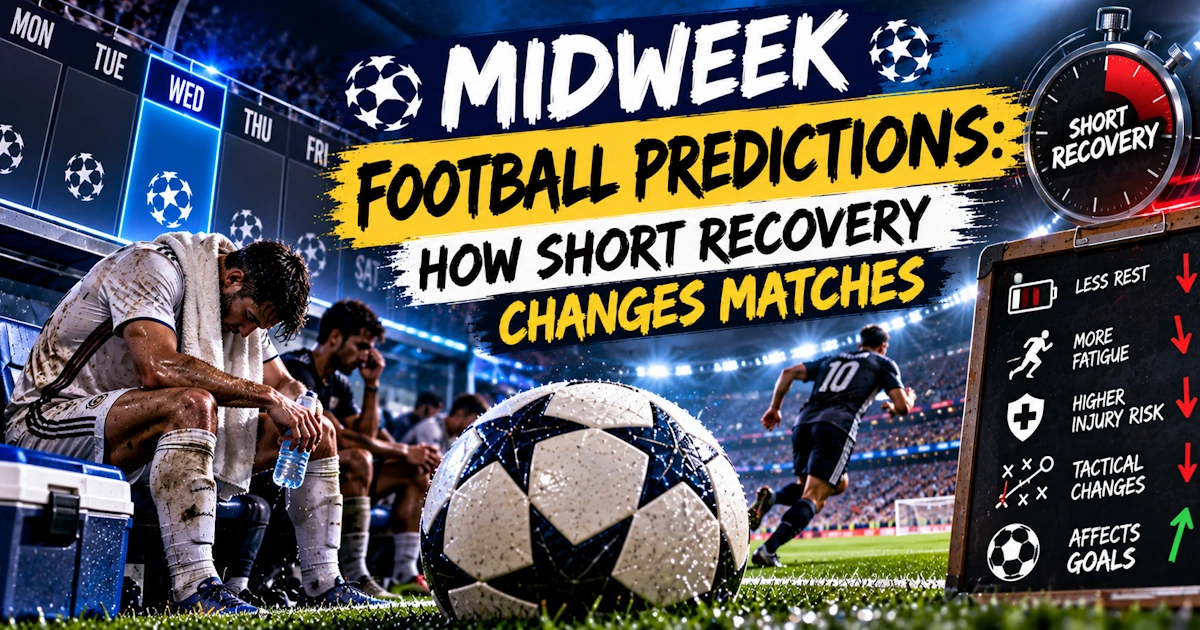
Midweek football creates one of the most common prediction questions: How much does a short recovery period really matter?
A team might play a difficult league match on Sunday, travel for a European game on Wednesday and then return to domestic action three days later. It sounds exhausting.
The natural assumption is that tired teams will perform worse, concede more goals and struggle late in matches. Sometimes that happens.
But research paints a more complicated picture. Professional footballers can often maintain surprisingly high levels of match performance even with only three or four days between games.
At the same time, full physical recovery may not be complete, injury risk can increase and managers may compensate through rotation or tactical changes. For football predictions, short recovery should therefore be treated as a context factor, not an automatic reason to oppose a team or back Over 2.5.
What Counts as Short Recovery?
In football research, congested schedules are often defined as periods where teams play again after four days or fewer of recovery. A typical schedule might look like a league match on Saturday, the Champions League on Tuesday, and a league match on Saturday.
Or, a league match on Sunday, the Europa League on Thursday, and a league match on Sunday.
The number of calendar days can also be misleading. A team playing Sunday evening and Wednesday evening has roughly 72 hours.
But those hours include recovery after the first game, travel, tactical preparation, training, and media obligations. The actual useful recovery window may be much smaller.
Seventy-Two Hours May Not Be Full Recovery
One systematic review found that several fatigue-related measures were still impaired 72 hours after a match. Hamstring force, physical-performance markers, muscle soreness and some measures of well-being had not completely returned to baseline.
The sports science researchers concluded that 72 hours is not always enough for complete physiological recovery after competitive football. A more recent systematic review reached a similar conclusion.
Even after 72 hours, some professional players still showed reduced vertical-jump ability and hamstring strength, although sprinting, change-of-direction ability and technical performance had generally recovered. That distinction matters.
A player may look capable of performing normally while still carrying some residual fatigue.
Short Recovery Does Not Automatically Mean Poor Results
This is where many predictions become too simplistic. An 11-season study involving 27 elite European teams found little overall relationship between short recovery and team results.
The main exception was Europa League matches, where teams experienced more defeats when they had three days or fewer of recovery. Another study followed a professional team through 35 official matches across 17 consecutive weeks, with matches separated by an average of no more than 3.5 days.
Researchers found no clear difference in several physical and physiological performance measures between shorter and longer recovery intervals.
So, three days of rest does not automatically make a strong team weak. Elite squads often adapt very well.
Injury Risk Is a Stronger Concern
The evidence becomes more convincing when we look at injuries. The 11-season UEFA study found that muscle injury rates were 32% higher in league matches played after four or fewer recovery days compared with matches following six or more days.
Hamstring and quadriceps injuries were particularly affected. A later systematic review also concluded that congested schedules generally expose professional players to greater match injury incidence.
For bettors, this means the main impact may not appear as the whole team being tired. It may appear as two important players being unavailable because of the schedule.
That can be much more useful for predictions.
Individual Minutes Matter More Than Team Rest Days
Imagine two teams both played on Sunday and play again on Wednesday. On paper, there are three days of recovery each.
But look deeper. For Team A, the main striker played 45 minutes, the creative midfielder was rested, and one centre-back played 60 minutes.
For Team B, seven starters played all 90 minutes, both full-backs played the entire game, and the main striker has started four straight matches. The schedule is identical, but the player workload is not.
For midweek predictions, individual minutes are often more useful than the basic fixture list.
Rotation Can Completely Change the Prediction
Managers know their players are dealing with short recovery. Their solution is often rotation, which can change a match more than fatigue itself.
Suppose a favourite normally averages 1.9 xG per match, but the manager rests the top scorer, main creator, and first-choice winger. The team may be physically fresher, but its attacking quality may still fall.
Now imagine the attack remains unchanged, but the manager rests the goalkeeper, centre-back, and defensive midfielder. The match may become more suitable for BTTS, Over 2.5, or opponent team goals.
Always check which positions are rotated.
Short Recovery Can Reduce Pressing
High pressing requires repeated high-intensity running. A team that normally attacks by aggressively winning the ball high up the pitch may become more selective after several matches in quick succession.
Instead of pressing every possession, it may drop into midfield, protect central areas, slow the tempo, and choose specific moments to press. This can reduce the number of transitions.
A match you expected to become fast and open may therefore become more controlled. That is one reason short recovery does not automatically mean more goals.
But Defensive Fatigue Can Create Late Chances
There is another side. Defenders may still be able to complete the match physically while becoming slightly slower in tracking runners, recovering position, reacting to second balls, and making decisions.
One delayed movement can create a clear chance. Research monitoring professional players during congested schedules found that perceived fatigue and muscle soreness two and three days after matches were associated with greater risk of non-contact injury.
For live betting, a heavily used defence facing fresh attacking substitutes can therefore become interesting late in the game.
Practical Example: Short Recovery Strengthens an Over
Imagine the home team has enjoyed seven days of rest. It averages 1.9 home xG, 5.7 shots on target, and strong second-half scoring.
The visitors played a Europa League away fixture on Thursday and now play again on Sunday. Their situation includes both centre-backs and the defensive midfielder playing 90 minutes, another injured defender, and limited bench depth.
The visitors already concede 1.6 away xGA. Here, short recovery strengthens an Over 2.5 prediction that already has statistical support.
That is the right way to use the schedule.
Practical Example: Short Recovery Supports an Under
Now imagine both teams played midweek. Both managers respond by rotating attacking players.
The lineups are missing two first-choice strikers, a creative midfielder, and a winger. The defensive units remain strong, and both managers also prefer controlled possession.
Possible results include 0-0, 1-0, or 1-1. In this situation, short recovery may reduce attacking quality.
The same schedule that supported an Over in the previous example can now support an Under. Context decides the direction.
Practical Example: Fresh Underdog Against a Tired Favourite
Suppose the favourite played Sunday, Wednesday, Saturday, and used almost the same XI. The underdog had no midweek match.
Normally, the favourite would be priced very short. But now compare the favourite’s three-day recovery, long European travel, heavy player minutes, and two defensive injuries against the underdog’s seven-day recovery, full squad, and strong counterattack.
This does not automatically make the underdog the better team. But the difference may be enough to reduce the favourite’s expected advantage.
Markets such as underdog + handicap, underdog to score, and BTTS may deserve more attention.
Travel Makes Short Recovery More Difficult
Not every three-day recovery period is equal. Compare Team A with a Saturday home match, Tuesday home European match, and Saturday home match against Team B.
Team B has a Sunday away domestic match, Thursday European match abroad, and Sunday domestic away match. Team B also deals with airports, flights, hotels, less normal sleep, and reduced training time.
Travel can therefore magnify the effect of an already congested schedule. For European competitions, always check where the previous match was played.
Strong Squads Handle Midweek Football Better
Squad depth is crucial. An elite club might replace an international striker with another international striker, a starting full-back with a high-quality backup, and a midfielder with another established player.
A smaller club may have a much larger quality drop. This means the same schedule can affect two teams differently.
When analysing a midweek fixture, ask how good the replacements are, not just how many players are being rested.
A Fresh Bench Can Matter Late
Modern substitution rules allow managers to introduce several fresh players. That can reduce some of the disadvantages of short recovery.
Imagine a team has played every three days but can bring on a fresh winger, fresh striker, and creative midfielder after 60 minutes. Its opponent has a much weaker bench.
The exhausted starting lineup does not tell the whole story. For second-half goal predictions, bench strength can be particularly important.
Short Recovery and First-Half Goals
Sometimes congested teams begin cautiously. They may avoid high pressing, end-to-end transitions, and aggressive attacking runs.
This can create quieter first halves. A team may simply try to remain organised and conserve energy.
If both sides have recently played, markets such as Under 1.5 First-Half Goals may deserve investigation when tactical data also supports a slower start. But again, do not use recovery time alone.
Short Recovery and Second-Half Goals
The second half can produce the opposite pattern. As the game develops, fatigue increases, defensive concentration can fall, fresh substitutes enter, and teams chasing results take more risks.
That can create a stronger environment for late goals. Suppose a match is 1-1 after 65 minutes, and one team is on three days’ recovery while its opponent has fresh attackers available.
If live xG and shots also show an open game, another goal becomes much more believable.
Do Not Assume Every Tired Team Concedes Late
Late goals are influenced by many factors. A tired elite team may still have excellent game management, deep squad quality, strong substitutes, and experience protecting leads.
A fresh weaker team may lack the ability to punish it. Fatigue creates opportunity, but the opponent still needs enough quality to use it.
Look at the Previous Match, Not Just the Date
Suppose a team played three days ago. Was the match an easy 3-0 home win where key players were substituted after an hour?
Or was it a 120-minute cup match that went to extra time and penalties? Those are completely different recovery situations.
Check the minutes played, extra time, match intensity, travel, and weather conditions. The word “midweek” does not tell you enough.
Recovery Is Individual
Research repeatedly shows that post-match recovery varies between players. Some recover quickly, while others carry muscle soreness or fatigue longer.
A systematic review on football recovery explicitly warned against a “one-size-fits-all” view of the 72-hour recovery period. That is another reason broad rules such as “three days rest equals oppose the team” are unreliable.
Use Short Recovery as an Adjustment
A practical way to think about it is through probability. Suppose your normal analysis gives Over 2.5 at 56%.
Then you discover the away defence played 120 minutes three days ago, travelled internationally, and has little rotation available. You might increase your estimate slightly, perhaps from 56% to 59%.
You are adjusting the prediction, not replacing your entire model with the schedule. That is a much more disciplined approach.
Midweek Prediction Checklist
Before adjusting a prediction for short recovery, check:
Days since the previous match and exact number of hours between games
Individual player minutes and whether extra time was played
Travel distance and home or away schedule
Squad depth, expected rotation, and injuries
Pressing style, age, and workload of key players
Bench strength and upcoming fixtures
Current xG, xGA, and shots on target
Whether the opponent is fresher
Short recovery is most useful when several of these factors point in the same direction.
Frequently Asked Questions
Is three days enough recovery for professional footballers? Players can often perform again after roughly 72 hours, but research shows that some measures of muscle function, soreness and physical recovery may still be impaired.
Does short recovery make teams lose more often? Not necessarily. Large studies have found limited overall effects on team results, although certain competitions and situations have shown poorer outcomes with very short recovery.
Does fixture congestion increase injuries? Research generally suggests yes. One major UEFA study found muscle injury rates 32% higher in league matches following four or fewer recovery days compared with six or more.
Does short recovery mean more goals? No. Tired defenders can create opportunities, but fatigued attackers and tactical rotation can reduce attacking quality. Analyse the specific teams.
What is more important: rest days or individual minutes? Individual workload often gives better context. A player who played only 30 minutes three days ago is in a very different position from someone who played 120 minutes.
Final Thoughts
Short recovery matters in football, but it does not work in the simple way many betting predictions suggest. Professional players can often maintain a high level of match performance despite playing every three or four days.
At the same time, complete recovery may not have occurred, and repeated short turnarounds can increase injury risk. The biggest prediction effects often come indirectly through rotation, player availability, tactical changes and individual workload.
So when analysing midweek football, do not stop at: “They played three days ago.” Ask who played, how many minutes they played, if they travelled, and who will be rotated.
Which part of the team is most affected, and does short recovery strengthen or weaken what the football statistics already suggest? If a tired defence already allows high xGA and now faces a fresh attacking team, the schedule can strengthen an Over prediction.
If the manager responds by resting several important attackers, it might instead strengthen an Under. Short recovery is therefore not a prediction by itself.
It is a modifier that becomes valuable when combined with xG, shots, lineups, tactics and opponent quality.
Responsible betting: Short recovery can affect performance and injury risk but cannot guarantee a particular result or goal total. Use it alongside current team data, keep stakes controlled and never bet money you cannot afford to lose.