
Big football clubs are easy to trust. They have famous players, expensive squads, huge fan bases and a history of winning major trophies.
When one of them faces a smaller opponent, the obvious prediction often seems simple: Back the famous team.
The problem is that bookmakers know exactly how strong and popular that team is. If everyone expects the favourite to win, the odds will usually be short.
That means an excellent football team can still be a poor betting selection. This is the difference between asking “Who is most likely to win?” and “Are the odds high enough for the probability of winning?”
Understanding that difference is one of the most important steps towards finding value in football predictions.
A Strong Team Is Not Automatically a Good Bet
Imagine an elite team has a 70% chance of winning. That is a very strong probability.
But suppose the bookmaker offers odds of 1.30. Odds of 1.30 imply a raw probability of 1 ÷ 1.30 = 76.9%.
Your estimate says 70%. The bookmaker price effectively requires the favourite to win more often than your analysis suggests.
So although you expect the famous team to win, you may still have a poor bet. Now suppose the same team is offered at 1.60.
The implied probability is 1 ÷ 1.60 = 62.5%. If you still estimate its real chance at 70%, that becomes much more interesting.
The club has not changed; the price has. That is what determines value.
Famous Clubs Are Usually Obvious to the Market
There is no secret information in knowing that Real Madrid, Bayern Munich, Barcelona, Liverpool or another major club has strong players. Bookmakers know it, professional bettors know it, and statistical models know it.
The market already considers:
Squad quality
Recent results
Injuries
Opponent strength
Expected line-ups
Research consistently shows that football betting markets contain a large amount of useful information. For example, a study covering odds from 51 online bookmakers and more than 16,000 English football matches found that market odds were generally well calibrated against actual results.
In other words, simply recognising the stronger team is not an edge. You need to find where the market’s probability differs from your own.
Popularity Can Influence Betting Behaviour
Famous teams attract more attention. They have more supporters, more television coverage and more casual bettors.
Research has found evidence that bettor sentiment can influence football betting behaviour. A study of Spanish football using more than 3,000 available bets found evidence that betting prices were related to club popularity.
Similar patterns were also observed in Scottish football. Other research using social-media popularity across professional sports also found evidence that market prices reflected bettor sentiment around popular teams, while this popularity did not translate into a higher probability of winning a bet.
This does not mean bookmakers always make famous teams too short. Research on market efficiency is mixed, and highly competitive betting markets can price popular teams very accurately.
The safer conclusion is: Popularity itself is not a reason to bet.
Fans Can Overestimate Teams They Like
Supporters rarely analyse their own team completely objectively. A fan may remember famous European victories, star players, big comeback wins, and great performances against rivals.
They may pay less attention to:
Defensive problems
Fatigue
Injuries
Poor away form
Short odds
Research during the 2018 World Cup found substantial reluctance among England supporters to bet against their own team, showing how emotional loyalty can affect betting decisions. This is useful beyond national teams.
If you support a famous club, ask yourself: Would I still make this prediction if the club badge were removed? That simple question can expose emotional bias.
Short Odds Create High Break-Even Requirements
The shorter the odds, the more frequently you must win just to break even. Consider these prices and their raw implied probabilities:
Odds 1.20 = 83.3%
Odds 1.30 = 76.9%
Odds 1.40 = 71.4%
Odds 1.50 = 66.7%
Odds 1.70 = 58.8%
Odds 2.00 = 50.0%
A famous home favourite priced at 1.25 may look extremely safe. But that price implies around an 80% probability before adjusting for bookmaker margin.
If the team actually wins only 74% of comparable matches, continually backing it at that price can lose money despite plenty of winning bets. That is one reason a high strike rate can be misleading.
Practical Example: The Winning Bet That Was Poor Value
Imagine Barcelona are priced at 1.35 against a weaker opponent. You estimate their chance of winning at 70%.
Fair odds based on your estimate would be 1 ÷ 0.70 = 1.43. The bookmaker offers only 1.35, but you place the bet anyway.
Barcelona win 3-0. Was the prediction correct? Yes.
Was the price necessarily good? No.
The result cannot change the value available when you placed the bet. This distinction is critical: A poor-value bet can win, and a good-value bet can lose.
The Favourite’s Name Can Distract From the Opponent
Another mistake is analysing only the famous team. Suppose a major club is travelling away.
People may focus on its superstar attackers and ignore that the opponent:
Has lost only once at home
Allows very little xGA
Presses effectively
Has had seven days of rest
The famous team may also have played in Europe three days earlier, rotated midfielders, and lost a centre-back to injury. Its badge is still impressive, but the matchup may not be.
Good prediction analysis asks what both teams bring to the game.
Away Favourites Need Extra Attention
Big clubs are frequently priced as short favourites even away from home. But away matches change several things.
A team may produce 2.1 xG at home but only 1.4 xG away. Its opponent may also be much stronger on its own ground.
Suppose a famous team is priced at 1.50 away. The implied probability is 66.7%.
If your analysis gives it only 58%, the famous club may be the likely winner without being a good selection at 1.50. Those are two different conclusions.
Rotation Can Make Historical Numbers Misleading
Major clubs often have the deepest squads. That helps them deal with busy schedules, but famous teams also play more matches.
They may be involved in the Champions League, domestic league, domestic cups, and international breaks. Suppose a team averages 2.2 goals at home.
Tonight it rests its main striker, creative midfielder, and first-choice winger. That 2.2 average was largely produced by a stronger attacking lineup.
Using it without adjusting for rotation can exaggerate the team’s scoring expectation.
Champions League Matches Can Affect Weekend Prices
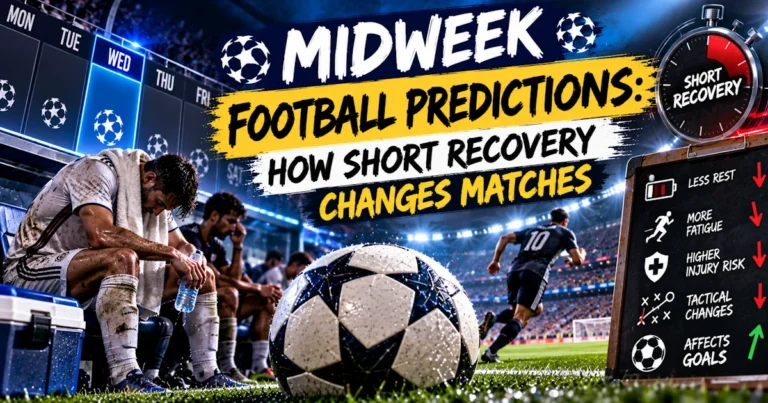
Imagine a famous team plays a difficult Champions League away match on Wednesday. It then has a league game on Saturday.
The opponent has had an entire week to prepare. The famous team still attracts public money because everyone recognises the quality difference.
But you should check:
Minutes played
Travel
Injuries
Rotation
Squad depth
The stronger team may still win, but that does not mean the shortest available odds represent value.
Recent Big Wins Can Make Teams Look Safer Than They Are
Recency can create another bias. Imagine a famous club’s last three results are 4-0, 5-1, and 3-0.
Bettors see 12 goals, and the bookmaker market sees them too. Now look underneath the results.
Perhaps the team generated 7.1 xG but scored 12 goals, which suggests extremely efficient finishing. If the next opponent is considerably stronger defensively, blindly following recent scorelines may lead you towards an overpriced favourite or an overpriced team-goal market.
Research using more than 160,000 football matches from 2000/01 to 2020/21 found evidence of a hot-hand bias in betting markets alongside the better-known favourite–longshot effect. Recent winning streaks can influence expectations.
A Famous Team Losing Last Week Does Not Automatically Create Value Either
The opposite mistake also happens. A big club loses unexpectedly, and bettors think: “They will definitely respond.”
Maybe. But there is no football law saying famous teams must win after a defeat.
Ask why they lost. Was it:
Poor finishing?
A red card?
Strong opposition?
Or was the performance genuinely poor? Check the xG, shots on target, injuries, and tactical problems.
A famous team’s reputation should not become a substitute for analysing the reason behind its form.
Favourite–Longshot Research Is More Complicated Than It Sounds
It is worth mentioning an important point. Betting research does not show that favourites are generally bad bets.
In fact, many studies have found the opposite problem: longshots can produce worse average returns than favourites. A large study used 163,992 football odds from 41,003 matches across ten European leagues and found evidence of favourite–longshot bias, where bettors taking longshots tended to suffer larger losses.
Another study covering 33,060 matches across 11 European leagues also investigated the favourite–longshot effect in football markets. More recent research published in the International Journal of Forecasting also reported a strong favourite–longshot pattern in traditional 1X2 football markets, while finding the Asian handicap market produced more efficient forecasts in its sample.
So the lesson is not to never bet famous favourites. The lesson is: Never assume favourite status equals value.
Do Not Automatically Bet the Underdog Either
If a famous team is overpriced, some bettors immediately move to the outsider. That can be another mistake.
Suppose the favourite is 1.30 and the underdog is 9.00. Odds of 9.00 imply roughly 11.1%.
But perhaps your analysis gives the underdog only 8%. Fair odds would be 1 ÷ 0.08 = 12.50.
The 9.00 price is still too short. Both sides of a market can be unattractive once the bookmaker margin is considered, and sometimes the best bet is no bet.
Goal Markets Can Be Overpriced Too
The same problem appears outside the match winner market. Suppose a famous attacking team averages many goals.
The market offers Team Over 1.5 Goals at 1.35. That requires a very high scoring probability.
Check:
Current xG
Opponent xGA
Home-away split
Lineup
Goalkeeper quality
The famous attack may still score twice. But if your estimated probability is lower than the bookmaker’s implied probability, the price is poor.
Famous Teams in Accumulators Can Be Dangerous
Another common pattern is building an accumulator around several big clubs. For example, you combine Team A (1.30), Team B (1.35), Team C (1.40), and Team D (1.30).
The combined price is approximately 3.19. It looks attractive because every team seems individually safe.
But each selection introduces another way for the accumulator to lose. Even if each team had a true 75% chance of winning, the probability of all four winning would be 0.75⁴ = 31.6%.
Four strong favourites do not create certainty. They create one bet requiring four separate results to go correctly.
Compare the Price With Your Own Probability
A useful habit is to stop saying “This team should win.” Instead say: “I estimate this team has a 68% chance of winning.”
That gives fair odds of 1 ÷ 0.68 ≈ 1.47. Now compare.
Bookmaker offers 1.65? Interesting.
Bookmaker offers 1.30? Probably not.
The same famous club can be attractive at one price and unattractive at another.
Look Beyond the Club Badge
Before backing a famous team, check:
Current xG and xGA
Shots on target
Home-away performance
Opponent quality
Injuries and rotation
Recovery time and tactical matchup
Estimated probability vs bookmaker implied probability
Whether the price has already shortened because of public attention
The aim is not to prove that the favourite will lose. It is to determine whether you are being paid enough for the risk you are taking.
Frequently Asked Questions
Are famous football teams usually overpriced? Not necessarily. Modern betting markets can be highly efficient, and research on popularity effects is mixed. The important point is that popularity itself does not create betting value.
Can a team be likely to win but still be a bad bet? Yes. If you estimate a team’s chance of winning at 70% but the odds imply 80%, you can correctly expect it to win while still rejecting the price.
Should I always bet against short-priced favourites? No. Research has often found longshots produce worse average returns than favourites. Every price needs to be evaluated individually.
Why do bettors like famous teams? Familiarity, recent success, star players and emotional loyalty can make famous teams feel safer. Research has found evidence that popularity and supporter sentiment influence betting behaviour.
What should I check before betting a big favourite? Compare the implied probability with your own estimate, then check current form, xG, opponent strength, venue, injuries, rotation and the available price.
Final Thoughts
Famous football teams win plenty of matches. That is exactly why their odds are usually short.
The biggest mistake is confusing a strong team with a strong bet. Those are not the same thing.
A club can have the better goalkeeper, stronger midfield and world-class attackers while still offering poor value at 1.25. Likewise, rejecting every favourite simply because the odds are short is not a solution, as research has repeatedly shown that longshots can produce even worse average returns.
The better approach is much simpler. Forget the badge for a moment, estimate the probability, and convert the bookmaker’s odds into implied probability.
Then compare the two. If you believe a famous team has a 70% chance of winning and the market is pricing it like an 80% chance, its reputation should not convince you to bet.
If the same team is priced below your estimated probability, the situation changes. Football betting value does not come from finding the most famous team on the coupon.
It comes from finding the biggest difference between what is likely to happen and what the bookmaker is asking you to pay for it.
Responsible betting: Even strong favourites lose, and no club is a safe bet at every price. Compare probability with odds, keep individual stakes controlled and never bet money you cannot afford to lose.