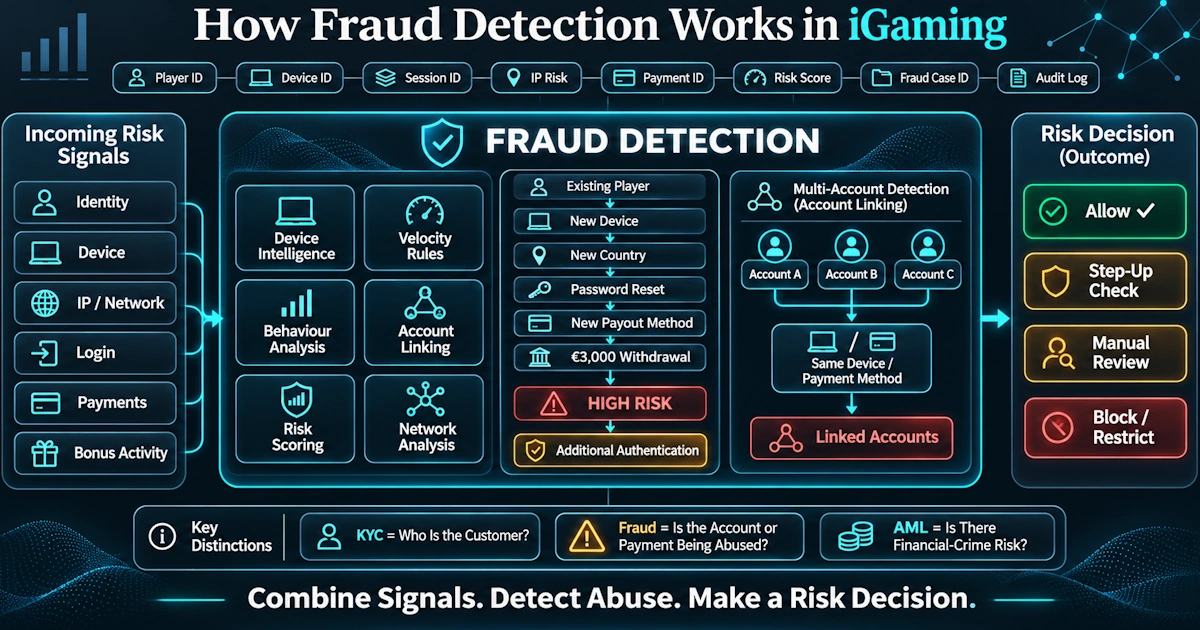
Fraud detection in iGaming is the use of technology, data and risk rules to identify potentially fraudulent activity across an online casino platform.
Fraud can appear at almost any stage of the player lifecycle. It can begin during registration through a false identity, appear during a deposit through a stolen payment method, emerge after login through account takeover, or involve several accounts created to exploit a promotion.
A modern fraud-detection system can therefore analyse signals from:
Identity
Devices
Network Connections
Player Accounts
Payments
Bonuses
Login Behaviour
Gaming Activity
The system combines those signals to calculate risk and decide whether the activity should be: Allowed Challenged Reviewed or: Blocked
The key principle is that fraud detection should not rely on one isolated signal. A shared device, unusual login or new payment method can have a legitimate explanation.
Strong fraud detection looks at the combination of signals and the context in which they appear.
What Is iGaming Fraud?
iGaming fraud broadly means attempts to abuse a gambling platform, player account, payment system or promotional programme for illegitimate financial or operational gain.
Common forms can include:
Identity Fraud Using stolen, altered or fabricated identity information.
Multi-Accounting Creating or controlling several accounts to bypass restrictions or obtain benefits intended for one customer.
Bonus Abuse Manipulating promotional rules to obtain rewards improperly.
Account Takeover Gaining unauthorised access to an existing player’s account.
Payment Fraud Using stolen or unauthorised payment credentials.
Chargeback Abuse Disputing legitimate payments after receiving the associated gambling value.
Collusion Several participants coordinating to gain an unfair advantage, particularly in peer-to-peer environments.
Bot or Automated Abuse Using scripts or automated clients to exploit platform processes.
Different fraud types require different evidence. A system designed to detect stolen cards will not automatically detect a coordinated multi-account bonus ring.
Why Is Fraud Detection Important in Online Gambling?
Online casinos combine several characteristics that make fraud controls important.
Players can:
register remotely
move money digitally
claim promotional value
maintain financial balances
withdraw funds without appearing physically at a casino.
A fraudster can also attempt to create many accounts or automate activity at scale.
Current British regulatory risk material highlights false and stolen identity documents, mule accounts, linked or duplicate accounts, multiple payment methods and increasingly sophisticated attempts to bypass verification using AI-generated documents, deepfake video and face swaps.
Fraud detection therefore needs to operate across the entire customer lifecycle rather than only at registration.
Fraud Detection vs Fraud Prevention
The terms are closely related.
Fraud Detection Asks: Does this activity appear risky or fraudulent?
Fraud Prevention Asks: What should we do about that risk?
For example: Detection identifies: New Device + Unusual Country + Large Withdrawal
Then prevention may respond with: Require Additional Authentication or: Send to Manual Review
Detection supplies the risk information. Prevention applies the control. In practice, commercial fraud platforms often perform both.
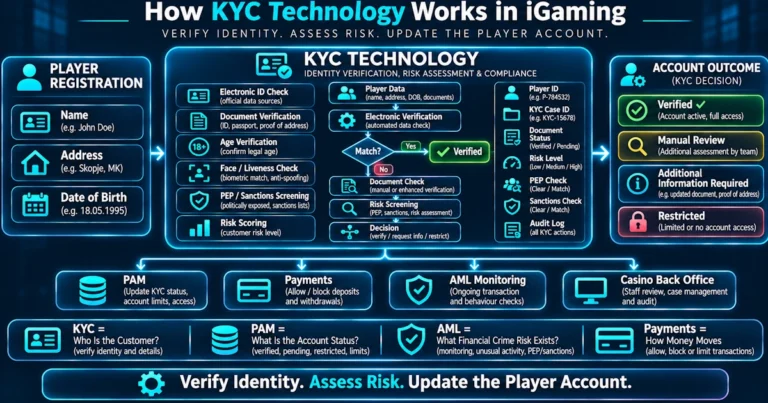
Fraud Detection vs KYC
KYC technology and fraud detection also overlap but are not identical.
KYC Primarily asks: Who is the customer?
It can verify: Name Address Date of Birth Identity Document
Fraud Detection Asks: Is this account or interaction being abused?
A player can pass KYC successfully and later have their account stolen. That creates: Valid Identity but: Fraudulent Session
Conversely, someone may attempt to create a new account using stolen identity information. In that case KYC and fraud technology work together.
A simple distinction is: KYC = Identity Verification Fraud Detection = Abuse Detection
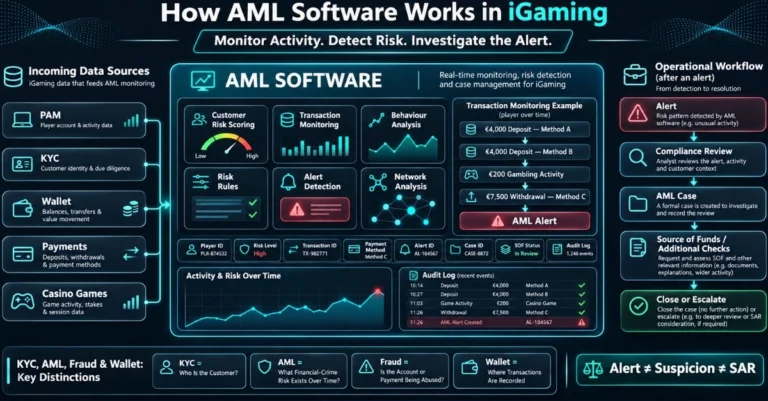
Fraud Detection vs AML Software
Fraud detection and AML software also share data, but their primary objectives differ.
Fraud Detection Often focuses on:
stolen accounts
stolen payments
bonus abuse
multi-accounting
platform manipulation
AML Software Primarily focuses on:
money laundering
terrorist financing
suspicious financial activity
An event can be relevant to both. For example: Player uses payment instruments belonging to several different people could indicate: Payment Fraud and also create: AML Risk
The strongest architecture therefore allows fraud and AML systems to exchange relevant signals.
Where Does Fraud Detection Sit in the iGaming Stack?
A simplified architecture can look like: Player ↓ Casino Website / App ↓ PAM / Casino Platform ↓ FRAUD DETECTION ↙ ↓ ↘ Identity Signals — Device / Network Signals — Payment Signals ↓ Risk Decision ↓ Allow / Challenge / Review / Block
The fraud engine may also receive data from: KYC Wallet Payment Orchestration Bonus Engine Casino Games AML Software
Fraud detection is therefore usually a cross-platform capability rather than one isolated screen.
At What Stages Can Fraud Be Detected?
Fraud controls can operate throughout the customer journey.
A typical lifecycle includes: Registration ↓ KYC ↓ Login ↓ Deposit ↓ Bonus Claim ↓ Gameplay ↓ Withdrawal
Different signals become useful at different stages. For example:
Registration may focus on identity, device reuse and account relationships.
Login may focus on account takeover.
Deposit may focus on payment fraud.
Bonus Claim may focus on multi-accounting.
Withdrawal may focus on account compromise, payment ownership and suspicious changes.
This is why fraud detection should not stop after onboarding.
Fraud Detection at Registration
Registration is the earliest opportunity to identify suspicious activity.
The system may examine signals such as:
Device
IP Address
Email
Phone Number
Address
Identity Data
Existing Account Relationships
Suppose a new account uses: a device already connected to 15 previous accounts. That may justify additional review.
But: shared device ≠ fraud
A household, public network or shared computer can have a legitimate explanation. The strongest decision therefore combines several signals.
Why Is Identity Verification Important for Fraud Detection?
Identity verification makes it harder to create accounts using:
False Identity
Stolen Identity
Altered Documents
Synthetic Identity
The UK Gambling Commission reiterated in August 2026 that effective remote identity verification supports fraud reduction as well as age, self-exclusion and AML controls, and that basic identity information must relate to the same individual.
Fraud technology can then add extra signals around that verified identity. For example: Identity Verified but: same device used for many unrelated identities may still require investigation.
What Is Identity Fraud?
Identity fraud occurs when someone uses false or stolen identity information.
Examples include:
Stolen Passport
Altered Identity Document
Fabricated Identity
Another Person’s Details
Modern fraudsters can also use AI-generated or altered material to try to defeat verification systems.
The UK Gambling Commission’s 2026 risk assessment specifically reports increased scale and sophistication in attempts involving false documentation, deepfake videos and face swaps. This makes identity verification and fraud detection increasingly interconnected.
What Is Synthetic Identity Fraud?
A synthetic identity combines real and fabricated information to create an apparently genuine person.
For example: Real Address combined with: False Name and: Manipulated Document
The exact techniques vary. Synthetic identity detection can therefore require several signals rather than one document check.
A fraud engine may compare: Identity Digital Footprint Device Payment Ownership and: Account Behaviour for inconsistencies.
What Is Multi-Accounting?
Multi-accounting occurs when one person or coordinated group creates or controls several player accounts in circumstances where the operator’s rules or regulatory controls require them to be linked or restricted.
Motives can include:
Repeated Welcome Bonuses
Avoiding Account Restrictions
Circumventing Limits
Returning After Account Action
The UK Gambling Commission currently requires relevant remote licensees to maintain policies and procedures designed to identify separate accounts held by the same individual.
Multi-account detection is therefore not only a promotional issue. It can also affect regulatory controls such as self-exclusion.
How Can Multi-Accounting Be Detected?
No single indicator is sufficient.
The system can look for relationships involving:
Same Device
Same Payment Method
Same Address
Similar Identity Information
Same Network
Similar Behaviour
For example: Account A → Device X Account B → Device X Account C → Payment Method Y Account D → Payment Method Y
Network analysis may reveal that these accounts form a connected cluster. The operator then needs to determine whether the relationship is legitimate.
What Is Device Fingerprinting?
Device fingerprinting creates a technical profile of a device or browser.
Signals may include characteristics relating to:
Browser
Operating System
Hardware
Screen
Device Configuration
The system can then recognise that the same or highly similar device has interacted with several accounts.
A simplified example is: Device 9281 ↓ Player A Player B Player C
This can be useful for detecting multi-accounting. But device fingerprinting should be treated as a risk signal rather than indisputable proof of identity.
Can Fraudsters Hide Their Devices?
They can try.
Techniques can involve:
Browser Manipulation
Virtual Machines
Emulators
Device Resetting
Anti-Fingerprinting Tools
Fraud technology therefore often combines device intelligence with: network identity payment and: behavioural signals.
Relying entirely on one device identifier creates an obvious weakness.
What Is IP Address Analysis?
An IP address provides information about the network connection used during an interaction.
Fraud systems can examine:
IP Address
Network Provider
Approximate Location
Previous Account Connections
If dozens of apparently unrelated accounts repeatedly use the same network, the relationship may warrant review.
However: same IP ≠ same person
For example: Hotel Wi-Fi University Network Office Network can involve many legitimate users. Context is essential.
What Are VPN and Proxy Signals?
VPNs and proxies can obscure the network route used by a customer. There can be legitimate privacy reasons for using them.
They can also be used to:
hide account relationships
alter apparent location
or: circumvent platform controls.
The UK Gambling Commission’s risk guidance identifies shared IP addresses, dormant accounts and VPN connections among factors that can be relevant when assessing fraud and remote-gambling risk.
A VPN flag alone should therefore not automatically mean: Fraud Confirmed. It is one signal.
What Is Geolocation Fraud Detection?
Geolocation technology evaluates whether the user appears to be physically located where the platform expects them to be.
This can be particularly important where gambling is restricted by jurisdiction.
A fraud system might compare: Declared Country with: IP Location Device Location and other network signals.
For example: Declared: Market A but: Device repeatedly appears in Market B could require investigation.
Geolocation and identity are different controls. A player can be: correctly identified while: located somewhere they are not permitted to gamble.
What Is Email Intelligence?
Email addresses can provide risk signals.
A fraud system might consider: Is the address newly created? Has it appeared in previous fraud cases? Does the format resemble other connected accounts?
For example: player001@example player002@example player003@example combined with the same device and payment method may be more significant than the email pattern alone.
An unusual email address is not proof of fraud.
What Is Phone Intelligence?
Phone numbers can also provide signals.
The system may examine:
Country Code
Carrier Information
Number Type
Account History
For example, dozens of accounts using numbers linked to the same suspicious pattern can increase risk.
Again: Phone Signal + Device Signal + Payment Signal is generally stronger than any one indicator.
What Is Account Takeover?
Account takeover, or ATO, occurs when an unauthorised person gains control of a legitimate player’s account.
This can happen through methods such as:
Stolen Passwords
Phishing
Credential Stuffing
Compromised Email
Session Theft
The attacker may then attempt to: change account details access stored funds or: request a withdrawal.
A player who passed every KYC check months earlier can still become an ATO victim today.
How Can Account Takeover Be Detected?
A fraud engine can compare current activity with historical account behaviour.
Possible signals include:
New Device
New Location
Unusual Login Time
Repeated Failed Authentication
Password Reset
Email Change
Payment Change
Immediate Withdrawal Attempt
For example: Known Account ↓ New Device ↓ Password Reset ↓ Payout Method Changed ↓ Large Withdrawal
This combination is much stronger than: New Device Alone
What Is Credential Stuffing?
Credential stuffing occurs when attackers try username and password combinations obtained from other compromised services.
The attacker hopes that a customer reused the same credentials on the gambling site.
A system can look for:
Large Volumes of Failed Logins
Many Accounts From One Source
Automated Login Patterns
Sudden Successful Login After Repeated Failures
Authentication controls and fraud detection need to work together here.
UKGC security requirements for critical remote-gambling systems include secure authentication, information-access restrictions, privileged access, logging and other security controls based on selected ISO/IEC 27001:2022 controls.
Does MFA Help Prevent Account Takeover?
Multi-factor authentication can make stolen passwords less useful.
For example: Password plus: Additional Authentication Factor
However, MFA does not make fraud impossible. Attackers may attempt:
phishing
social engineering
or: session compromise.
Fraud detection can therefore continue monitoring activity even after successful authentication.
Authentication asks: Can this user prove access?
Fraud detection asks: Does this interaction make sense for this account?
What Is Behavioural Fraud Detection?
Behavioural fraud detection examines how a customer interacts with the service.
Signals can include changes in:
navigation
login behaviour
transaction pattern
session behaviour
For example, an established player might normally: log in from one country play several games withdraw occasionally
Then suddenly: new country new device no gameplay large withdrawal
The change in behaviour can increase risk.
What Are Behavioural Biometrics?
Behavioural biometrics analyse interaction patterns such as:
typing rhythm
mouse movement
touch behaviour or other interaction characteristics.
The idea is to identify whether the current user behaves differently from the legitimate account holder or from normal human activity.
These signals can help with: account takeover and: automation detection.
They should be treated as probabilistic signals, not perfect identity proof.
What Is Payment Fraud?
Payment fraud occurs when payment instruments are used improperly.
Examples can include:
Stolen Debit Card
Compromised Payment Account
Unauthorised Funding
False Payment Identity
The gambling account may receive value before the true payment owner notices the transaction.
Fraud controls can compare: Player Identity with: Payment Ownership and monitor: Deposit Behaviour Failed Transactions Payment Changes
The UK Gambling Commission has previously highlighted stolen debit cards, inability to match customer and card details and multiple bank accounts as risk indicators relevant to remote gambling.
What Is Third-Party Payment Fraud?
Suppose: Player Account = Person A but: Card Holder = Person B
This mismatch may require investigation. There can be legitimate circumstances depending on market and payment rules.
But third-party payment instruments can also be linked to:
stolen credentials
fraud
money laundering
Fraud detection therefore needs information from both: KYC and: Payments.
What Is Deposit Fraud?
Deposit fraud can involve attempts to fund a casino account using:
stolen payment credentials
unauthorised payment accounts
or manipulated payment processes.
The fraud engine may assess:
Payment Method
Payment Owner
Device
Deposit Velocity
Previous Chargebacks
Account Age
For example: Brand-New Account New Device Several Failed Cards One Successful High-Value Deposit may justify stronger review.
What Is a Chargeback?
A chargeback is a payment reversal initiated through the card-payment dispute process.
There are many legitimate reasons for chargebacks. A customer may genuinely report: unauthorised transaction
A fraudster may also attempt: friendly fraud where a genuine transaction is later disputed improperly.
Operators therefore need payment and account evidence to investigate disputes accurately. A chargeback should not automatically be classified as customer fraud.
What Is Chargeback Abuse?
Chargeback abuse can occur when someone knowingly makes a legitimate deposit, uses the gambling value and later falsely disputes the original payment.
A fraud system can examine:
Account Login
Device
KYC Status
Deposit
Gameplay
Withdrawal
Previous Disputes
This evidence can help payment teams understand the transaction history.
What Is Deposit Velocity?
Velocity measures how frequently events occur over time.
For example: 1 deposit in one hour is very different from: 20 card attempts in one minute.
A fraud rule could examine: Number of Payment Attempts within: 10 Minutes
Rapid repeated activity may indicate:
automation
card testing
or another form of abuse.
But velocity rules need careful tuning because legitimate users can also retry failed payments.
What Is Card Testing?
Card testing occurs when fraudsters make small or repeated payment attempts to determine whether stolen card credentials are still valid.
A pattern might involve:
many cards
small amounts
short time window
Fraud detection can look for:
high payment-method velocity
many declines
device reuse
account clusters
This is different from ordinary player frustration after one failed deposit.
What Is Bonus Abuse?
Bonus abuse means exploiting promotional offers outside their intended conditions.
A simple example is: One welcome bonus per customer but one person creates: 10 accounts to receive the offer 10 times.
Fraud systems can help detect relationships across those accounts.
Signals can include:
Shared Devices
Shared Payment Methods
Related Identities
Similar Signup Timing
Similar Gameplay Patterns
The casino bonus engine applies the promotional rules. The fraud engine looks for attempts to manipulate those rules.
Bonus Engine vs Fraud Detection
These systems perform different functions.
Bonus Engine Asks: Does this account satisfy the configured promotion rules?
Fraud Detection Asks: Does the wider evidence suggest that this customer is abusing those rules?
For example, each of five accounts might individually satisfy: New Customer = Yes
The bonus engine sees five valid-looking accounts. Fraud detection may discover: all five use the same device and payment instrument.
This is why bonus abuse cannot always be solved entirely inside the bonus engine.
What Is a Bonus Farm?
A bonus farm is a coordinated operation creating or controlling many accounts to repeatedly extract promotional value.
The accounts may attempt to appear independent by using:
different emails
different identities
different networks
Fraud detection can use graph or network analysis to find hidden relationships.
For example: 50 Accounts ↓ connected through: 5 Devices 3 Payment Methods Repeated Behaviour
This cluster can be more revealing than analysing each account separately.
What Is Link Analysis?
Link analysis identifies relationships between accounts and other entities.
A graph might contain: Player Device Payment Method Address Email IP
For example: Player A → Device 7 Player B → Device 7 Player B → Payment X Player C → Payment X
The system can then see: A, B and C may be related even though A and C share no direct identifier.
This is useful for detecting coordinated fraud.
What Is Graph-Based Fraud Detection?
Graph-based detection models the ecosystem as connected entities.
Instead of asking only: Is Player A suspicious?
it asks: Who and what is Player A connected to?
This can reveal:
account farms
shared payment networks
coordinated activity
Graph analysis can be especially useful where fraudsters deliberately change individual identifiers but continue sharing infrastructure.
What Is Collusion?
Collusion occurs when players coordinate in ways that create an unfair advantage over other participants.
It is particularly relevant to: peer-to-peer games such as poker.
Possible indicators can include:
Repeatedly Sharing Tables
Unusual Transfer of Value
Suspicious Patterns of Play
Coordinated Actions
The current UKGC technical standard for peer-to-peer gaming requires measures intended to deter, prevent and detect collusion and cheating, including retention of relevant activity records to support investigations.
What Is Chip Dumping?
Chip dumping is a form of coordinated behaviour where one player intentionally transfers value to another through gameplay.
For example, one participant may deliberately lose to another. The transaction can look like ordinary gaming activity if the system examines only: win and: loss.
Detection may therefore require:
player relationships
repeated table interaction
unusual betting behaviour
game statistics
This is one example of fraud detection overlapping with game integrity.
What Is Bot Detection?
Bots are automated programs that interact with the gambling platform. The relevance depends heavily on the product.
Possible signals include:
unhumanly regular timing
extreme interaction speed
repetitive behaviour
automation tools
A fraud or integrity system may compare the activity against normal human behaviour. Not every automated process is fraud.
The operator needs to distinguish prohibited automation from legitimate platform integrations.
What Is Account Sharing?
Account sharing occurs when someone other than the registered customer uses the account.
This can create problems involving:
identity
age verification
self-exclusion
responsible gambling
fraud
A fraud engine may notice: rapid device changes large geographic changes behaviour incompatible with previous sessions
These indicators can justify additional authentication or review.
What Is Risk Scoring?
A fraud engine can combine signals into a risk score.
For example: New Device +10 Proxy +15 Payment Mismatch +40 Linked Fraud Account +50
The result might be: Risk Score: 82
The operator can then configure: 0–30 → Allow 31–70 → Review or Challenge 71–100 → Higher-Risk Action
This is only an illustration. Real scoring models vary substantially.
The key is that several pieces of evidence can contribute to one decision.
What Is Rules-Based Fraud Detection?
Rules-based fraud detection uses explicit conditions.
For example: IF New Account AND: More Than Five Payment Attempts in Ten Minutes THEN: Review
Rules have several advantages. They are: clear auditable and: easy to explain.
But fraudsters can adapt to predictable rules. A system relying only on fixed thresholds may therefore miss more complex patterns.
What Is Machine-Learning Fraud Detection?
Machine-learning models analyse large numbers of historical signals to identify patterns associated with fraudulent behaviour.
They can potentially evaluate relationships too complex for simple rules.
For example: Device Account Age Login Pattern Payment Behaviour Network Bonus History may all influence one score.
Models can adapt more effectively to complex fraud. But they also require careful: training testing monitoring and: explanation.
Rules vs Machine Learning
The strongest fraud stack often combines both.
Rules Useful for: Known Restrictions Clear Business Logic Hard Controls
Machine Learning Useful for: Complex Patterns Anomaly Detection Large Signal Sets
For example: Known Stolen Payment Method may justify a clear rule.
A subtle account-takeover pattern may benefit from behavioural modelling. One approach does not completely replace the other.
How Is AI Used in Fraud Detection?
AI can assist with areas such as:
Identity Fraud Detection
Deepfake Detection
Behavioural Analysis
Network Analysis
Risk Scoring
Anomaly Detection
AI can process more signals than a human analyst can realistically review in real time. But AI creates its own governance questions.
Operators need to understand: Which data affects the decision? Can the model be overridden? How are errors measured? How are false positives handled?
Meanwhile, regulators are also seeing AI used on the attacking side, particularly for fabricated identity documents, deepfakes and face swaps.
What Is Real-Time Fraud Detection?
Real-time fraud detection evaluates activity while it is happening.
For example: Player Requests €2,000 Withdrawal ↓ Fraud Engine Checks: Device Session Payment Method Account History ↓ Risk Decision ↓ Allow / Challenge / Review
The decision can happen before money leaves. This is particularly valuable at: Login Deposit Bonus Claim Withdrawal where acting several hours later may be too late.
Does Every Fraud Check Need to Be Real Time?
No. Some controls need immediate decisions. Others can run later.
Real-Time Useful for: Login Risk Payment Risk Bonus Claim Withdrawal
Batch Analysis Useful for: Account Networks Historical Pattern Review Fraud Trend Analysis
A mature fraud system can use both.
What Is Step-Up Authentication?
Step-up authentication adds an extra verification step when risk increases.
For example: Normal Login ↓ Low Risk ↓ Continue
But: New Device + New Country + Withdrawal ↓ High Risk ↓ Additional Authentication
This can reduce fraud while avoiding unnecessary friction for every legitimate session.
The objective is: more friction when risk is higher rather than: maximum friction for everyone.
What Is Risk-Based Authentication?
Risk-based authentication decides how much authentication is necessary based on the current interaction.
A familiar device might receive: normal login flow
An unusual session might require: additional factor
The system can consider:
Device
Network
Location
Behaviour
Account History
This approach connects fraud detection directly with account security.
What Is a Fraud Decision Engine?
A decision engine converts fraud signals into actions.
For example: Risk Score 12 ↓ ALLOW
Risk Score 55 ↓ CHALLENGE
Risk Score 78 ↓ MANUAL REVIEW
Confirmed Stolen Payment Method ↓ BLOCK
The exact policy belongs to the operator. The fraud vendor supplies data and technology. The operator decides how different risk levels affect the customer journey.
What Is Manual Review?
Automated systems cannot confidently resolve every case. A transaction may therefore be sent to: Manual Review
A fraud analyst can examine: Player History KYC Devices Payment Methods Linked Accounts Login Activity and then decide whether the activity appears legitimate.
Manual review is particularly useful in ambiguous cases.
Why Not Automatically Block Every Suspicious Player?
Because fraud systems make mistakes.
Consider: three accounts from one IP
That could be: one fraudster or: three family members using the same home internet.
Automatically blocking every shared network could harm legitimate customers.
A better architecture may combine: Shared IP with: Shared Device Shared Payment Method and: Identical Behaviour before taking stronger action.
What Is a False Positive?
A false positive occurs when legitimate activity is incorrectly classified as fraud.
Examples might include:
travelling player using new device
family members sharing internet
legitimate customer changing bank
Excessive false positives can cause: blocked deposits delayed withdrawals customer complaints manual workload
The goal is therefore not: detect everything by blocking everything.
It is: detect fraud while allowing legitimate players to continue.
What Is a False Negative?
A false negative occurs when actual fraudulent activity is incorrectly treated as legitimate.
For example: Account Takeover passes every control and: withdrawal succeeds.
Fraud systems therefore balance two types of error: False Positives and: False Negatives
Making rules stricter may reduce one while increasing the other.
What Is Fraud Model Tuning?
Tuning adjusts fraud rules or models according to actual performance.
Suppose a rule: New Device = Review creates thousands of unnecessary manual cases.
The operator might improve it to: New Device plus: New Country plus: High-Value Withdrawal
Fraud rules should therefore evolve as the operator learns which signals produce useful decisions.
What Is Velocity Checking?
Velocity checking counts how often an event occurs within a time period.
Examples include:
Account Registrations per Device
Login Attempts per Minute
Cards Used per Account
Bonus Claims per Address
Velocity can expose automation and fraud at scale. A single event may look normal.
100 similar events in five minutes may not.
What Is Anomaly Detection?
Anomaly detection asks: Is this activity significantly different from normal behaviour?
For example: A player usually: logs in from Skopje deposits €50
Then suddenly: new continent new device €3,000 withdrawal request
The individual elements might each be possible. Together, the pattern is unusual. The system can flag it for additional checking.
What Is Fraud Network Detection?
Fraudsters often operate as groups rather than isolated accounts.
The system may therefore look for networks involving: Accounts Devices Payment Methods Addresses Emails IP Ranges
A network might show: 30 players connected to: two payment methods and: three devices.
This can reveal organised abuse that account-by-account rules would miss.
What Is a Fraud Case?
A fraud case groups related evidence into one investigation.
For example: Case ID: FRAUD-4821 Accounts: 8 Devices: 2 Payment Methods: 3 Reason: Suspected Bonus Ring Status: Investigation
An analyst can then record: Evidence Notes Decision Action
Case management becomes particularly important when many accounts are connected.
What Is Fraud Case Management?
A typical workflow can look like: Alert ↓ Analyst Review ↓ Evidence Collection ↓ Decision ↓ Allow / Restrict / Close Account / Escalate
The precise action depends on: evidence terms regulation internal policy.
The system should record how the decision was reached.
Why Are Audit Logs Important?
Suppose an account is blocked for suspected fraud. The operator should be able to establish:
Which signal triggered the case?
Who reviewed it?
Which evidence was considered?
Who applied the restriction?
When?
This supports: customer disputes internal review compliance security investigations
Fraud decisions should not disappear into an untraceable black box.
How Does Fraud Detection Connect to PAM?
The PAM system manages player-account state. The fraud system generates risk decisions.
For example: Fraud Engine → High Risk ↓ PAM → Withdrawal Temporarily Restricted
or: Fraud Engine → Confirmed Linked Account ↓ PAM → Account Action
The PAM remains responsible for implementing the relevant account state. The fraud engine provides the risk information.
How Does Fraud Detection Connect to KYC?
KYC can provide information such as: Identity Verified Document ID Age
The fraud system may then compare identities across several accounts.
For example: Same Document appears on: Account A and: Account B That creates a strong relationship.
Another example: KYC Name does not match: Payment Owner
The fraud system can use that inconsistency as a risk signal.
How Does Fraud Detection Connect to Payments?
Payments provide some of the most valuable fraud signals.
These can include:
Payment Method
Account Holder
Deposit Result
Decline Reason
Chargeback
Payout Destination
For example: One card used across 10 unrelated player accounts may require investigation.
The payment platform processes the transaction. The fraud engine evaluates its risk context.
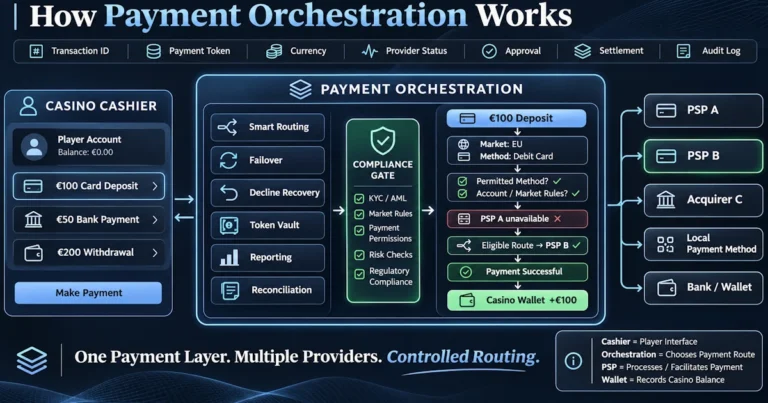
Fraud Detection and Payment Orchestration
Payment orchestration decides: Which payment route should be used?
Fraud detection asks: Should this payment be allowed to proceed at all, or should extra controls apply?
A simplified flow could be: Deposit Request ↓ Fraud Check ↓ Approved ↓ Payment Orchestration ↓ PSP
Depending on architecture, fraud checks can also occur after routing data becomes available. The two layers need coordinated rules.
How Does Fraud Detection Connect to the Bonus Engine?
The bonus engine can tell the fraud system: Bonus Claimed Campaign ID Reward Amount
Fraud detection can then examine: How many related accounts claimed this campaign?
For example: Campaign 100 ↓ 50 New Accounts ↓ Same Device Cluster ↓ Fraud Review
This makes promotion abuse easier to identify across accounts.
How Does Fraud Detection Connect to AML?
Fraud systems can send useful signals to AML monitoring.
For example:
Stolen Identity Suspected
Payment Ownership Mismatch
Linked Accounts
Mule Behaviour
Conversely, AML investigations may reveal information useful to the fraud team. The systems should exchange relevant information without becoming one undifferentiated risk engine.
A clear division helps teams understand: why an account was flagged and: which process owns the investigation.
How Does Fraud Detection Connect to Responsible Gambling?
Some signals can be relevant to several risk functions.
For example: multiple accounts could indicate: bonus abuse but also: attempt to bypass self-exclusion.
Great Britain requires relevant remote operators to identify separate accounts held by the same individual so that controls such as self-exclusion can be applied correctly across those accounts.
This is another reason account-linking technology should not be owned only by the promotions team.
Can Fraud Detection Find Self-Excluded Players Returning?
It can help.
Suppose a self-excluded customer creates: New Email but uses: same identity same device or: same payment instrument.
Account-linking technology can identify the relationship. Identity verification remains critical. Fraud-style device and network signals can provide additional evidence.
What About Collusion and Cheating?
Fraud detection can extend beyond payments and accounts into game integrity.
For peer-to-peer games, suspicious behaviour can include:
Repeated Same-Table Activity
Unusual Transfers of Value
Coordinated Betting
Abnormal Gameplay Statistics
UKGC RTS 11 specifically requires measures intended to deter, prevent and detect collusion and cheating, with relevant records retained to support investigation. Game-integrity monitoring may therefore be part of the broader anti-fraud architecture.
Fraud Detection vs Game Integrity
These areas overlap.
Fraud Detection Can focus on: Identity Payments Accounts Promotions
Game Integrity Can focus on: Collusion Bots Cheating Game Manipulation
The same operator may use separate specialist tools. Both can feed into a central risk or case-management environment.
What Is Fraud Risk at Withdrawal?
Casino withdrawals are a particularly important fraud checkpoint.
Suppose: Account KYC Passed months ago.
Then today: New Device ↓ Password Changed ↓ Payout Method Added ↓ €4,000 Withdrawal Requested
That sequence can indicate account takeover. A strong fraud system therefore does not assume: Verified account = permanently trusted session.
Risk needs to be evaluated continuously.
Why Does Withdrawal Destination Matter?
The payout destination can be compared with:
player identity
deposit history
previous withdrawal methods
A sudden change can be legitimate. It can also indicate:
account takeover
third-party control
or another risk.
The fraud engine may therefore request: additional authentication or: manual review before money leaves.
What Is Fraud Detection at Login?
Login fraud detection can examine:
Device Familiarity
IP
Location
Failed Attempts
Session Behaviour
Password Reset
For low-risk sessions: Login continues normally
For higher-risk sessions: Step-Up Authentication may apply.
This lets the operator avoid treating every login as equally risky.
Fraud Detection at Bonus Claim
A bonus claim provides another decision point.
The system might evaluate: How many accounts are linked to this device? Has this payment instrument claimed the promotion before? Is the account connected to previously confirmed abuse?
The result could be: Bonus Allowed Bonus Held for Review or another operator-defined action.
The player account itself may remain valid even if one promotion requires investigation.
Fraud Detection at Deposit
A deposit fraud check can examine:
Player Identity
Payment Owner
Device
Amount
Velocity
Previous Payment Results
Chargeback History
A high-risk deposit may require: additional authentication different payment treatment or: manual review.
The exact response should match the identified risk.
Fraud Detection at Gameplay
Gameplay monitoring can detect certain types of abuse. Examples include: Bots Collusion Highly Coordinated Accounts Unusual Technical Patterns
However, normal gambling outcomes should not automatically be treated as fraud signals. A player winning frequently is not proof of cheating.
The fraud model needs evidence of: rule abuse or: abnormal interaction rather than: the player won money.
Can a Big Win Trigger Fraud Detection?
A large win may justify routine security or account checks depending on the operator’s controls.
But: Large Win ≠ Fraud
Fraud detection should focus on evidence such as: account compromise identity inconsistency payment abuse game manipulation rather than punishing a player simply because they were successful.
This is an important distinction in fair platform design.
Can Fraud Detection Be Fully Automated?
Some decisions can be automated.
For example: Known Compromised Credential or: Impossible Technical Request may justify immediate controls.
Other cases are ambiguous.
For example: Shared Device + Same Address could represent: fraud or: family members.
The strongest architecture therefore combines: Automation with: Manual Review for uncertain cases.
What Is a Fraud Decision Matrix?
A decision matrix maps risk to action.
For example: Risk | Possible Action Low | Allow Medium | Additional Check High | Manual Review Confirmed Known Fraud | Restrict / Block According to Policy
The exact actions should be based on operator policy. A numerical score alone should not determine every customer outcome.
Why Does Fraud Detection Need Explainability?
Suppose the system blocks a €500 withdrawal. The fraud team should be able to see why.
For example: New Device Password Changed 8 Minutes Ago Payout Destination Newly Added Linked to Previous Fraud Case
This allows the analyst to investigate properly. A system that only returns: Risk = 97 without meaningful supporting information can be difficult to govern.
What Is Fraud Model Governance?
Model governance defines how automated risk logic is controlled.
Questions include: Who can change rules? Who approves new models? How are false positives measured? How are changes tested? Can staff override decisions? Are overrides logged?
Fraud technology directly affects legitimate customer access and money. Its decision process therefore needs governance.
Why Are Role-Based Permissions Important?
Not every employee should be able to: change fraud thresholds or: unblock restricted accounts.
Different roles might include: Fraud Analyst Senior Risk Manager Payments Team System Administrator
The platform can limit each role to appropriate functions. This reduces: mistakes insider risk and: unauthorised overrides.
What Is a Fraud Watchlist?
A watchlist stores identifiers associated with previously identified risk.
Examples might include: Device Payment Instrument Email Phone Account
Future activity can be compared with these records.
For example: New Account ↓ Device Matches Confirmed Fraud Case ↓ Higher Risk Score
A watchlist should be managed carefully. Incorrectly adding legitimate identifiers can create repeated false positives.
What Is Negative Data Sharing?
Some fraud systems use information about previous fraudulent activity across a network of clients.
This can potentially identify: device previously linked to fraud or: identity previously abused before the fraud reaches another operator.
However, shared fraud intelligence raises important questions around: data accuracy privacy legal basis false matches
Operators should understand what information is shared and how corrections are handled.
What Is Fraud Data Retention?
Fraud systems may retain: Device Histories Risk Decisions Case Records Payment Signals Account Relationships
Retention should be governed by: regulation privacy obligations legitimate operational need
Keeping everything forever simply because it may be useful is not necessarily appropriate. Fraud detection needs data governance as well as technical capability.
Why Is Security Important for Fraud Systems?
Fraud infrastructure itself becomes a valuable target.
It may contain: identity information device intelligence account relationships payment data security decisions
If an attacker can manipulate the fraud engine, they may attempt to: whitelist accounts change rules or: access sensitive data.
UKGC security standards apply to critical remote systems handling sensitive customer and authentication information and account balances, with controls covering areas including authentication, access restrictions, logging, cryptography and secure system design.
Why Are APIs Important?
Fraud engines need data from many systems.
APIs or event streams may send: PlayerRegistered LoginAttempt DepositAttempt BonusClaimed WithdrawalRequested
The fraud engine then responds with: Allow Challenge Review or another defined status.
The integration needs to be fast enough for the relevant customer flow.
What Happens if the Fraud Engine Is Slow?
Suppose every deposit waits: 10 seconds for the fraud decision.
Legitimate players will notice. Operators therefore need to balance: risk analysis with: transaction latency.
Different actions can use different strategies.
For example: Login may require a very fast inline decision.
A broader fraud-network investigation can run asynchronously after the session event has been recorded.
What Happens if the Fraud System Goes Offline?
The operator needs a defined fallback policy.
Possible approaches could include: Fail Closed Risk-sensitive activity is stopped.
or: Fail Open Certain low-risk activity continues.
or: Degraded Mode Only predefined actions remain available.
The correct approach depends on: transaction type risk regulation and: business continuity design.
An outage should not leave teams wondering what the casino is currently allowing.
Why Should Fraud Events Be Logged?
A fraud event record could contain: Player ID Session ID Device ID Rule Risk Score Decision Timestamp
This allows teams to reconstruct what happened later.
For example: 18:02 Login Allowed 18:04 Payment Risk Increased 18:06 Withdrawal Challenged
Without reliable event history, fraud investigation becomes much harder.
What Is Fraud Analytics?
Fraud analytics looks beyond individual cases to identify broader trends.
For example: Fraud by Country Fraud by Payment Method Fraud by Campaign Fraud by Device Type Account Takeover Rate Chargeback Rate Manual Review Rate
This can help the operator improve controls.
For example: Campaign A may attract far more multi-account abuse than: Campaign B.
That information can feed back into bonus design.
What Metrics Matter?
Useful metrics can include: Fraud Detection Rate False Positive Rate Manual Review Rate Account Takeover Rate Chargeback Rate Bonus Abuse Rate Decision Latency Fraud Loss Fraud Prevented
Metrics need clear definitions. For example: fraud prevented should not simply equal the value of every transaction the system blocked. Some blocked transactions would have been legitimate.
Why Is False Positive Rate Important?
Imagine the system blocks: 1,000 withdrawals but only: 10 are genuinely fraudulent.
That means large numbers of legitimate customers experienced unnecessary friction.
A fraud programme should therefore measure both: fraud captured and: legitimate customers affected.
The goal is not the maximum possible block rate. It is better decision quality.
What Is Manual Review Rate?
Manual review rate measures how much activity needs human intervention.
For example: 100,000 transactions ↓ 5,000 Manual Reviews Rate: 5%
Reducing this can improve operating efficiency. But a very low review rate is not automatically positive if high-risk cases are being approved without sufficient scrutiny.
Why Should Fraud Detection Be Layered?
No single control detects every type of fraud.
A stronger architecture combines: Identity Verification Device Intelligence Network Analysis Authentication Payment Risk Behaviour Analysis Account Linking Transaction Monitoring
For example: A fraudster might defeat: IP detection using a proxy.
But they may still reuse: Device or: Payment Instrument or: Identity Pattern.
Layered controls make fraud harder to scale.
Great Britain: Linked and Duplicate Accounts
The UK Gambling Commission’s current 2026 remote-casino risk assessment identifies inadequate controls around linked or duplicate accounts as a high-risk operator-control issue.
It also provides case examples involving customers creating several accounts using different identities and customers circumventing earlier account controls by making small changes to registration information.
This is particularly relevant to fraud detection because simple checks such as: Exact Email Match are not enough.
Systems may need to recognise: near matches account relationships and: reused infrastructure.
Great Britain: Identity Verification and Fraud
UKGC guidance emphasises that remote identity verification supports several objectives simultaneously: Age Controls Self-Exclusion AML Fraud Reduction
The current requirement is that sufficient verified information establishes that the customer’s name, address and date of birth relate to the same person before gambling is permitted.
This creates a strong base layer. Fraud detection then continues monitoring after the identity is verified.
Great Britain: Collusion and Cheating
For peer-to-peer gaming, UKGC technical standards specifically require measures designed to: deter prevent and: detect collusion and cheating.
Systems must retain relevant activity records, support investigation and be capable of suspending or disabling accounts or sessions where required. This illustrates how anti-fraud technology can extend beyond payments into the integrity of gaming itself.
GLI and Fraud Controls
Gaming Laboratories International currently lists GLI-19 Interactive Gaming Systems v4.0 as the current GLI standard for interactive gaming systems.
The GLI interactive-gaming framework treats player-account security, records, authentication and operator controls as core components of the wider gaming system.
This is useful for B2B buyers because fraud prevention should not be evaluated only as: one external risk API.
It also depends on how the online casino platform handles the PAM, wallet, authentication, transaction records and operator procedures.
What Should Operators Look for in iGaming Fraud Detection?
A strong B2B evaluation should consider the complete lifecycle.
Registration Controls Can it identify linked accounts, suspicious devices and risky identity patterns?
Device Intelligence Can relationships across devices and accounts be identified?
Account Takeover Detection Can unusual login and account-change patterns be recognised?
Payment Fraud Can payment ownership, deposit velocity and chargeback risk be evaluated?
Bonus Abuse Can promotions be analysed across connected accounts?
Network Analysis Can the platform identify fraud rings rather than only individual accounts?
Real-Time Decisioning Can high-risk events be evaluated before money or promotional value leaves?
Manual Review Can ambiguous cases be investigated efficiently?
Explainability Can analysts see why an account was flagged?
Case Management Can evidence and decisions be recorded?
APIs Can fraud decisions integrate with PAM, wallet, payments and bonus systems?
Audit Logs Are rules, overrides and account actions traceable?
Data Export Can the operator retain its fraud history when changing vendors?
The best fraud system is not simply the one that blocks the most activity. It is the one that can identify meaningful abuse while creating as little unnecessary friction as possible for legitimate customers.
What Should Operators Test Before Buying?
A practical proof of concept should include realistic scenarios. Test:
Two Legitimate Players Sharing One Household
Ten Accounts Sharing One Device
New Account Using Previously Flagged Payment Instrument
Known Player Logging In From New Phone
New Device + Password Reset + Withdrawal
Several Failed Cards Followed by One Successful Deposit
Multiple Accounts Claiming Same Welcome Bonus
VPN Without Other Risk Signals
VPN + Shared Device + Reused Payment Method
Potential Account Takeover
Peer-to-Peer Collusion Pattern
Fraud Engine Timeout
Manual Review
Rule Override
Audit Trail
This tests whether the system understands context rather than merely counting red flags.
Common Fraud Detection Red Flags
Potential weaknesses in a B2B fraud solution include:
One Signal Automatically Blocks the Account This can create unnecessary false positives.
No Device or Account Linking Multi-account fraud becomes harder to identify.
No Payment Context The fraud system sees accounts but not how money enters or leaves.
KYC Pass Means Permanent Trust Valid identities can still suffer account takeover.
No Withdrawal Risk Check The system misses one of the most important financial decision points.
No Manual Review Ambiguous cases become forced automated decisions.
No Explainable Risk Factors Analysts cannot understand why decisions were made.
No Audit Trail Overrides and rule changes become difficult to investigate.
No Fraud Network View Coordinated accounts appear unrelated.
Fraud and AML Are Treated as Exactly the Same Thing Important workflows and responsibilities can become confused.
Fraud Detection vs Related iGaming Systems
System | Main Role KYC Technology | Verifies who the customer is Fraud Detection | Identifies abuse of accounts, payments, bonuses and platform rules AML Software | Monitors money-laundering and wider financial-crime risk PAM | Controls player account state Wallet | Records balances and transactions Payment Orchestration | Routes external payment transactions Bonus Engine | Applies promotional rules and rewards Back Office System | Gives staff operational access to platform systems
These systems can share information. They still solve different problems.
A Simple End-to-End Fraud Detection Flow
Consider this fictional scenario.
Step 1 — Legitimate Existing Player Account has been active for: 18 months ↓ Step 2 — New Login New Device New Country ↓ Step 3 — Account Change Password Reset ↓ Step 4 — Payment Change New Payout Method Added ↓ Step 5 — Withdrawal €3,000 Requested ↓ Step 6 — Fraud Engine Checks: Device History Login Behaviour Location Account Changes Payment Destination ↓ Step 7 — Risk Decision High Account-Takeover Risk ↓ Step 8 — Action Withdrawal Held Additional Authentication Required ↓ Step 9 — Review If legitimate: Account Restored / Withdrawal Continues If compromise confirmed: Account Secured / Fraud Process Initiated
This shows the purpose of fraud detection. None of the first four signals individually proves fraud. Together, they create a much stronger risk picture.
Final Thoughts
So, what is fraud detection in iGaming technology?
It is the technology and decision framework used to identify attempts to misuse casino accounts, payments, promotions and gaming systems.
A modern fraud stack can analyse:
Identity
Devices
IP and Network
Login Behaviour
Payment Methods
Bonus Claims
Game Activity
Account Relationships
and turn them into: Risk Signals ↓ Risk Score ↓ Allow / Challenge / Review / Block
The core distinction from nearby technologies is: KYC asks who the customer is. Fraud detection asks whether the account, payment or platform is being abused. AML asks whether financial activity creates money-laundering or wider financial-crime risk.
The strongest systems connect all three without treating them as the same function.
And the most important fraud-detection principle is: One unusual signal is rarely enough. A new device can be legitimate. A shared IP can be legitimate. A new payment method can be legitimate.
What matters is the relationship between: Identity Device Payment Behaviour and: Account History.
Good fraud detection therefore does not simply create more blocks. It creates better evidence for faster, more proportionate risk decisions while allowing genuine players to continue using the casino with as little unnecessary friction as possible.
Frequently Asked Questions
What is fraud detection in iGaming? Fraud detection in iGaming is the use of identity, device, behavioural, account and payment information to identify potentially fraudulent activity across online gambling platforms.
What types of fraud affect online casinos? Common risks include identity fraud, account takeover, payment fraud, multi-accounting, bonus abuse, chargeback abuse, collusion and automated platform abuse.
Is fraud detection the same as KYC? No. KYC verifies the customer’s identity. Fraud detection monitors whether accounts, payments, promotions or platform functions appear to be abused.
What is the difference between fraud detection and AML? Fraud detection generally focuses on account and payment abuse, while AML focuses on money laundering, terrorist financing and related financial-crime risk. The same activity can sometimes be relevant to both.
How does device fingerprinting help detect fraud? Device fingerprinting helps identify technical relationships between devices and player accounts. It can be useful for detecting multi-accounting and account networks but should normally be combined with other signals rather than treated as proof of fraud by itself.
Can AI automatically identify fraudulent players? AI can help identify unusual patterns, account networks and risk signals, but its decisions require testing, monitoring and governance. Suspicious activity should not automatically be treated as proven fraud without appropriate evidence and review.