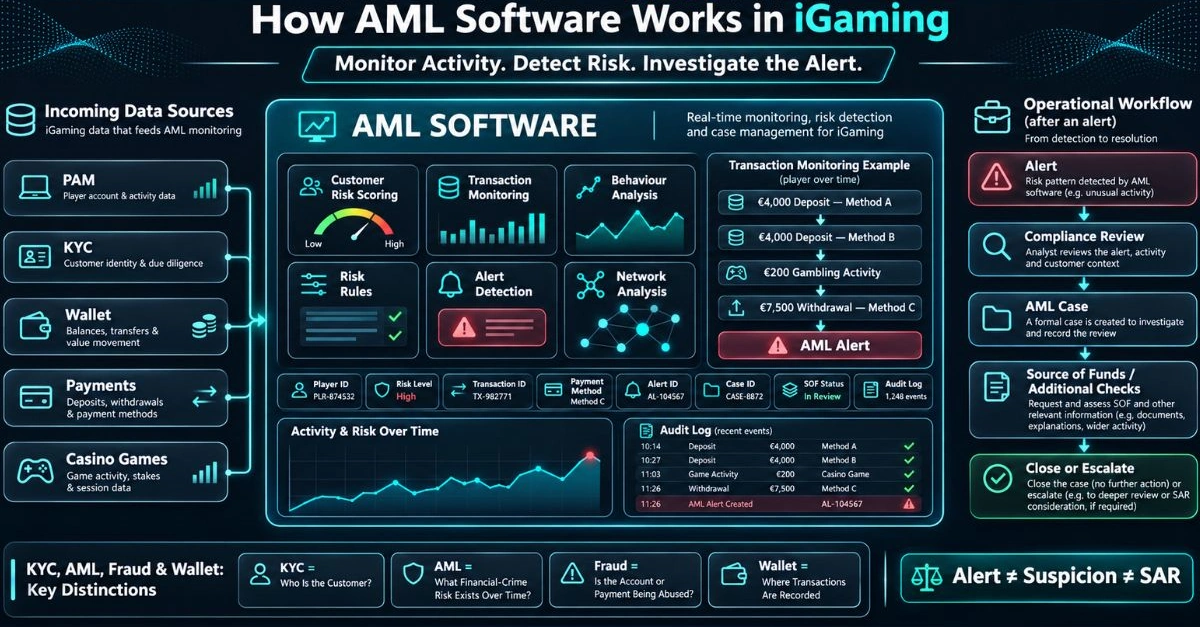
AML software in iGaming is technology used by gambling operators to identify, monitor and investigate activity that could indicate money laundering, terrorist financing or other financial-crime risk.
AML stands for Anti-Money Laundering.
While KYC technology focuses heavily on establishing who the customer is, AML software monitors what happens throughout the customer relationship.
It can analyse information such as:
- Deposits
- Withdrawals
- Payment Methods
- Game Activity
- Account Relationships
- Customer Risk
- KYC Information
- Source-of-Funds Reviews
The system can apply rules or risk models to this information and generate alerts when activity requires further investigation.
A simplified process looks like: Player Activity ↓ AML Monitoring ↓ Risk Rules / Behaviour Analysis ↓ Alert ↓ Compliance Investigation ↓ Decision / Escalation
The important point is that AML software does not automatically determine that a customer is laundering money. It helps compliance teams identify and investigate activity that may require closer attention.
What Is AML Software?
AML software is a technology layer that helps operators apply anti-money-laundering controls across customer accounts and financial activity.
Depending on the product, it can support:
- Customer Risk Scoring
- Transaction Monitoring
- Behaviour Monitoring
- PEP / Sanctions Screening
- Alert Generation
- Case Management
- Source-of-Funds Workflows
- Suspicious Activity Escalation
- Audit Trails
- Reporting
The software normally receives information from other casino systems. For example: PAM → Player Account Information Wallet → Financial Transactions Payments → Deposit and Withdrawal Data KYC → Identity and Risk Information Games → Gambling Activity
The AML system combines this information to evaluate financial-crime risk.
Why Is AML Important in Online Gambling?
Online casinos process large numbers of financial transactions.
Money can move: into the gambling account through deposits, then: through gambling activity and later: out of the account through withdrawals.
That creates opportunities for legitimate entertainment. It can also attract attempts to misuse gambling accounts for financial crime.
Potential risks can include:
- Third-Party Funding
- Mule Accounts
- Fraudulent Identities
- Multiple Payment Methods
- Open-Loop Withdrawals
- Unusual Movement of Funds
- Accounts Used Mainly to Transfer Value
Remote gambling creates additional challenges because the customer is not physically present.
The UK Gambling Commission’s 2026 money-laundering risk assessment continues to classify the remote casino sector as high risk for money laundering.
The assessment highlights risks involving fraudulent documentation, mule accounts, multiple payment methods, e-wallets, prepaid methods, cryptoasset-linked funds and increasingly sophisticated attempts to bypass customer-due-diligence controls.
This is why AML technology has become an important component of modern iGaming infrastructure.
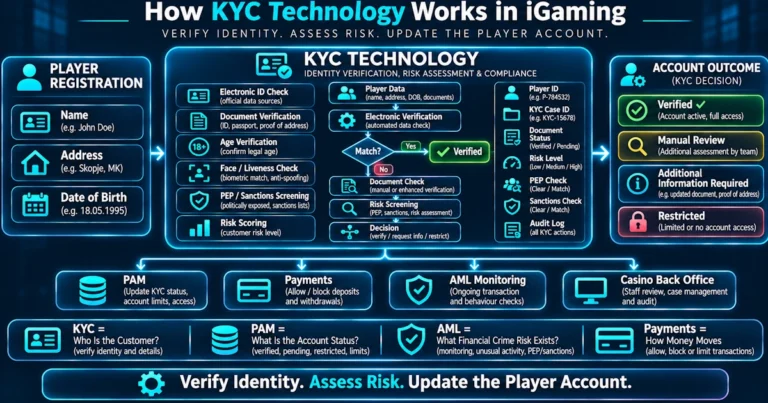
AML Software vs KYC Technology
AML and KYC systems work closely together, but they perform different roles.
KYC Technology Primarily asks: Who is this customer?
It can support: Identity Verification Age Verification Document Checks PEP / Sanctions Screening Initial Risk Assessment
AML Software Primarily asks: Does this customer’s ongoing activity create financial-crime risk?
It can monitor: Transactions Payment Patterns Gambling Activity Changes in Customer Behaviour Source of Funds
A useful distinction is: KYC = Know the Customer AML = Monitor the Financial-Crime Risk
KYC is therefore an important input into the wider AML framework.
Where Does AML Software Sit in the iGaming Stack?
A simplified architecture can look like: Player ↓ Casino Platform ↓ PAM + Wallet ↓ Payments + Gaming Activity ↓ AML MONITORING ↙ ↓ ↘ KYC Data — Risk Rules — Transaction Behaviour ↓ Alerts ↓ Compliance / MLRO Workflow
The AML system can also connect with: Casino Back Office Payment OrchestrationFraud Systems Reporting
The exact architecture varies. Some operators use AML functionality built directly into the casino platform. Others integrate a specialist financial-crime platform through APIs and event feeds.
What Data Does AML Software Use?
AML software is only as useful as the information it receives.
Relevant data can include player information such as: Player ID Country Account Status KYC Status
It can also use financial data: Deposit Amount Withdrawal Amount Payment Method Transaction Time Currency
Gaming information may include: Amount Wagered Game Type Wins and Losses Time Between Deposit and Withdrawal
Risk information can also include: PEP Status Sanctions Alerts Source-of-Funds Status Previous Compliance Cases
These data points allow the system to analyse the customer’s activity in context rather than treating every transaction independently.
Why Does Context Matter?
Consider two customers who both deposit: €2,000
For Customer A, this may be consistent with: known income historical activity established payment method
For Customer B, the same transaction may represent: sudden activity on a new account unusual payment source risk inconsistent with known profile
The amount is identical. The context is different.
AML systems therefore need to understand: transaction + customer + historical behaviour + risk profile rather than only: transaction amount.
What Is Transaction Monitoring?
Transaction monitoring is one of the core functions of AML software.
The system reviews financial activity and looks for patterns that may require investigation.
For example: Deposit €5,000 ↓ Very Limited Gambling ↓ Withdrawal €4,900
This does not automatically prove money laundering. There may be a legitimate explanation. But the pattern may justify a closer look.
Transaction monitoring helps identify these situations automatically.
What Types of Transactions Can Be Monitored?
An iGaming AML system may monitor:
- Deposits
- Withdrawals
- Refunds
- Wallet Adjustments
- Payment-Method Changes
- Transfers where relevant to the product.
It may also consider gambling behaviour between the financial transactions.
For example: Money In → Gambling Activity → Money Out
The relationship between these stages can be more informative than any one event.
What Is Ongoing Monitoring?
Ongoing monitoring means continuing to assess the customer after initial registration and verification.
In Great Britain, casino operators are required to monitor business relationships on an ongoing basis. This includes scrutiny of customer transactions so that activity can be assessed against what the operator knows about: the customer their activity and: their risk profile
Where necessary, the operator may also need to understand the source of the funds involved.
This means KYC does not end the compliance process. A player can pass identity verification successfully and later generate activity requiring additional AML review.
What Is a Transaction Monitoring Rule?
A rule is a defined condition that creates an alert or another action.
For example: IF Total deposits in 24 hours > configured threshold AND Account age < configured period THEN Create Review Alert
Another rule might examine: Large Deposit followed by: Minimal Gambling followed by: Withdrawal
The values and conditions should be based on the operator’s risk assessment. There is no universal rule set suitable for every casino.
What Is a Monitoring Scenario?
A scenario combines several events or conditions into a pattern.
For example: Scenario: Rapid Movement of Funds Large Deposit ↓ Low Gambling Activity ↓ Rapid Withdrawal
Another scenario might be: Multiple Payment Methods Card A
E-Wallet B
Bank Account C used within a short period.
The system generates an alert when the configured pattern appears. Compliance staff then investigate the context.
What Is Threshold-Based Monitoring?
Threshold-based monitoring creates alerts when activity exceeds a defined level.
For example: Deposits > X or: Number of Payment Methods > Y
Threshold rules are relatively easy to understand. But they can also be easy to overuse.
A customer transacting: €1 below a threshold is not automatically low risk.
A strong AML programme therefore generally needs more than fixed thresholds.
What Is Behaviour-Based Monitoring?
Behaviour-based monitoring evaluates how a player’s activity compares with previous patterns or expected behaviour.
For example: A customer normally deposits: €50–€100 per month Then suddenly deposits: €10,000
The transaction may trigger an alert because it is inconsistent with the established profile.
This approach asks: Is this activity unusual for this customer? rather than only: Is this amount globally high?
Behavioural analysis can therefore complement fixed rules.
What Is Velocity Monitoring?
Velocity describes how quickly activity occurs.
For example: 20 deposits in 30 minutes may carry different risk from: 20 deposits over one year
AML software can therefore evaluate: number of transactions within: a defined time window
This is useful for detecting patterns involving rapid movement or structuring of funds.
What Is Transaction Structuring?
Transaction structuring involves splitting activity into smaller amounts.
For example, instead of making: one large transaction a customer may make: many smaller transactions
An important risk is that transaction amounts may be deliberately structured to avoid controls or attention.
FATF’s 2026 gaming and gambling risk indicators specifically highlight the use of multiple smaller transactions, sometimes referred to as smurfing, as behaviour authorities and operators should consider when assessing financial-crime risk.
Again: multiple small transactions do not automatically prove money laundering. The pattern needs investigation.
What Are Multiple Payment Method Risks?
A player may legitimately use more than one payment method. But unusual combinations can increase risk.
For example: Deposit from Card A Deposit from E-Wallet B Deposit from Bank Account C then: Withdrawal to another route
can create questions about: who supplied the funds and: where the money is going.
The UK Gambling Commission’s 2026 risk assessment specifically identifies multiple payment methods as a relevant risk in the remote casino sector.
AML software can therefore monitor relationships between: Player Payment Method Deposit and: Withdrawal
What Is Open-Loop Payment Risk?
An open-loop payment structure allows funds to enter through one payment method and leave through another.
For example: Deposit → Payment Method A then: Withdrawal → Payment Method B
This can increase financial-crime risk because the gambling account may potentially be used to move money between payment instruments.
Closed-loop arrangements generally seek to return money through the same or appropriately linked payment route where possible. The payment-orchestration system may implement the routing. The AML system monitors the risk around that routing.
What Is Third-Party Funding?
Third-party funding occurs when money appears to come from someone other than the registered player.
For example: Player Account = Person A but: Payment Account = Person B
There can be legitimate explanations in some circumstances. But third-party funding can also create: fraud money-laundering or: account-control concerns.
AML software can compare payment ownership information with player identity data and create alerts where inconsistencies appear.
What Is a Mule Account?
A mule account is an account used to receive or move money on behalf of another party, often as part of criminal activity.
In gambling, a criminal could attempt to use another person’s casino account to move or disguise funds.
Signals might include:
- unusual funding
- third-party payment methods
- rapid transactions
- linked accounts
- behaviour inconsistent with customer profile
The UK Gambling Commission identified mule-account creation as an important remote casino risk in its 2026 assessment. AML software can help connect these signals.
What Is Minimal-Play Monitoring?
One potential scenario involves money entering a casino account, receiving very limited gambling exposure and then leaving.
Example: Deposit €5,000 ↓ Wager €100 ↓ Withdraw €4,850
This pattern may require review because the account appears to have been used primarily to move money rather than gamble.
But the pattern alone is not proof of financial crime. The AML system should: flag rather than automatically: convict.
Human investigation remains important.
What Is Pass-Through Activity?
Pass-through activity refers broadly to money entering an account and leaving with limited meaningful use of the gambling product.
The account effectively behaves more like a transfer mechanism.
A monitoring model might evaluate: Deposit Volume against: Turnover and: Withdrawal Volume
For example: High Deposit
Very Low Turnover
High Withdrawal could increase the risk score.
The appropriate interpretation depends on customer history and circumstances.
What Is Player Risk Scoring?
AML software can assign a financial-crime risk profile to each customer.
A simplified model could use: Low Medium High
The score can consider factors such as: Customer Geography Payment Methods PEP Status Transaction Behaviour Source-of-Funds Status Previous Alerts
The purpose is to help the operator apply stronger controls where risk is greater.
Is Customer Risk Fixed at Registration?
No.
A customer may start: Low Risk and later become: Medium Risk or: High Risk because new information appears.
For example: New payment behaviour PEP status change unusual transactions new high-risk geographic connection
The risk profile should therefore be capable of changing throughout the relationship. This is one of the main reasons ongoing monitoring is important.
How Is Risk Scoring Different From an AML Alert?
A risk score describes the customer’s broader risk profile. An alert identifies a specific event or pattern requiring review.
For example: Customer Risk = Medium but: Alert = Rapid Deposit and Withdrawal
One customer can generate multiple alerts. The compliance team may resolve each alert while the overall risk score remains unchanged or may decide that the cumulative activity justifies increasing the customer’s risk profile.
What Is Dynamic Risk Scoring?
Dynamic risk scoring updates risk as customer behaviour changes.
For example: Initial Risk Score: 20 Then: New Payment Method Unusual Deposit Higher-Risk Geography
The score could rise. The exact numerical model differs between systems.
The important idea is: risk is updated using new information rather than calculated once and forgotten.
What Is an AML Alert?
An AML alert is a system-generated warning that activity has matched a monitoring rule or risk condition.
For example: Alert #AML-58291 Scenario: Rapid Movement of Funds Risk: High Player: P-48291 Status: Open
The alert tells staff: This activity needs review.
It does not tell them: This customer is definitely laundering money. That distinction is fundamental.
Alert vs Suspicion
A technical alert and legal suspicion are not the same thing.
The software can identify: unusual behaviour
A trained compliance professional evaluates: whether the behaviour can be reasonably explained and: whether grounds for suspicion exist.
This prevents automated rules from becoming automatic criminal accusations.
What Is Alert Triage?
Large casinos can generate many alerts. Triage determines which need the quickest attention.
The system might classify: High Priority Medium Priority Low Priority
based on factors such as: Customer Risk Transaction Amount Scenario Previous Alerts
A high-risk PEP with several unusual payment events may receive greater priority than a low-risk customer generating one minor anomaly.
What Is Alert Deduplication?
Suppose one behaviour triggers: Rule A Rule B and: Rule C all based on essentially the same activity.
Without deduplication, compliance staff could receive three separate alerts for one event. A strong AML system can potentially combine related alerts into: one case
This reduces unnecessary workload.
What Is an AML Case?
An AML case is a structured investigation containing relevant alerts, customer data and evidence.
For example: Case: AML-20481 Customer: P-48291 Risk: High Alerts: 4 Assigned To: Analyst 7 Status: Investigation
The investigator can then review: Transactions KYC Information Payment Methods Gaming Activity Previous Cases
The goal is to create one organised investigation rather than working through disconnected spreadsheets and emails.
What Is AML Case Management?
Case management provides the operational workflow for compliance teams.
A typical process could be: Alert Generated ↓ Analyst Reviews ↓ Information Requested ↓ Evidence Added ↓ Decision ↓ Close / Escalate
The system should record: who performed each action when and: why.
This creates an audit trail.
What Is Source of Funds?
Source of Funds, or SOF, asks: Where did the money used for this gambling activity come from?
Possible legitimate sources could include: Salary Savings Business Income Investment Proceeds
An AML system can trigger a source-of-funds workflow when activity requires further understanding.
For example: Risk Rule Triggered ↓ Request SOF Information ↓ Documents Submitted ↓ Compliance Review ↓ Decision
The system supports the process. A human may still need to evaluate whether the evidence makes sense.
What Is Source of Wealth?
Source of Wealth, or SOW, asks a broader question: How did the customer acquire their overall wealth?
Examples can include: Employment Business Ownership Inheritance Investments
SOF and SOW are related but not identical. AML case management may support both depending on the customer and risk situation.
Can AML Software Automatically Verify Source of Funds?
It can automate parts of the process.
For example, technology can:
- request documents
- extract data
- connect to external information sources
- compare information
But an automated result should not always be treated as final. A compliance analyst may still need to assess whether: the evidence is credible the amounts are plausible and: the activity is consistent with the customer profile.
AML is not simply a document-upload workflow.
What Is Enhanced Due Diligence?
Enhanced Due Diligence, or EDD, means applying additional scrutiny to higher-risk relationships or situations.
This can involve: Additional Customer Information Source of Funds Source of Wealth Closer Monitoring Additional Approval
The UK Gambling Commission’s AML guidance requires enhanced CDD and enhanced ongoing monitoring in higher-risk situations. AML software can help identify the trigger and manage the workflow.
How Do PEPs Fit Into AML Software?
PEP stands for: Politically Exposed Person
PEP screening is often performed during KYC. But status can change after registration.
A customer who was not previously a PEP could later become one. AML systems can therefore support: ongoing re-screening and: enhanced monitoring
PEP status does not mean: the customer committed a crime.
It means a higher-risk framework may need to be applied according to the relevant rules.
What About Sanctions Screening?
Sanctions screening can also continue after onboarding.
A customer could appear on a relevant sanctions list after the account was opened. The operator therefore may need updated screening.
A simplified process is: Sanctions List Updated ↓ Customer Re-Screening ↓ Potential Match ↓ Compliance Investigation ↓ Confirmed / False Positive
A potential name match should not automatically be treated as a confirmed sanctions match.
What Is Ongoing Screening?
Ongoing screening means periodically or continuously checking customer records against changing risk information.
This can include: PEP Data Sanctions Data and other relevant screening sources.
An alert may occur because: the customer changed or: the external database changed.
This is another reason AML monitoring extends beyond initial KYC.
What Is Link Analysis?
Link analysis looks for relationships between apparently separate accounts or transactions.
For example: Player A and: Player B may share: Payment Method Device Address or another relevant attribute.
A network can then be visualised as: Player A ↔ Payment Method X ↔ Player B
This can help identify: account networks fraud rings mule relationships
But shared information does not automatically prove wrongdoing. For example, family members can legitimately share an address. The relationship needs context.
What Is Network Analysis?
Network analysis extends link analysis across larger sets of connected entities.
A graph might contain: Players Devices Payment Methods Addresses Transactions
A system may identify: one payment instrument connected to 15 accounts
That can be much more informative than reviewing each player independently. Graph and network techniques are increasingly useful where financial-crime activity involves several coordinated accounts.
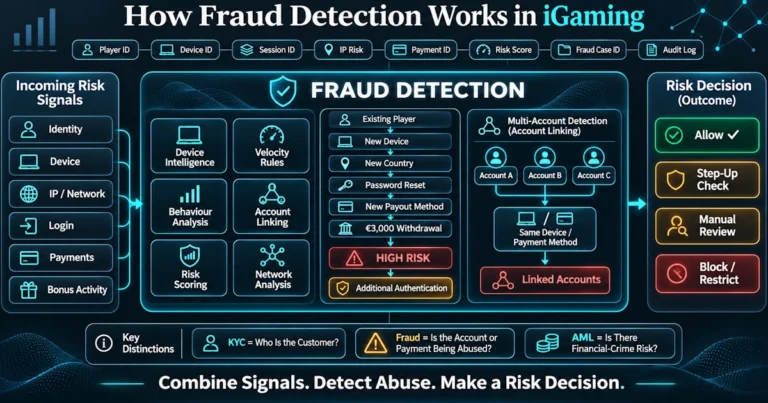
AML Software vs Fraud Software
AML and fraud systems overlap, but they focus on different problems.
Fraud Software Often focuses on: Is someone attempting to steal money or abuse the account? Examples include: Stolen Cards Account Takeover Bonus Abuse
AML Software Focuses more on: Could the financial activity involve laundering, terrorist financing or criminal property?
The same event can be relevant to both systems. For example: Stolen identity + unusual deposits could create both: fraud alert and: AML concern.
Data sharing between the systems can therefore be valuable.
AML Software vs KYC vs Fraud
A simple distinction is:
System | Main Question KYC Technology | Who is the customer? AML Software | Does ongoing activity create financial-crime risk? Fraud System | Is the account or payment being abused?PAM System | What is the player’s account state? Payment Platform | How is money moving?Casino Back Office | How do staff manage the operation?
These functions can exist in separate products or inside one larger platform.
How Does AML Connect With the Casino Wallet?
The wallet is an essential AML data source because it records financial activity.
For example: Deposit €500 Wager €20 Withdrawal €470
The AML system can receive these events and evaluate the pattern.
The wallet remains the authoritative ledger for casino balances. The AML system uses the transaction information to assess risk.
So: Wallet = Financial Record AML = Risk Analysis
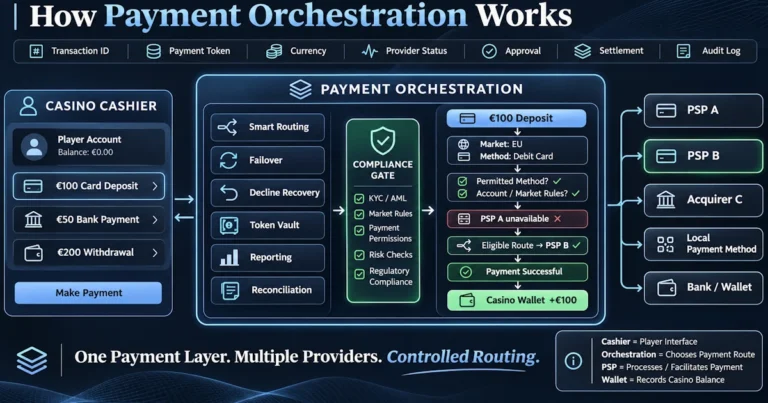
How Does AML Connect With Payment Orchestration?
Payment orchestration knows how external payment transactions are routed.
The AML system may need information such as: PSP Payment Method Account Holder Country Deposit / Payout Route
For example: Deposit through Method A followed by: Withdrawal through Method B may require closer analysis.
The orchestration system manages the route. The AML system evaluates the financial-crime implications.
How Does AML Connect With Games?
Gambling activity can help explain what happened to deposited funds.
Consider: Customer A Deposit €1,000 Wager €20,000 over time Withdraw €700 versus: Customer B Deposit €1,000 Wager €20 Withdraw €970
These patterns are very different.
The AML engine may therefore receive: Turnover Game Type Bet Size Session Information Win / Loss
The purpose is not to label certain games automatically suspicious. It is to understand how money moved through the gambling product.
Can AML Software Monitor Gaming Behaviour?
Yes.
Transaction monitoring in iGaming can involve both: payment activity and: gambling activity.
Relevant patterns may include: Very Low Play Before Withdrawal Unusual Betting Patterns Coordinated Activity Unexpected Changes in Turnover
FATF’s 2026 gaming and gambling work specifically identifies suspicious transactional and betting patterns among the warning signs relevant to financial-crime detection.
Is High Gambling Activity Automatically Money Laundering?
No. High spend alone does not establish money laundering.
The operator needs to consider: customer profile source of funds payment activity risk factors behaviour over time
A wealthy legitimate customer and a high-risk account could show similar headline turnover. The surrounding evidence determines the risk assessment.
Is Low Gambling Activity Automatically Suspicious?
No. A player may deposit funds, decide not to gamble and request a casino withdrawal. That can be entirely legitimate.
The role of AML technology is to identify combinations of indicators.
For example: Large Deposit
Third-Party Funding
Minimal Gambling
Different Withdrawal Method could create a stronger case for review than: Minimal Gambling Alone.
Rules-Based AML vs Machine Learning
AML monitoring can use different approaches.
Rules-Based Monitoring Uses predefined conditions. Advantages include: clear logic easy explanation
But rigid rules can generate many false positives.
Machine-Learning Monitoring Uses statistical patterns and historical data to identify unusual activity. Potential advantages include: more adaptive behaviour analysis
But models can be: harder to explain and require: training, testing and governance.
Many systems combine both approaches.
How Can AI Be Used in AML Software?
AI can potentially support: Anomaly Detection Alert Prioritisation Network Analysis Document Review Case Summaries Behaviour Modelling
But AI should not be treated as: an automatic money-laundering detector.
The UK Gambling Commission’s 2026 risk assessment also notes the other side of the equation: criminals are increasingly able to use AI-generated documents, deepfake videos and face swaps to try to defeat compliance controls.
So AI changes both: defence and: threat.
What Is Anomaly Detection?
Anomaly detection identifies activity that differs from expected patterns.
For example: A player normally uses: one bank account Then suddenly uses: five payment methods with: rapid deposits and withdrawals
The model may classify the behaviour as unusual. An anomaly is not automatically suspicious criminal conduct.
It is a reason to ask: Why is this different?
Why Is Explainability Important?
Suppose the AML system creates: Risk Score: 94
The analyst needs to know why. Useful explanations might include: New Payment Method Unusual Deposit Velocity Open-Loop Withdrawal High-Risk Geography
Without explanation, analysts may struggle to investigate the alert properly. This becomes even more important when AI or machine-learning models are used.
Compliance systems need more than a mysterious: RED button.
What Is Model Governance?
If AML software uses models, the operator should understand: Which data is used? How is the model tested? How often is it reviewed? How are false positives measured? Can compliance rules override it? Who approves changes?
A model can deteriorate over time as: customer behaviour payment methods and: criminal techniques change.
Monitoring the model is therefore part of operating the system.
What Is Alert Tuning?
AML rules need to be calibrated.
Suppose a rule generates: 50,000 alerts per day and: 99.9% are immediately closed as irrelevant.
The system is creating work rather than useful detection.
Operators can adjust: thresholds conditions risk factors to improve signal quality.
But tuning should not simply mean: reduce alerts at any cost.
The goal is: reduce unnecessary alerts without weakening detection.
What Is a False Positive?
A false positive occurs when an AML rule generates concern about activity that ultimately has a legitimate explanation.
Example: A customer suddenly receives: large legitimate property-sale proceeds and deposits more than usual.
The change may trigger an alert. After investigation: Source of Funds Verified No Suspicion Identified
The alert was still useful because the unusual activity was reviewed. The goal is not to eliminate every false positive. It is to keep the workload manageable while identifying relevant risk.
What Is a False Negative?
A false negative is more dangerous.
It occurs when suspicious activity is present but the monitoring system fails to flag it.
For example: A criminal pattern stays below every fixed threshold.
This is one reason a strong AML framework should not depend on: one rule or: one amount threshold.
Risk assessment, behaviour analysis and staff judgement remain important.
What Is Alert Fatigue?
Alert fatigue occurs when analysts receive so many low-quality alerts that important cases become harder to identify.
For example: 1,000 alerts with: 995 obvious false positives creates a major operational problem.
The result can be:
- slower investigations
- inconsistent decisions
- missed risk
Good AML software therefore needs: prioritisation deduplication tuning case management not merely: more alerts.
What Is a Risk-Based Approach?
A risk-based approach means applying controls according to the level and nature of risk.
Higher-risk customers may require: stronger due diligence closer monitoring more frequent review
Lower-risk relationships may require proportionate controls.
The UK Gambling Commission’s casino AML guidance is explicitly built around a risk-based approach. The Malta Gaming Authority similarly requires relevant gaming licensees to apply AML/CFT measures proportionate to identified risks.
The software therefore needs enough flexibility to reflect the operator’s own risk assessment.
Is There One Universal AML Rule Set?
No.
A casino operating in: Market A may face different risks and regulatory requirements from: Market B.
Operators also differ in: products payment methods customer base geographic exposure
Therefore, buying software with: “500 AML Rules Included” does not automatically create an effective AML programme. The rules need to match the actual business.
What Is Jurisdiction Risk?
Geographic risk considers whether a customer, payment or business relationship is connected with higher-risk locations.
AML systems may consider: Customer Residence Payment Country IP / Location Information Bank Location High-Risk Jurisdiction Lists
Geography is one factor. It should not automatically be used to conclude that every customer from a particular country is suspicious. The risk needs to be evaluated proportionately.
What Is Product Risk?
Different gambling products can create different financial-crime risks.
For example: high return-to-player products or: peer-to-peer gambling can create different risk profiles.
The UK Gambling Commission’s 2026 remote casino assessment specifically highlights the potential money-laundering risk associated with higher-RTP products and peer-to-peer poker activity.
An AML platform may therefore need to understand: what product the customer used not just: how much money moved.
Why Does RTP Matter to AML?
Suppose someone wants to move money through gambling while losing as little as possible. A product with a high theoretical return to player may appear attractive for that purpose.
That does not mean players choosing high-RTP games are suspicious. It means product characteristics can form part of the wider risk assessment.
AML models should combine product information with other customer and transaction indicators.
What Is Cross-Account Monitoring?
A customer may have activity across: Casino Poker Betting or several operator brands.
Where legally and technically appropriate, AML monitoring may need a broader view than one isolated wallet.
For example: Brand A deposits plus: Brand B withdrawals could form part of the same customer relationship depending on the operating structure.
The UK Gambling Commission expects casino monitoring arrangements to be sufficient across relevant accounts, products and platforms.
What Is Multi-Brand AML?
A gambling group might operate: Brand A Brand B Brand C
AML technology can potentially monitor customers across those brands. But the architecture needs clear rules for: legal entity data access customer identity jurisdiction permissions
A compliance analyst should not automatically receive unrestricted access to every brand simply because all brands use the same technology.
What Is an Internal AML Escalation?
When an analyst identifies concerning activity, the case may be escalated internally.
For example: Analyst ↓ Senior Investigator ↓ Nominated Officer / MLRO
The escalation path depends on jurisdiction and company structure.
The software can manage: Case Status Owner Evidence Notes Decision
The legal judgement remains with the appropriate responsible person.
What Is an MLRO?
MLRO stands for: Money Laundering Reporting Officer
Different jurisdictions use different terminology and legal structures. In Great Britain, casino operators subject to the relevant AML regulations appoint a nominated officer.
That person receives internal disclosures, determines whether they should be reported externally and handles relevant interactions with the National Crime Agency.
AML software can support this workflow. It should not replace the nominated officer’s judgement.
What Is a Suspicious Activity Report?
A Suspicious Activity Report, or SAR, is a formal report made to the relevant authority when the legal criteria for reporting suspicious activity are met.
The exact terminology and reporting process vary by jurisdiction. In Great Britain, the nominated officer determines whether appropriate internal disclosures should be reported to the National Crime Agency.
AML software can support: Evidence Collection Case Notes Decision Records Report Preparation
But the system should not automatically convert every alert into a SAR.
The sequence is: Alert ≠ Suspicion ≠ SAR These are separate stages.
Alert vs Case vs SAR
A useful distinction is:
Alert The system identifies unusual activity. ↓ Case Compliance investigates. ↓ Suspicion Appropriate responsible person concludes there are grounds for suspicion. ↓ SAR / STR Report submitted where legally required.
This distinction is essential for understanding how AML technology actually works.
What Is an STR?
STR means: Suspicious Transaction Report
Some jurisdictions use STR rather than SAR terminology. For example, Malta’s AML framework requires relevant subject persons to report suspicious transactions to the FIAU.
The terminology differs. The underlying idea is similar: financial-crime suspicion is escalated to the competent authority through the prescribed process.
Why Should AML Software Not Automatically File Every Alert?
Because rules can create false positives.
Imagine: Unusual Deposit Alert
The analyst investigates and finds: Documented Salary Bonus Known Customer Consistent Source of Funds
There may be no grounds for suspicion.
Automatic reporting of every alert would create huge volumes of unnecessary reports and remove professional judgement from the process. Monitoring technology should support the decision. It does not make the legal judgement by itself.
What Records Should AML Software Keep?
AML systems can store records such as: Customer Risk Assessments Alerts Cases Evidence Investigation Notes Decision History SOF / SOW Reviews Internal Escalations SAR / STR Decisions Rule Changes
Record keeping creates an audit trail. In Great Britain, AML guidance specifically expects records covering identification and verification, monitoring, internal and external SARs, nominated-officer decisions and related actions.
Why Are Audit Trails Important?
Suppose an alert is closed. Six months later, a regulator asks: Why was this case closed?
The operator should be able to show: what activity triggered the review what evidence was considered who reviewed it what decision was reached and: why.
A record saying only: Alert Closed is not enough for strong governance.
Why Should Rule Changes Be Audited?
Imagine an administrator changes: Deposit Velocity Threshold from: X to: 10× X
This could dramatically reduce alerts. The system should record: Who changed the rule? When? Who approved it? What was the previous value?
This supports both operational control and regulatory accountability.
Why Are User Permissions Important?
AML systems contain highly sensitive information.
A CRM employee generally does not need access to: SAR Investigation Notes
A customer-support agent might need to see: Account Under Compliance Review without seeing: why a SAR is being considered.
Access should therefore be role based. Possible roles can include: AML Analyst Senior Investigator MLRO / Nominated Officer System Administrator
Each should have only the access necessary for their responsibilities.
Why Is Confidentiality Important?
AML investigations can contain sensitive information.
In particular, staff need to avoid improperly alerting customers that suspicious-activity reporting or law-enforcement disclosure is being considered. This is often discussed in the context of tipping off.
For that reason, highly sensitive AML case information should not automatically appear in: general customer-support notes or: CRM campaign profiles.
The system architecture needs appropriate separation.
How Does the Back Office Interact With AML Software?
The casino back office system may display a limited AML status.
For example: Compliance Review: Pending
The specialist AML system can contain deeper information: Alert Details Case Evidence Investigation Notes MLRO Decision
This allows operational teams to know that restrictions exist without exposing every sensitive detail. Some casino platforms combine both systems into one back-office environment with strict permissions.
How Does AML Software Work in Real Time?
A real-time AML system receives events as they happen.
For example: 14:02 — Deposit €2,000 14:07 — Deposit €2,000 14:12 — Deposit €2,000
The engine evaluates each event and may create an alert after the third transaction. This allows the operator to react during the customer relationship rather than reviewing everything days later.
Real-Time vs Batch Monitoring
Not every AML control needs to run in real time.
Real-Time Monitoring Useful where a decision may need to affect: current transactions or: immediate account controls.
Batch Monitoring Can analyse broader historical patterns periodically. For example: daily behavioural review
A strong AML programme can use both. Real time is not automatically better for every scenario.
What Is Data Latency?
Data latency is the delay between: activity happening and: AML software receiving it.
Suppose a withdrawal happens at: 15:00 but AML receives the event at: 03:00 the next morning.
That is a very different operating model from: 15:00:02
Whether that delay is acceptable depends on the risk scenario. B2B operators should therefore understand which feeds are: real time and which are: batch.
Why Are Data Quality and Completeness Critical?
AML software cannot analyse information it never receives.
Suppose the payment platform sends: Amount but not: Payment Account Owner
A third-party-funding rule may become less effective.
Or suppose: Withdrawal Reversals are missing.
The customer’s financial activity may look different from reality.
AML implementation therefore requires careful: data mapping data validation monitoring of failed feeds not merely installing a software dashboard.
What Is AML Data Reconciliation?
The operator should verify that transactions reaching the AML system match relevant source systems.
For example: Wallet says 1,000,000 transactions but: AML platform received 998,500
The missing: 1,500 events create a monitoring gap.
Technical teams should therefore monitor: event counts failed messages duplicate events delayed feeds
An AML system that silently misses transactions creates false confidence.
What Are AML APIs Used For?
APIs can connect the AML system with other parts of the platform.
For example: PAM → AML API sends: Player Created
Payments → AML API sends: Deposit Completed
AML → PAM API could return: Compliance Review Required
The exact authority granted to the AML system should be carefully designed. For example, it may recommend an account restriction while the PAM remains the system that actually applies it.
What Are AML Webhooks?
A webhook can notify another system that AML status changed.
For example: AML Case Escalated ↓ Webhook ↓ PAM ↓ Account Restriction Applied
Or: SOF Review Completed ↓ Compliance Status Updated
This allows systems to react without continuously polling the AML platform.
What Happens if the AML System Goes Offline?
This can be a serious operational issue.
The casino might still process: deposits wagers withdrawals while the monitoring system is unavailable.
The operator needs to understand: Are events queued? Will they be replayed later? Are certain transactions stopped? Is there a manual fallback process?
Business-continuity planning should include compliance systems, not only the customer-facing casino.
Can AML Be Outsourced?
Technology can be supplied by third parties. Some monitoring or operational services can also be outsourced depending on the legal structure.
But the gambling operator cannot assume: Vendor = Regulatory Responsibility
The operator remains responsible for maintaining an effective AML framework under the rules that apply to it.
A vendor can provide: Software Rules Data Analytical Tools
The operator still needs: governance trained staff risk assessment decision-making regulatory reporting.
What Should Operators Look for in AML Software?
A B2B evaluation should cover much more than the number of monitoring rules.
Important areas include:
Transaction Monitoring Can the system analyse deposits, withdrawals, wallet activity and relevant gambling behaviour?
Dynamic Risk Scoring Can customer risk change as new information appears?
Scenario Builder Can the operator create and adjust its own risk rules?
Alert Triage Can alerts be prioritised and deduplicated?
Case Management Can investigators manage evidence and decisions in one place?
SOF / SOW Workflow Can additional financial information be requested and reviewed?
KYC Integration Can identity and screening data feed into AML risk?
Payment Integration Can different payment methods and account ownership be analysed?
Network Analysis Can related accounts, devices or payment methods be identified?
Audit Logs Are rule and case changes traceable?
Reporting Can management and compliance reports be generated?
Multi-Brand Support Can accounts be monitored appropriately across several brands?
Multi-Jurisdiction Support Can rules and workflows differ by market?
APIs and Events Can the platform receive real-time data?
Data Export Can investigation records be retrieved if the operator changes vendor?
The best AML platform is not necessarily the one producing the largest number of alerts. It is the one that helps compliance teams identify meaningful risk efficiently and document what they did about it.
What Should Operators Test Before Buying?
A strong proof of concept should use realistic scenarios. Test:
- Large Deposit + Minimal Gambling + Withdrawal
- Multiple Payment Methods
- Third-Party Payment Instrument
- Rapid Deposit Velocity
- Many Small Transactions
- Open-Loop Withdrawal
- Customer Risk Score Increase
- Potential PEP Match
- Source-of-Funds Request
- Multiple Linked Accounts
- Duplicate Alert Handling
- Case Escalation
- Rule Change Audit
- Missing Data Feed
- AML System Outage
- SAR / STR Decision Recording
The vendor should show not only: How an alert appears but also: How the investigation ends.
Common AML Software Red Flags
Thousands of Alerts With No Triage More alerts do not automatically mean better monitoring.
Rules Cannot Be Explained Compliance teams need to understand why an alert exists.
No Customer Context Transaction amounts alone are not enough.
No Gaming Data The system may not understand what happened between deposit and withdrawal.
No Payment Ownership Information Third-party-funding analysis becomes weaker.
No Case Management Investigations move back into spreadsheets and email.
No Audit Trail Decisions become difficult to defend later.
No Data-Feed Monitoring Missing transactions can silently escape monitoring.
No Rule Versioning Operators may not know which monitoring logic was active at a particular time.
Vendor Makes the Final SAR Decision Automatically Regulatory reporting requires appropriate human and governance processes.
AML Software vs Related iGaming Systems
System | Main Role KYC Technology | Establishes and verifies customer identity AML Software | Monitors ongoing financial-crime risk and activity Fraud System | Detects account and payment abuse PAM | Manages player accounts and account states Wallet | Records player balances and financial transactions Payment Orchestration | Routes external deposits and payouts Back Office | Provides staff access to operational systems CRM | Manages player communications and lifecycle journeys
The systems exchange information. They should still have clearly defined responsibilities.
A Simple End-to-End AML Flow
Consider this fictional player activity.
Step 1 — Player Already Verified KYC = Complete ↓ Step 2 — Financial Activity Player deposits: €4,000 using: Payment Method A ↓ Step 3 — Additional Activity Player makes another: €4,000 Deposit through: Payment Method B ↓ Step 4 — Gambling Activity Only: €200 Turnover ↓ Step 5 — Withdrawal Request Player requests: €7,500 to: Payment Method C ↓ Step 6 — AML Monitoring System evaluates: Multiple Payment Methods High Deposit Volume Low Gambling Activity Different Withdrawal Route ↓ Step 7 — Alert High-Priority AML Alert ↓ Step 8 — Investigation Compliance reviews: KYC Payment Ownership Transaction History Customer Risk Source of Funds ↓ Step 9 — Decision The activity may be: explained and case closed or: escalated for further action.
The important point is that the software identifies the pattern. Compliance professionals determine what the pattern means.
Great Britain: Why AML Monitoring Matters
The UK Gambling Commission’s current casino AML guidance requires ongoing monitoring of business relationships.
Monitoring includes scrutiny of transactions to determine whether activity is consistent with the operator’s understanding of: the customer the customer’s activity and: risk profile.
The Commission also expects unusual transactions or activity to be flagged for further examination.
Its guidance makes another important point: monitoring is not merely a mechanical process.
Technology can identify unusual behaviour. The operator still needs appropriate customer information and professional judgement to decide whether the activity is suspicious.
Great Britain: 2026 Remote Casino Risks
The Commission’s 2026 money-laundering risk assessment continues to classify remote casinos as high risk.
Current risk themes include:
- Mule Accounts
- Fraudulent Documentation
- AI-Generated Identity Manipulation
- Multiple Payment Methods
- Open-Loop Payment Systems
- E-Wallets and Prepaid Methods
- Cryptoasset-Linked Funds
- Higher-RTP Products
- Peer-to-Peer Activity
This does not mean every customer using one of these products or methods is suspicious.
The point of a risk-based system is to evaluate the combination of: Customer Transaction Payment Method Product Behaviour and: Context.
FATF: New Gaming and Gambling Risk Indicators in 2026
In September 2026, FATF published new work on financial-crime risks across gaming and gambling.
The risk indicators include patterns such as:
- multiple small transactions
- multiple accounts
- multiple payment methods under different identities
- discrepancies between customer and payment information
- suspicious identity documentation and:
- unusual betting or transaction patterns.
These indicators demonstrate why AML software increasingly needs data from more than the payments system alone.
The operator needs to connect: identity payments accounts and: gambling behaviour.
Malta: AML in Remote Gaming
Malta also requires relevant gaming operators to apply a risk-based AML/CFT framework.
This includes:
- Business Risk Assessment
- Customer Acceptance Policy
- Customer Due Diligence
- Customer Risk Profiling
- Transaction Monitoring
- Suspicious Transaction Reporting
Malta’s national risk-assessment material describes remote gaming operators using transaction-monitoring systems that continuously assess player activity, maintain player risk profiles and create alerts when behaviour deviates from expected patterns.
The alert is then investigated. If grounds for suspicion remain, the appropriate reporting process follows.
That provides a useful real-world description of how AML technology fits into gambling operations.
Does AML Software Guarantee Compliance?
No. This is one of the biggest misconceptions in compliance technology.
An operator can purchase sophisticated AML software and still operate a poor AML programme. Technology cannot replace: Risk Assessment Policies Staff Training Management Oversight Investigation Professional Judgement Regulatory Reporting
A technically advanced alert system is useful only if the organisation knows: which risks it is trying to detect and: what to do when an alert appears.
What Does Good AML Technology Actually Achieve?
Strong AML software helps the operator move from: Millions of Transactions to: Relevant Risk Signals then from: Risk Signals to: Structured Investigations and finally from: Investigations to: Documented Decisions.
That is the real value of the system. It is not designed to replace the compliance team. It gives that team better visibility, prioritisation and evidence.
Final Thoughts
So, what is AML software in iGaming technology?
It is technology used to monitor customer activity for signs of money laundering, terrorist financing and related financial-crime risk throughout the player relationship.
A modern AML platform can combine:
- Customer Risk Scoring
- Transaction Monitoring
- Behaviour Analysis
- Payment Monitoring
- PEP / Sanctions Information
- Source-of-Funds Workflows
- Alert Management
- Case Management
- Network Analysis
- Audit Trails
A simplified architecture is: PAM + Wallet + Payments + Games + KYC ↓ AML Software ↓ Risk Rules / Behaviour Analysis ↓ Alert ↓ Investigation ↓ Decision / Escalation
The central distinction is: KYC establishes who the customer is. AML monitoring evaluates what the customer does over time.
And the most important operational principle is: An AML alert is a signal, not a verdict.
Technology can identify unusual behaviour. It can connect transactions that would be difficult for a human to spot manually. It can prioritise cases. It can preserve the investigation trail.
But the operator still needs trained people to understand: why the activity occurred whether the explanation is credible and: whether further action or regulatory reporting is required.
The strongest AML software therefore does not simply generate more alerts. It helps the operator identify the right risks, investigate them efficiently and show clearly how each important decision was reached.
Frequently Asked Questions
What is AML software in iGaming? AML software is technology used by online gambling operators to monitor customer transactions and behaviour, assess financial-crime risk, generate alerts and support compliance investigations.
What is the difference between KYC and AML software? KYC technology primarily verifies who the customer is. AML software monitors ongoing customer activity to identify potential money-laundering, terrorist-financing or other financial-crime risk.
What does AML transaction monitoring look for? It can look for patterns such as unusual deposit velocity, multiple payment methods, rapid movement of money, third-party funding, limited gambling before withdrawal and activity inconsistent with the customer’s known profile.
Does an AML alert mean a player is laundering money? No. An alert means activity matched a monitoring rule or risk pattern and requires review. Compliance staff need to investigate the context before determining whether genuine suspicion exists.
Can AML software automatically submit suspicious activity reports? Software can support the investigation and reporting workflow, but regulatory reporting decisions should follow the applicable legal process and responsible-person review. A system alert should not automatically be treated as a reportable suspicion.
Does AML monitoring continue after KYC is complete? Yes. Initial identity verification is only one part of the process. Ongoing monitoring can continue throughout the customer relationship and can trigger updated due diligence or enhanced review when risk changes.