
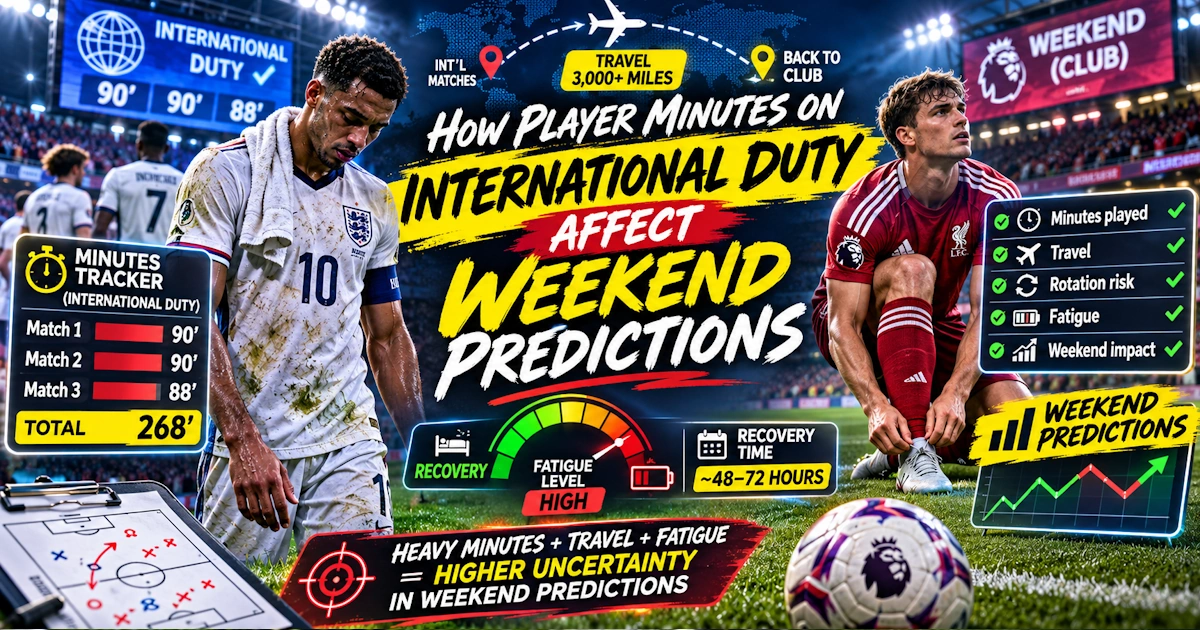
An international break ends on Tuesday night. By Saturday afternoon, the Premier League, La Liga, Serie A, Bundesliga and other domestic competitions are back.
At first glance, four days sounds like plenty of recovery time, but not every player returns to his club in the same condition. One player may have spent the international break on the bench and travelled only a short distance. Another may have played two full 90-minute matches, travelled across several countries, and returned to his club late on Thursday. A South American international based in Europe may have an even more demanding schedule involving long-haul flights, time-zone changes and limited normal sleep.
That is why simply asking “Did he play for his country?” is not enough.
For weekend football predictions, a better question is: “How many minutes did he play, where did he travel, how much recovery time does he have, and how important is he to his club?” Those details can affect team selection, pressing intensity, defensive organisation and even goal predictions.
International Break Fatigue Is Not the Same for Every Player
Imagine two teammates returning from international duty.
Player A: Played 25 minutes in one appearance, took a short European flight home, and was back at the club on Wednesday.
Player B: Played 90 + 90 minutes, started both matches, had a long return journey, and was back late on Thursday.
Both technically went on international duty, but their workloads are completely different. Player A accumulated only 25 competitive minutes; Player B accumulated 180. That difference should heavily influence how you analyse the weekend fixture.
Why 180 International Minutes Matter
A football match places substantial physical demands on players. Even when a player looks fully recovered, some physiological effects of match play can remain for several days.
A 2025 expert review of the international match calendar found that several studies indicated at least 72 hours may be required for full physical recovery after a match, highlighting exactly how rest days and recovery affect goal scoring. The same review also found that international travel frequently had negative effects on wellness, and in four of five studies evaluating match performance, travel was associated with poorer performance.
That does not mean a player who played on Tuesday will automatically perform badly on Saturday. It means recovery time should become part of the prediction.
Do Not Treat Fatigue as an Automatic Performance Collapse
This is an important distinction: football players are elite athletes accustomed to playing frequently.
Research examining players with only 72–96 hours between matches has found that physical performance can often be maintained, even though injury rates may increase during congested schedules. Another study examining three matches within one week found evidence of increased muscle soreness and physiological stress after congestion, but sprint and jump performance were not clearly reduced.
So avoid the simplistic prediction: “He played twice internationally, therefore he will be poor this weekend.” The more realistic interpretation is that heavy minutes may increase fatigue, recovery demands, injury susceptibility and the probability of rotation. Those factors can then influence your prediction.
Player Minutes Are More Useful Than International Appearances
Suppose a website tells you a player made two international appearances. That sounds like a heavy workload. But perhaps he played 15 minutes in the first match and 20 minutes in the second, totalling 35 minutes. Compare that with a player who started both matches (90 + 90 = 180 minutes). The appearance count is identical; the workload is not.
When analysing the first club match after an international break, try to record actual minutes rather than simply whether a player represented his country.
Practical Example: Two Strikers Return Differently
Imagine Club A and Club B meet on Saturday.
Club A’s main striker played 180 international minutes and returned after a long journey.
Club B’s striker played 22 minutes and returned home two days earlier.
Normally, you rate the two attacks similarly. Should you suddenly downgrade Club A dramatically? Probably not. But you should investigate if the striker is likely to start, if his club has another important match three days later, and if the manager regularly rotates after international breaks. If the replacement is significantly weaker, Club A’s expected attacking output may need a small adjustment. This shows exactly how squad rotation changes football predictions.
The 180-Minute Problem Becomes More Important With a Short Turnaround
Consider a Sunday international followed by a Saturday club match versus a Tuesday international followed by a Saturday club match. The first player has considerably more recovery time.
Now consider a Tuesday night international abroad followed by a Saturday 12:30 club kickoff. That is a much tighter sequence.
The number of calendar days can also be misleading because travel consumes part of the recovery period. A player who finishes an international at 22:45 on Tuesday does not immediately begin full recovery at his club training ground. He may still need to complete post-match recovery, travel to an airport, fly home, travel from the airport, sleep, and rejoin club training. This is why return timing matters.
Travel Can Matter Almost as Much as Minutes
An international player can play only 70 minutes and still have a difficult return if the travel burden is large.
Research involving 50 elite national-team footballers across 355 trips found that perceived fatigue and sleep quality worsened as more time zones were crossed. Travel across nine or more time zones produced significantly worse fatigue, sleep, and overall wellness during the first two days after arrival than journeys involving fewer than six time zones. Eastward travel was also associated with poorer sleep ratings.
That creates an obvious difference between travelling from Paris to London versus South America to Europe. Both are international travel, but they should not receive the same fatigue adjustment.
Returning to the Club Can Be the Difficult Part
Another study followed 68 national-team footballers across 396 flights. Researchers found poorer perceptual responses after players travelled from their national teams back to their clubs compared with other travel situations. Long travel routes and inconvenient arrival times were also associated with worse responses.
That is particularly useful for weekend predictions. The bettor should not only ask where the international match took place, but also when the player realistically got back.
Long-Haul Travel Can Reduce Sleep
Sleep is an important part of football recovery. A study involving elite footballers travelling approximately 18 hours from the United Kingdom to South America found significantly reduced sleep duration during long-haul travel, while sleep efficiency was also lower during the journey than during subsequent recovery nights.
Again, this does not mean a long-haul traveller cannot perform. It means 180 minutes plus long-haul travel plus short recovery is a more important prediction signal than any one of those factors individually.
Look at the Previous 28 Days, Not Only the International Break
International duty may simply be the final part of a larger workload problem. Imagine a midfielder has played in the League, Champions League, League again, and two International matches, all within a short period.
A 2024 study covering players from Europe’s five major leagues compared workload before 1,270 injuries with 2,540 control observations. Players in the injury group had averaged 337 match minutes in the previous 28 days, compared with 303 among controls. They had also travelled farther on average—about 3,041 km compared with 2,213 km. The differences were statistically significant but generally small, so these numbers should be interpreted as workload signals rather than deterministic thresholds.
Do not isolate Tuesday’s international; ask what the player has been doing for the previous month. This explains how busy schedules affect goals and results.
Hamstring Data Makes Workload Particularly Interesting
The same study found an even clearer workload difference among players who suffered hamstring injuries. In the preceding 28 days, the hamstring-injury group averaged 362 minutes compared with 310 minutes among matched controls. They also had more matches with fewer than five days of recovery and greater travel exposure.
This does not allow you to predict that an individual player will be injured, but it explains why club managers may manage heavily used international players carefully. For bettors, the most immediate effect may therefore be rotation, not visible fatigue.
Rotation May Matter More Than Fatigue
Suppose a team has an important winger who played 180 international minutes. The player might still be perfectly capable of starting on Saturday. But the manager knows another Champions League match arrives on Tuesday. Instead of risking another 90 minutes, the player starts on the bench.
That changes the prediction immediately. The relevant chain is: heavy workload → increased recovery concern → possible rotation → different team quality. This is often more useful than trying to guess exactly how tired the player feels.
The Position of the Player Matters
Not every missing or fatigued player affects a match in the same way. Imagine a club has four players returning from heavy international duty.
If they are two centre-backs, a defensive midfielder, and a goalkeeper, you may worry about defensive coordination. If they are a striker, both wingers, and an attacking midfielder, you may reduce attacking expectations. If most tired players are substitutes anyway, the effect may be minimal. Always identify where the workload sits in the team.
Pressing Teams Can Be Particularly Interesting
Some football systems demand repeated sprints, pressing actions, recovery runs, and high defensive positioning. If several key players return from heavy international workloads, a manager may choose to reduce pressing intensity.
That can alter the match tactically. Lower pressing can allow the opponent more comfortable possession. Alternatively, tired pressing can become poorly coordinated—one player presses, another does not, and spaces appear. This can increase transition opportunities and sometimes support Over markets or BTTS. But this should be based on actual tactical evidence, not simply the word “fatigue”.
Defensive Fatigue Does Not Automatically Mean Over 2.5
A common betting argument is: tired players = defensive mistakes = goals. Sometimes. But coaches can respond to fatigue by becoming more conservative.
A team may defend deeper, reduce pressing, slow possession, rotate attackers, and prioritise structure. That can actually reduce match tempo. Workload can push goal predictions in either direction. The manager’s response matters.
Practical Example: International Minutes Support Over 2.5
Imagine Team A normally presses aggressively. Four key starters played around 160–180 minutes internationally, two returned after long journeys, and their weekend opponent has quick attackers and strong transition numbers. Team A also has another match three days later.
Possible consequences: poor pressing coordination, more rotation, and increased space in transition. If both teams already have strong Expected Goals (xG) numbers, international workload can provide additional support for Over 2.5 Goals. Notice the wording: additional support. The workload is not the entire prediction.
Practical Example: International Minutes Support Under 2.5
Now imagine Team B’s main striker and both attacking wingers played heavy international minutes. The manager has strong defensive replacements but limited attacking depth. Team B’s normal attacking xG is already modest.
The likely response may be: one forward rested, a lower tempo, more controlled possession, and fewer aggressive runs. In this situation, the international break can reduce attacking expectations, making Under 2.5 or Team B Under 1.5 Goals more interesting.
Players Who Did Not Travel Can Gain an Advantage
Do not analyse only the tired players. A domestic player who was not selected internationally may have spent nearly two weeks training normally, recovering, working tactically with the manager, and sleeping at home. That can be an advantage.
Suppose one club has eight starters away internationally and its opponent has only two. The second team may have enjoyed much more preparation time. This does not automatically make it the better team, but it can narrow the expected gap.
Returning Early Can Be Important
Not all international players stay until the final match. A player may be suspended, leave camp early, play only the first fixture, or be released because of a minor issue.
If he returns to his club several days earlier than teammates, his recovery situation may be completely different. Always check the timeline using reliable databases like soccerprediction.io rather than assuming everyone returns together.
The Saturday Kickoff Time Matters
Saturday 12:30 and Sunday 20:45 are not equivalent. A player returning from international duty on Thursday has far less preparation for the early Saturday fixture than for Sunday evening.
Those additional hours can mean another night’s sleep, another recovery session, and another tactical training session. Small differences become more meaningful when the original recovery window is already short.
Do Not Double-Count Fixture Congestion
Suppose you already downgraded a team because it played in Europe midweek and has a congested schedule. Then you also downgrade it heavily for international minutes. Be careful. These may all be different expressions of the same underlying factor: player workload. Do not count the same fatigue signal three times and become excessively confident. Instead, create one overall workload assessment.
A Simple International-Duty Workload Checklist
Before making the first domestic prediction after an international break, check:
Minutes played by important starters
Total workload over the previous three to four weeks
Distance travelled and number of time zones crossed
Return date and arrival time
Saturday or Sunday club kickoff
Upcoming European or cup fixture
Likelihood of rotation and quality of replacements
Which positions carry the heavy workload
Confirmed starting lineups
No single item should decide the bet. The combination is what matters.
Wait for Lineups When the Uncertainty Is High
International-break weekends often create more lineup uncertainty than normal. If your prediction depends heavily on whether several internationals start, waiting for confirmed teams can be sensible. You may sacrifice a slightly better price, but you remove an important unknown.
For example, if your Over 2.5 prediction depends on two star forwards starting and both are rested, your original analysis may no longer apply. A price without reliable lineup information is not always a bargain.
Frequently Asked Questions
Does playing 180 minutes internationally mean a player will be tired at the weekend? It increases recovery demands, but it does not guarantee poor performance. Research shows that some players can maintain physical performance with 72–96 hours between matches, although physiological stress and injury risk can remain elevated.
How much recovery does a football player need after a match? Recovery varies by player and workload, but a recent expert review found evidence from several studies suggesting at least 72 hours may be required for full physical recovery.
Is travel more important than minutes played? Neither should be considered alone. A player who plays 180 minutes but travels a short distance may have a different recovery profile from a player combining heavy minutes with long-haul travel and several time-zone changes.
Does long-haul international travel affect players? Research in national-team footballers has found progressively worse perceived fatigue and sleep as more time zones are crossed, particularly after journeys involving nine or more time zones.
Should I automatically bet against teams with many internationals? No. Strong clubs often have deep squads and sophisticated recovery programmes. International workload is best used to assess rotation, lineup quality and tactical changes rather than as an automatic reason to oppose a team.
Final Thoughts
Player minutes on international duty can improve weekend football predictions, but only when you look beyond the basic international-break narrative. The important distinction is not international player vs non-international player. It is 25 minutes vs 180 minutes.
Then add the rest of the picture. Was there long-haul travel? When did the player return? What did he play in the previous month? Will the manager rotate him?
Research suggests that congested workloads and international travel can increase recovery demands and injury susceptibility, but the evidence does not support automatically assuming that every heavily used player will perform badly. That makes international-duty minutes a context variable, not a standalone prediction system.
Use them to adjust your expectations. A team returning several heavily used defenders may become less reliable defensively. A club resting its main attackers may lose scoring potential. A side with almost its entire starting XI rested during the break may have a preparation advantage over an opponent whose stars returned late from around the world.
After an international break, do not ask only: “Who played for their country?” Ask: “Who played the most, travelled the farthest, recovered the least—and what will the club manager do about it?” That is the information that can genuinely change a weekend football prediction.
Responsible betting: International workload can affect recovery, selection and tactical decisions, but it cannot guarantee a poor performance or a particular match result. Combine player minutes with lineups, travel, team strength and available odds, keep stakes controlled and never bet money you cannot afford to lose.