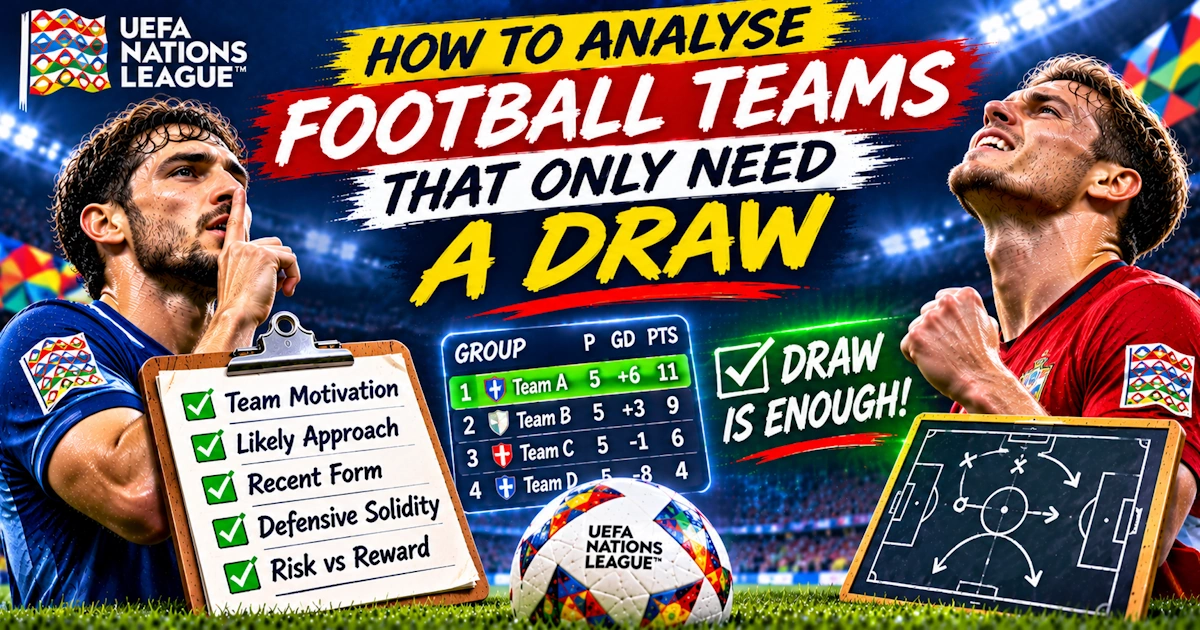
Few phrases in football prediction sound more useful than: “They only need a draw.”
It immediately creates an image of a cautious team sitting deep, protecting the score and trying to reach full time without taking unnecessary risks. Sometimes that is exactly what happens. But betting every draw-friendly team to produce a low-scoring match is far too simplistic.
A team that needs one point may defend cautiously from kickoff. Another may attack normally because its manager believes scoring first is the safest way to avoid defeat. And if the opponent desperately needs to win, the final 20 minutes can become extremely open even though one side is perfectly happy with a draw.
The important question is therefore not simply: Does this team need only a draw? It is: How will that objective change its behaviour at different scores and different stages of the match?
That is where the useful prediction information begins.
Why the Value of a Draw Changes Tactics
Normally, football teams receive more value from winning than drawing. But competition situations can change that calculation.
A draw may:
Secure qualification
Guarantee promotion
Avoid relegation
Protect an aggregate lead
Confirm first or second place
Eliminate a direct rival
When one point achieves the team’s objective, the cost of taking attacking risks increases. A full-back making an aggressive overlapping run may normally create an attacking advantage. In a match where a draw guarantees qualification, the manager may ask: Is that attack worth exposing the space behind him?
Often the answer becomes no. That can produce more conservative football.
Research Shows Scoreline Changes How Teams Play
This is not only a tactical theory. Football research consistently shows that teams adjust their behaviour according to match status.
A study examining elite football found that when teams were one goal ahead, their ball possession, entries into the final third and shots on goal decreased compared with other score situations. Earlier research on professional Spanish football similarly found that possession was greater when a team was losing than when it was winning or drawing.
A Bundesliga study analysing the 2016/17 season also found clear differences between match-status phases. Teams trying to improve an unfavourable score increased activities such as passing and possession, while match behaviour changed when teams were protecting a favourable situation.
For betting analysis, the lesson is important: Teams do not play the same way at 0-0, 1-0 and 0-1.
“Need a Draw” Does Not Mean “Play for 0-0”
This is one of the biggest misconceptions. Imagine Team A qualifies with a draw. Does that mean the manager wants 90 minutes of desperate defending? Not necessarily.
A 1-0 lead can be much safer psychologically and tactically than protecting 0-0 for the entire match. Some teams therefore begin normally and try to score first. Once ahead, they reduce risk. That creates a different prediction profile from a team that immediately uses a deep defensive block.
Before choosing an Under, examine the manager’s normal behaviour. Does the team:
Defend possession?
Press high?
Sit deep?
Attack at home regardless of the situation?
The objective matters, but tactical identity still matters too.
The Opponent’s Situation Is Just as Important
A team cannot create the match environment by itself. Suppose Team A needs only a draw. There are two completely different opponent scenarios.
Scenario 1: Team B also benefits from a draw
Neither side has much incentive to increase risk. This can create:
Slow possession
Conservative full-backs
Few counterattacks
Limited pressing
That can favour an Under.
Scenario 2: Team B must win
Now the game contains conflicting incentives. Team A wants control. Team B eventually needs risk. The first hour may still be cautious, but the final stages can become very open. This is why you should always analyse both teams’ required results.
Practical Example: Both Teams Are Happy With a Draw
Imagine:
Team A: Qualifies with one point, Strong defence, 1.1 xGA per match
Team B: Also reaches its objective with a draw, Low-risk tactical style, 1.2 xG per match
At 0-0 after 60 minutes, nothing needs to change. Neither team benefits enough from taking major risks. Possible scores: 0-0, 1-0, 1-1.
Markets worth examining could include: Under 2.5 Goals or Under 1.5 Second-Half Goals. The draw scenario supports the prediction because the underlying team profiles are already relatively cautious.
Practical Example: Only One Team Wants the Draw
Now imagine:
Team A: Qualifies with a draw
Team B: Must win
The score is 0-0 after 70 minutes. Team A’s objective is currently achieved. Team B’s is not.
Team B starts pushing:
Full-backs higher
Another striker forward
More players into the box
Team A gains counterattacking space. Suddenly both teams may have better scoring opportunities. A match that looked suitable for Under 2.5 before kickoff can become attractive for a live goal market.
The First Goal Changes Everything
Suppose the draw-friendly team scores first. Now the score is 1-0.
Its situation has improved. It can become even more conservative. The opponent, meanwhile, needs at least two goals if a draw is no longer enough. That can create enormous space.
Possible outcomes: 1-0, 2-0, 1-1, 2-1. The match may remain low scoring—or become open because the trailing team takes risks. This is why the identity of the first scorer matters.
What If the Team That Needs a Draw Concedes First?
This is the scenario that destroys many pre-match predictions. Suppose Team A only needs one point but falls behind 0-1 after 20 minutes.
Its original low-risk plan is now useless. To obtain the required draw, it must score. That means:
Higher possession
More attacking players
Greater pressing
More shots
Research on match status repeatedly finds that losing teams adapt their behaviour and often increase possession or attacking activity when trying to improve the score. So “they only need a draw” can actually become an argument for attacking football once they fall behind.
Do Not Automatically Back Under 2.5
This deserves emphasis. The draw situation may reduce pre-match attacking risk, but Under 2.5 still needs support from the football data.
Check:
xGA
Shots on target
Big chances
Defensive absences
Set-piece strength
Suppose both teams normally generate more than 1.8 xG. One side needing a draw does not automatically erase all that attacking quality. The market may already have shortened the Under price because everyone knows the qualification scenario.
Practical Example: Draw Situation Supports Under
Imagine the team needing a draw has:
0.9 xGA
Few defensive errors
Strong goalkeeper
Its opponent:
1.0 xG away
Only 3 shots on target per match
Now the tactical incentive and statistical profile agree. Under 2.5 becomes much more logical.
Practical Example: Draw Situation Does Not Support Under
Now imagine:
Team A: Needs a draw, Scores regularly, Concedes 1.7 xGA
Team B: Needs victory, 1.9 xG, Strong counterattack
The table situation is defensive for Team A. Its actual defensive quality is poor. If Team B presses aggressively, Team A may not be capable of protecting the draw. Possible scores: 1-1, 1-2, 2-2.
The words “only needs a draw” should not override weak defensive numbers.
BTTS Can Still Be Strong
BTTS may seem contradictory when one side wants a draw. It is not.
Suppose the team protecting a draw is dangerous on the counterattack. Its opponent must attack. That can create excellent chances in both directions. Team B pushes forward. Team A sits deeper. Then Team A wins possession and attacks the space behind the full-backs.
That is a perfectly realistic route to 1-1 or 2-1. When one side must chase, a draw-friendly team with strong transition attackers can still contribute to BTTS.
Team Totals Can Be Cleaner
Sometimes the situation mainly affects one team. Suppose:
Team A only needs a draw
Team B must win
Team A has an elite defence
Team B struggles to score
Instead of betting full-match Under 2.5, you might investigate: Team B Under 1.5 Goals.
Now reverse it. If Team B must attack and has a weak defence, Team A may receive excellent counterattacking chances. Then: Team A Over 0.5 Goals could be more interesting than a match-total bet. Choose the market that reflects the specific tactical expectation.
Home and Away Context Matters
A team protecting a draw at home may behave differently from one doing it away. At home, the crowd may expect possession, pressure, and attacking intent. Playing an extremely deep 0-0 strategy can become uncomfortable.
Away from home, defending compactly may feel much more natural. So compare home tactical behaviour with away tactical behaviour rather than assuming the same plan appears everywhere.
Team Quality Matters More Than Motivation
Imagine a weak team needs only a draw against an elite opponent. That objective does not suddenly make its defence world class.
It may sit with ten players behind the ball. The favourite may still create:
2.5 xG
Seven shots on target
Multiple big chances
The weaker team knows exactly what it wants. It may simply be unable to achieve it. This is why motivation should modify team-strength estimates rather than replace them.
Strong Defensive Teams Are Better at Protecting Draws
Some teams are naturally suited to these scenarios. Look for:
Low xGA
Strong aerial defending
Experienced goalkeeper
Good defensive midfield
Low error rate
Ability to defend transitions
These teams can reduce risk without becoming completely passive. A team already comfortable defending deep is usually more trustworthy in a draw-protection scenario than a side built around aggressive pressing and possession.
Defensive Absences Matter Even More
Suppose historical data says the draw-friendly side has an excellent defence. But its lineup is missing:
First-choice goalkeeper
Senior centre-back
Defensive midfielder
Now the historical numbers may overstate its ability to protect the result. This is why confirmed team news should carry significant weight. The tactical intention can be perfect. Execution still depends on the players available.
Set Pieces Can Break a Cautious Game
A low-tempo match can still produce goals through corners, free kicks, and penalties.
This matters because a team protecting a draw may allow possession without giving up much open-play space. The attacking side may increasingly rely on dead balls.
If it has strong corner delivery, tall centre-backs, and a dangerous free-kick taker, the Under may be less secure than the open-play statistics suggest. Always check set-piece matchups.
Do Not Confuse Possession With Danger
If Team B must win, it may finish with 65% possession. That sounds dominant. But possession alone does not guarantee chances.
Research from the 2022 World Cup group stage found that winning sides had significantly more attempts on target and more receptions and actions breaking defensive lines, while possession itself did not significantly differ across match outcomes.
When analysing a draw-protection strategy, focus on whether the chasing team is actually creating shots on target, big chances, final-third entries, and line breaks rather than simply holding the ball.
Substitutions Become Crucial After 60 Minutes
A manager protecting a draw may introduce a defensive midfielder, an additional centre-back, or a hard-working winger. The opponent may respond with an extra striker, an attacking midfielder, or a more aggressive full-back.
Those substitutions can completely change the game. For live predictions, pay close attention to whether the tactical changes are protective or aggressive. The final 20 minutes often provide better information than the pre-match narrative.
Time Becomes an Asset for the Draw-Friendly Team
At kickoff: 90 minutes remain. At 70 minutes: 20 minutes remain. At 85: 5 minutes remain.
If the score remains level, every minute increases the value of the current position for the team wanting a draw. That usually makes it less willing to attack. At the same time, every minute makes the chasing team more desperate. This creates increasingly asymmetric risk. That is one reason live betting can be particularly useful in these matches.
Watch Other Matches in the Group
In final-round tournament football, another result can completely change whether a draw is actually enough. Suppose Team A begins believing one point guarantees qualification. Then another team scores elsewhere.
Suddenly Team A needs victory. Its conservative plan can disappear immediately. This makes live standings essential when several matches affect one another. Never assume the pre-match scenario remains valid for 90 minutes.
Be Careful With Bookmaker Prices
“Only needs a draw” is public information. Bookmakers know it. Other bettors know it. If everybody expects a cautious match, Under 2.5 may already be priced very short.
Suppose Under 2.5 = 1.45. Raw implied probability: 1 ÷ 1.45 ≈ 69%.
Your task is not to decide whether Under is likely. It is to decide whether it is likely more than roughly 69% of the time before accounting for margin. A sensible tactical prediction can still be a poor bet at the wrong price.
Draw-Friendly Team Prediction Checklist
Before making a prediction, check:
Is a draw mathematically enough?
Does a draw help the opponent too?
What happens if another group result changes?
Current xG and xGA
Shots on target
Defensive quality
Counterattacking quality
Home or away venue
Injuries and suspensions
Set-piece defence
Manager’s normal tactical style
What happens if the draw-friendly team scores first?
What happens if it concedes first?
What changes after 70 minutes?
Has the bookmaker already shortened the obvious Under or draw price?
The tactical situation should always be translated into probabilities rather than treated as certainty.
Frequently Asked Questions
Do teams that only need a draw usually play more defensively? Often they reduce risk, especially as the match progresses. Research shows teams change possession, shots and territorial behaviour according to match status. However, the exact response depends on team style and opponent incentives.
Is Under 2.5 always good when one team needs a draw? No. If the opponent must win and both teams have strong attacks or weak defences, the match can become very open, particularly late.
What happens if the team needing a draw concedes first? Its tactical situation changes completely. It now needs to score to recover the required result and may increase possession, pressing and attacking risk.
Can BTTS still be a good prediction? Yes. A team protecting a draw may still score through counterattacks or set pieces while its opponent takes greater risks chasing victory.
When is the draw situation most useful for predictions? Often in the second half and particularly after 60–70 minutes, when the remaining time and current score make each team’s incentives much clearer.
Final Thoughts
Knowing that a football team only needs a draw can be valuable information. But it is not a prediction by itself.
The biggest mistake is turning: “A draw is enough” into: “This match will be Under 2.5.”
A draw-friendly team may reduce risk. That can create a cautious match. But the opponent may desperately need victory. A first goal may completely change the tactical balance. And a weak defence may simply be unable to protect the result no matter how conservative the manager wants to be.
The better approach is to analyse the match in stages.
At kickoff, ask: How does each team intend to play?
After the first goal, ask: Who now needs to change?
After 70 minutes, ask: Who can accept the current score—and who cannot?
Research confirms that football teams alter possession, shooting and territorial behaviour according to match status. The closer the match gets to full time, the more important those incentives can become.
So use the draw requirement as a tactical modifier. Combine it with xG, defensive quality, team news, counterattacking ability and the available odds. When those factors agree, a draw scenario can provide valuable insight. When they conflict, trust the football evidence rather than the headline.
Responsible betting: A team’s required result can influence tactics but cannot guarantee a draw, an Under or any other market outcome. Use scenario analysis alongside current performance data, keep stakes controlled and never bet money you cannot afford to lose.