
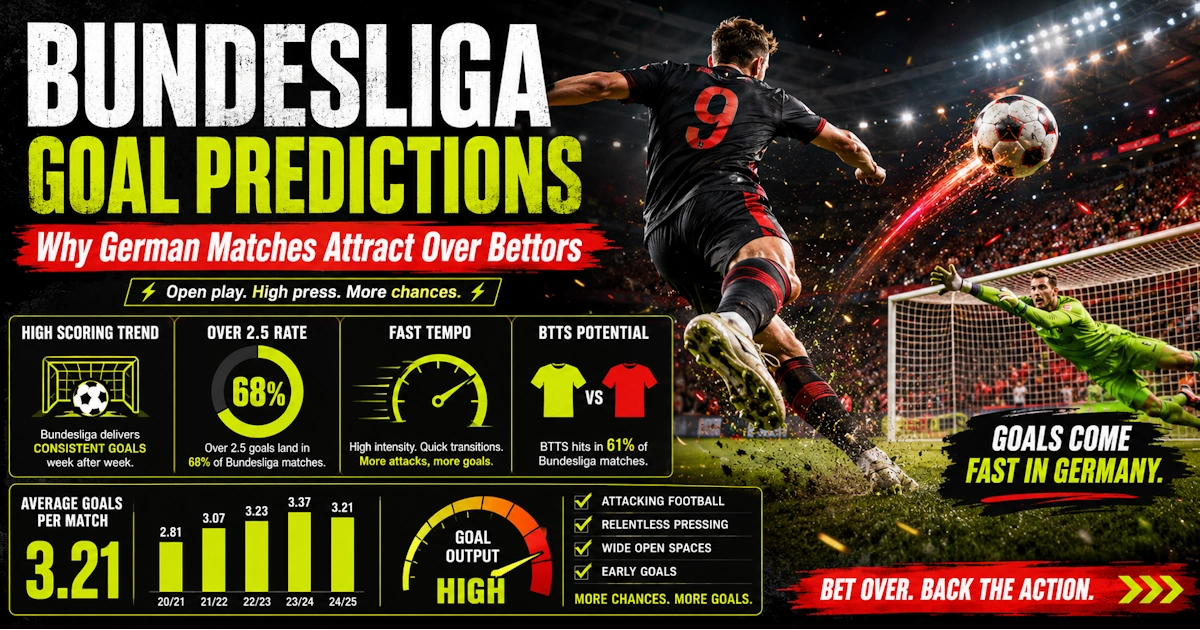
The Bundesliga has earned a reputation as one of Europe’s most attractive leagues for goal betting. Fast transitions, aggressive pressing and teams that continue looking for another goal after taking the lead can create matches that feel very different from slower, more controlled competitions.
The numbers give that reputation some support.
The 2025/26 Bundesliga season produced 990 goals in 306 matches, an average of 3.24 goals per game. Over 2.5 goals landed in 64% of league fixtures, while Both Teams to Score occurred in 62%.
Those are eye-catching figures for Over bettors, but they should not become a shortcut. A high-scoring league still contains defensive teams, difficult tactical matchups and fixtures where the market has already priced the expectation of goals very aggressively.
The Bundesliga is a good place to look for Over 2.5 opportunities. It is not a league where Over 2.5 should be selected automatically.
For the broader analytical framework, read our guide to football goal predictions, including Over/Under, BTTS, venue form, expected goals and match context.
Why Does the Bundesliga Produce So Many Goals?
There is no single explanation.
One important factor is the attacking philosophy used by many German teams. High pressing is common, and teams frequently try to recover possession quickly rather than immediately dropping into a defensive block.
That can create chances in both directions.
When the press works, possession may be won close to the opponent’s penalty area, producing a chance before the defence is organised. When the press fails, the opponent can suddenly attack large areas of open space.
That combination is ideal for high-scoring football.
A match does not need poor teams to produce goals. Two tactically ambitious sides can create an open game simply because both are willing to commit players forward.
Transitions Can Matter More Than Possession
Possession statistics alone are not particularly useful for Bundesliga goal predictions.
A team may have only 42% of the ball but create several excellent chances through fast transitions. Another can dominate possession without consistently reaching dangerous areas.
This is especially important when one team uses a high defensive line.
Imagine the home side presses aggressively and keeps its defenders close to halfway. The visitors have two quick forwards who are comfortable attacking space.
The home team may create chances through pressure, but every broken press provides the visitors with an opportunity to run behind the defence.
That matchup can support both Over 2.5 and BTTS – Yes, even when one team is expected to control most of the ball.
Look at how chances are created rather than simply who is expected to dominate possession.
Teams Often Continue Attacking After Scoring
One reason Over bettors like the Bundesliga is that a 1-0 lead does not always signal the end of attacking football.
Some teams continue pressing and committing players forward after scoring. This can produce a second goal, but it can also expose them to an equaliser.
The first goal therefore has the potential to open the match rather than close it.
Our guide to goal timing in football explains how the opening goal can change tactics, game state and the likelihood of further scoring as the match develops.
Consider a team that leads 1-0 after 25 minutes but continues sending its full-backs forward. The opponent now needs to attack more, while the leading side still has several players positioned aggressively.
Suddenly, 2-0, 1-1 and 2-1 all become realistic.
This is very different from a team whose first reaction to scoring is to slow possession and defend its lead.
When analysing Bundesliga goal markets, check how the teams behave after scoring first, not simply how frequently they score.
The League Average Is Only the Starting Point
A 64% Over 2.5 rate is useful background information, but individual clubs can be completely different.
Bayern Munich were an extreme example in 2025/26. Their league matches averaged 4.65 total goals, and 94% finished Over 2.5. Bayern themselves scored 122 goals across the season.
Compare that with Borussia Dortmund. Despite scoring 70 league goals, only 56% of their matches finished Over 2.5, below the Bundesliga average of 64%.
For broader context, our comparison of European leagues with the most Over 2.5 goals shows how the Bundesliga’s scoring rate compares with Serie A, the Premier League, Eredivisie and other competitions.
That difference shows why the phrase “Bundesliga match” is not enough.
A league may provide a high-scoring environment, but the two teams involved still determine whether a particular fixture deserves an Over bet.
Home and Away Form Is Especially Important
Always separate home and away numbers.
A team may play aggressive football in its own stadium but become more conservative away. Another may actually produce more goals on the road because its counterattacking style works better when the opponent takes the initiative.
For the home team, compare its home scoring and conceding averages. For the visitors, use away numbers.
Our guide to home and away form for goal bets explains how the home side’s venue-specific attack and defence should be compared directly with the visitor’s away profile.
Suppose the home side averages 2.0 goals scored and 1.5 conceded at home. The visitor scores 1.6 away but concedes 1.8.
That gives the match several realistic routes to three goals.
Now imagine the visitor scores only 0.7 away and has failed to score in half its road fixtures. The match may still go Over, but the prediction increasingly depends on the home team scoring three goals alone.
In that situation, a home team total could be more suitable than BTTS.
When the analysis points more clearly towards one side scoring than both teams contributing, our team-to-score betting guide explains how scoring frequency, opponent conceding rates, xG and venue data can be combined.
Expected Goals Can Expose Misleading Results
Bundesliga matches can produce spectacular scorelines, but one 5-3 result should not completely change your prediction for the next game.
Expected goals help show whether those scores were supported by the quality of the chances.
A team may score four times from an xG total of only 1.4. That is possible, but repeating such finishing every week is difficult.
Another may score only once despite producing 2.3 xG. Its attack may actually be performing better than the scoreline suggests.
The Bundesliga itself makes extensive use of xG and related Match Facts to measure shot quality and attacking momentum. Its Match Momentum metric also considers shots, xG, attacking-zone entries, crosses, corners and touches inside the penalty area.
For an Over 2.5 prediction, look for matches where actual goals and underlying chance creation both point towards an open game.
For a deeper explanation, our expected goals guide shows how xG and xGA can reveal whether spectacular scorelines are supported by sustainable chance creation or unusually efficient finishing.
Shots on Target Help Confirm Attacking Threat
Total shots can be noisy.
A team taking 18 attempts does not necessarily look dangerous if 12 come from poor positions. Shots on target and big chances provide a better indication of whether goalkeepers are genuinely being tested.
A useful Over profile is often created when one or both teams:
regularly produce five or more shots on target
allow opponents several accurate attempts
create chances inside the penalty area
struggle to prevent transitions
This does not mean setting a rigid minimum. The purpose is to confirm that high goal averages are supported by actual attacking activity.
Set Pieces Add Another Route to Goals
Open play gets most of the attention, but set pieces were also highly productive in the Bundesliga.
By March 2026, 164 goals had already been scored from set-piece situations, comfortably above the previous season’s final total of 143. Bayern, Borussia Dortmund and Freiburg were among the most productive teams from dead-ball situations.
This matters because a match does not need to be end-to-end for Over 2.5 to remain possible.
A corner, penalty or free kick can produce the first goal in a controlled fixture. Once the score changes, the team behind may have to attack more aggressively, creating additional opportunities.
Before dismissing a match as tactically tight, check set-piece strengths and weaknesses.
When Over 2.5 May Be the Better Market
Imagine a strong home favourite that averages more than two goals per match. The visitors concede regularly away but also fail to score often.
The likely results might include: 3-0, 4-0, 3-1 or 2-0.
BTTS depends on the weaker team contributing. Over 2.5 does not.
This is one of the most important distinctions in Bundesliga goal predictions. A league can produce plenty of goals without every high-scoring match involving both teams.
If the favourite can realistically cover three goals alone, Over 2.5 may be stronger than BTTS.
Our guide on how to predict Over 2.5 goals explains how scoring averages, defensive weaknesses, venue form, xG and shots on target should confirm that higher-scoring scenario.
When BTTS May Be Better
Now imagine two balanced teams.
Both score in most of their relevant matches, neither keeps many clean sheets and each averages around 1.5 goals.
Likely scores might include 1-1, 2-1 or 1-2.
Here, BTTS – Yes has one major advantage: 1-1 is enough.
Over 2.5 would still require another goal.
When both attacks are reliable but neither regularly scores three alone, BTTS can fit the expected match pattern better than the traditional Over market.
Our BTTS vs Over 2.5 comparison explains how to choose between the markets by identifying whether both teams have a reliable scoring route or one side may produce most of the total.
Do Not Ignore Defensive Teams
The Bundesliga’s overall scoring numbers can encourage bettors to overlook strong defensive profiles.
That is a mistake.
If both teams allow little xG, keep frequent clean sheets and struggle to create against organised opponents, the league average should carry very little weight.
For example, if the relevant teams have produced Under 2.5 in seven of their last ten home and away fixtures respectively, a 64% league Over rate does not suddenly make their matchup an automatic goal fest.
Individual statistics should always override the general reputation of the competition.
When low xG, frequent clean sheets and venue-specific results all point towards a controlled match, our guide on how to predict Under 2.5 goals explains how to assess the lower-total market without relying on league stereotypes.
A Simple Bundesliga Goal Checklist
Before selecting an Over market, check:
Relevant home and away scoring averages
Over 2.5 and BTTS percentages
xG and xGA
Shots on target and big chances
Clean-sheet and failure-to-score rates
Pressing and transition styles
Performance after scoring or conceding first
Defensive injuries
Set-piece strengths
Whether the available odds already reflect the Bundesliga’s high-scoring reputation
The strongest selections normally have several independent indicators supporting the same match scenario.
Frequently Asked Questions
Is the Bundesliga a good league for Over 2.5 goals?
Historically it often produces high goal averages, and 64% of matches finished Over 2.5 in 2025/26. That makes it useful for goal analysis, but individual fixtures still need to be assessed separately.
Why are Bundesliga games often high-scoring?
High pressing, fast transitions, attacking full-backs and teams continuing to attack after scoring can create more chances and defensive space.
Is BTTS better than Over 2.5 in Germany?
Neither is automatically better. BTTS is often more suitable when both teams score reliably, while Over 2.5 can be stronger when one favourite can score three goals alone.
Should I always back Over when Bayern play?
No. Bayern’s 2025/26 matches were exceptionally high-scoring, but odds reflect that reputation. Opponent quality, line-ups and price still matter.
Are xG statistics useful for Bundesliga predictions?
Yes. They help determine whether recent goals are supported by sustainable chance creation rather than unusually efficient finishing.
Final Thoughts
The Bundesliga attracts Over bettors for a good reason. The completed 2025/26 season produced 990 goals at 3.24 per match, with almost two-thirds of fixtures crossing the 2.5-goal line.
But the best Bundesliga goal predictions do not begin with “Germany equals goals”.
They begin with the two teams.
Look at home and away form, pressing styles, transition threat, expected goals, shots on target and defensive weaknesses. Then decide whether both teams are likely to contribute or whether one side can produce most of the scoring.
The Bundesliga provides an attractive environment for goals. Good analysis determines which matches actually deserve the bet.
Explore our football betting resources for more guides covering goal markets, league analysis, football statistics and prediction strategy.
Responsible betting: High-scoring league trends cannot guarantee individual results. Keep stakes within a fixed budget and never bet money you cannot afford to lose.