
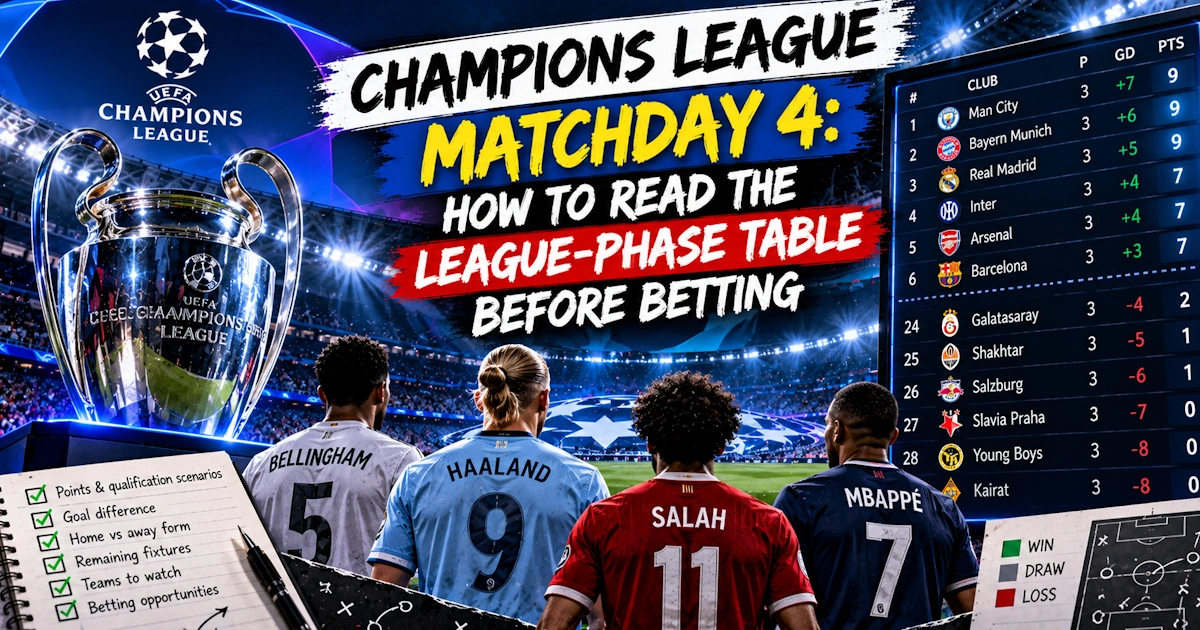
Champions League Matchday 4 is different from the opening rounds. After three matches, the league-phase table has started to take shape.
Some clubs are already pushing towards the top eight, others are sitting around the play-off positions, and teams near the bottom are beginning to feel pressure. But the table can also mislead bettors.
A club sitting fifth may have faced a relatively easy schedule. A team in 22nd may have played several elite opponents and still have much easier fixtures ahead.
That is why Matchday 4 analysis should go beyond simply looking at league position. Under the current Champions League format, all 36 clubs share one league table.
Each team plays eight different opponents—four at home and four away. The top eight qualify directly for the round of 16, teams ranked ninth to 24th enter the knockout phase play-offs, and positions 25 to 36 are eliminated.
Matchday 4 therefore represents the halfway point. That makes the standings much more useful—but not yet decisive.
Matchday 4 Is the Halfway Point
After Matchday 4, every team will have played 4 of 8 league-phase matches. That means four games remain.
A team can still collect 12 more points after Matchday 4. This is important because bettors sometimes react too strongly to early league position.
Imagine a club is 24th before Matchday 4. That sounds dangerous.
But it still has five matches including the upcoming fixture, meaning plenty of points remain available. The pressure is real.
It is not yet the same as Matchday 8, when qualification mathematics can become absolute.
Understand the Three Main Areas of the Table
Before making a prediction, divide the standings into three zones.
Positions 1–8: Direct Qualification The top eight clubs qualify directly for the round of 16. That is extremely valuable because those teams avoid an additional two-legged play-off.
A club sitting around seventh, eighth or ninth therefore has more to think about than simple qualification. It is fighting to avoid two extra matches.
Positions 9–24: Knockout Play-Off Zone These clubs remain in the competition but must play an additional knockout tie. There is also a difference within this group.
Teams ranked ninth to 16th are seeded for the knockout phase play-offs, while teams in positions 17 to 24 are unseeded. So finishing 11th is not the same as finishing 23rd.
Ranking matters even after a team enters the qualification zone.
Positions 25–36: Elimination Zone These teams are eliminated after the league phase. There is no drop into the Europa League.
That means clubs around 23rd to 27th eventually face one of the most important battles in the table.
Do Not Read Position Without Reading Points
League position alone can be misleading. Imagine:
8th place – 7 points
15th place – 6 points
22nd place – 4 points
The visual gap from eighth to 22nd looks huge. The actual points gap may be only three.
One win could change the table dramatically. That is why you should always look at position and points rather than position alone.
The league phase can remain extremely compressed during the middle matchdays.
Goal Difference Is Already Important
When teams are level on points during the league phase, goal difference is the first tiebreaker. Goals scored come next, followed by further criteria such as away goals scored.
That means a result such as 4-0 can be significantly more valuable than 1-0, even though both produce three points. For bettors, this is relevant because strong teams may sometimes continue attacking after the result looks comfortable.
Suppose a club leads 2-0 after 70 minutes and sits close to several other teams on the same number of points. Improving goal difference may still matter.
That can support:
Over 3.5 Goals
But do not assume every team will chase additional goals aggressively. Tactics and fixture context still matter.
The Champions League Has Been Producing Plenty of Goals
The 2025/26 league phase produced 487 goals in 144 matches, an average of 3.38 goals per game. Interestingly, through the first four matchdays of that season, there had already been 246 goals, averaging approximately 3.42 per game.
Only five of those first 72 matches finished 0-0. Those numbers show that league-phase football can create an attacking environment.
But they should not become a reason to blindly back Over 2.5 on Matchday 4. The individual table situation and matchup remain more important.
Look at Who the Team Has Played
This is perhaps the biggest weakness in reading the table. Under the current format, every club faces eight different opponents.
Each team is drawn against two clubs from each of four seeding pots, with one home and one away match against an opponent from each pot. That means two teams on six points may have reached that total through completely different schedules.
Team A
Beat two weaker opponents
Lost to an elite team
Team B
Beat a top club
Drew away against another strong side
Lost narrowly to another elite opponent
Both may have similar points, but Team B’s performances could actually be more impressive. Before using the table in your prediction, check the quality of the opponents already faced.
Future Fixtures Matter Too
You should also look forward. Suppose Team A sits eighth but still has to face two elite opponents and two difficult away matches.
Team B sits 14th but has several more favourable fixtures remaining. Their current positions do not tell the full story.
This matters for motivation too. A team with difficult future fixtures may place greater importance on winning Matchday 4.
Another club may know it has more manageable opportunities later. You cannot measure motivation perfectly, but schedule difficulty adds useful context.
Do Not Call Matchday 4 “Must Win” Too Easily
This is one of the biggest betting mistakes. A club loses two of its opening three matches and you hear: “Matchday 4 is must win.”
Usually, that is an exaggeration. After Matchday 4, four more games remain.
A team can recover a surprising number of positions with two or three consecutive victories. So rather than saying “must win,” use more accurate language like “increasingly important” or “needs points to avoid falling behind.”
That difference matters because “must-win” reasoning often leads bettors directly towards Over markets without enough evidence.
Motivation Does Not Automatically Mean Goals
Suppose Team A badly needs three points. That does not automatically mean it will attack with six players from the first minute.
The manager may think the most important thing is not conceding first. The team could begin cautiously and increase risk later.
This is why Matchday 4 table pressure can sometimes be more useful for second-half goals or late goals than aggressive first-half markets. Game state matters.
Practical Example: Team Just Outside the Top Eight
Imagine Team A sits 10th with 6 points. The top eight are only one point ahead.
Team A plays at home and averages:
1.9 home xG
5.7 shots on target
Strong possession numbers
Its opponent allows:
1.6 away xGA
Plenty of shots
Few clean sheets
The table adds motivation to an already strong attacking profile. Possible scores: 2-0, 2-1, 3-1.
Here, Matchday 4 position strengthens the case for a home-team goal market. The table is supporting the football statistics.
Practical Example: Bottom Team but Poor Over Candidate
Now imagine Team B has 1 point from 3 matches. It clearly needs improvement.
But its current attacking numbers are:
0.8 xG per game
2.4 shots on target
Few big chances
Its Matchday 4 opponent has a strong defence. The betting argument: “They need points, so there will be goals” is weak.
Motivation cannot manufacture attacking quality. Possible scores may still include: 0-1, 1-1, 0-2.
The table tells you Team B needs a result. It does not tell you Team B is capable of creating three goals.
Practical Example: Both Teams Around the Play-Off Cut-Off
Imagine Team A is in 23rd place with 3 points, and Team B is in 25th place with 2 points. Both would like to move away from the elimination zone.
At 0-0 after 60 minutes, however, neither team is necessarily desperate enough to abandon all defensive structure. There are still several matches remaining.
This is different from the same situation on Matchday 8. Do not apply final-round logic to Matchday 4.
Practical Example: Strong Favourite Chasing Goal Difference
Suppose an elite club has 9 points and sits around the top eight. It hosts a weaker opponent and leads 2-0 after 65 minutes.
If several nearby clubs are level on points, improving goal difference has some value. The favourite also has strong bench depth, high xG, and fresh attacking substitutes.
Now, Home Team Over 2.5 may remain interesting. But goal difference should be the final supporting argument, not the first one.
Use xG Alongside the Table
The league table records outcomes, while xG helps explain performance. You can review these metrics on statistical platforms like FBref.
Suppose:
Team A: 7 points, 4.1 total xG
Team B: 4 points, 6.8 total xG
Team A looks much stronger in the standings. Team B may actually have created better chances but finished poorly.
For Matchday 4, that difference can matter. The table tells you what has happened, but underlying statistics help estimate what could happen next.
Goal Difference Can Be Misleading Too
Suppose a club has +5 goal difference after three matches. Excellent.
But one match ended 5-0, while the other two were 0-1 and 1-0. That +5 figure is heavily influenced by one result.
Check how the goal difference was created. The same applies to a team sitting at -6.
Perhaps four of those goals came after an early red card. Context matters.
Compare Goals With xG
A team may sit high in the table because it has been extremely clinical. For example, 8 goals from 4.9 xG.
That finishing may not continue. Another club may have 3 goals from 6.2 xG and a disappointing table position.
Its future attacking prospects may actually be better. This is why betting directly from the standings can be dangerous.
League position is an outcome statistic. It does not always describe performance quality.
Watch for Strong Goalkeeping
Defensive table numbers can also mislead. Suppose a club has conceded only 2 goals in three matches.
But it has allowed 5.0 xGA. The goalkeeper may have been outstanding.
Against a strong Matchday 4 attack, that clean defensive record may be less reliable than it appears. For Under and BTTS-No predictions, always check what sits behind the goals-conceded column.
Home and Away Context Still Matters
The table combines home and away results, but your prediction should not. Suppose a club has seven points.
But both victories came at home, and its only away fixture was a poor defeat. Now Matchday 4 is away.
The overall league position may overstate its suitability as a favourite. Compare the home and away context before allowing table position to influence your view.
Ranking Beyond 24th Matters Eventually
One useful feature of the league-phase system is that there are several ranking incentives. The difference between 8th and 9th means direct qualification versus a play-off.
The difference between 16th and 17th affects seeding for the play-off. The difference between 24th and 25th means qualification versus elimination.
That means a team can have motivation even when it is already “inside the top 24.” But on Matchday 4, those positions are still highly fluid.
Use them as context, not certainty.
Matchday 4 Table Checklist
Before making a Champions League prediction, check:
Current position and current points
Distance from eighth place and 24th place
Goal difference and goals scored
Opponents already faced
Remaining fixture difficulty
Home-away split
xG, xGA, and shots on target
Whether recent results match the performances
Injuries and rotation
Whether the team really needs a win or a draw has value
Whether the available odds already reflect the table situation
The league table should help explain motivation. It should not replace normal football analysis.
Frequently Asked Questions
Why is Champions League Matchday 4 important? It is the halfway point of the eight-match league phase. After Matchday 4, each club has only four matches remaining, so the table begins to provide much more useful qualification context.
How do teams qualify from the league phase? The top eight qualify directly for the round of 16. Teams ranked ninth to 24th enter knockout phase play-offs, while positions 25 to 36 are eliminated.
Is goal difference important on Matchday 4? Yes. Goal difference is the first tiebreaker between teams level on points, although there are still enough matches remaining for positions to change significantly.
Should I back Over 2.5 when a team needs points? Not automatically. A team also needs attacking quality. Check xG, shots on target, opponent strength and tactics before using motivation as an Over argument.
Are teams outside the top 24 already in must-win situations? Usually not on Matchday 4. The pressure is increasing, but several matches remain. Genuine must-win situations are more common near the end of the league phase.
Final Thoughts
Champions League Matchday 4 is where the league table starts becoming genuinely useful for football predictions. Three matches have already been played, and qualification positions are beginning to form.
And after this round, half of the league phase will be complete. But do not make the mistake of treating the table as a complete description of team quality.
A club can be eighth because it had an easier schedule. A team in 20th can have strong underlying numbers after facing difficult opponents.
And a side with only three points can still have plenty of time to recover. The best approach is to read the table together with points, goal difference, schedule strength, xG, shots, venue and team news.
Then ask what the position actually changes. Does the team need to push harder? Can it accept a draw?
Does improving goal difference matter? Or is the table creating a dramatic story that the football statistics do not support?
By Matchday 4, the standings deserve attention. They just should not get the final word.
Responsible betting: League-phase position can influence motivation but cannot guarantee a result or goal total. Combine standings with current performance data, compare probability with price, keep stakes controlled and never bet money you cannot afford to lose.