The Champions League no longer has the familiar eight groups of four teams. Since 2024/25, UEFA’s main competition has used a single 36-team league phase, and that change matters for football bettors far more than it may appear at first.
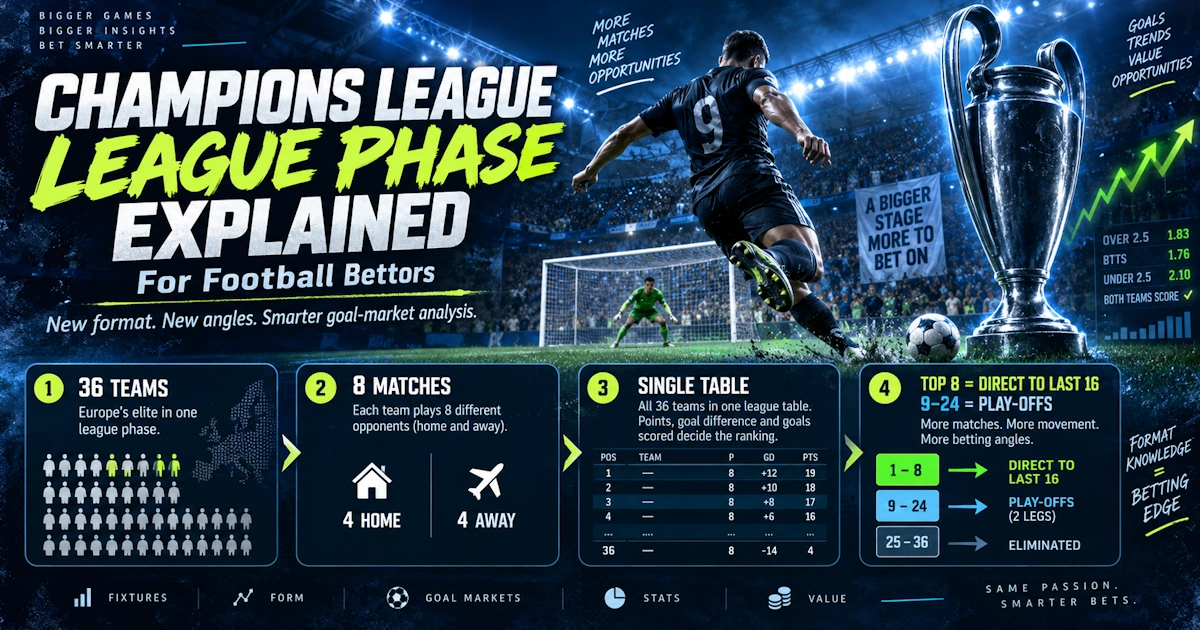
Every club plays eight matches against eight different opponents. There are no traditional home-and-away group rematches, and all 36 teams are ranked in the same table. In 2026/27, the league phase again contains 144 matches spread across eight matchdays.
For betting analysis, this creates new questions. A team may face a completely different level of opposition from the club sitting directly above it. Goal difference can become important. A club that appears comfortable in 15th place may suddenly need a victory because several teams are only one or two points behind.
Understanding the format therefore helps explain motivation, rotation and the way matches may develop.
How Does the Champions League League Phase Work?
All 36 clubs are placed into one table.
Each team plays eight matches against eight different opponents: four at home and four away. The teams are divided into four seeding pots, and each club is drawn against two opponents from every pot, with one of those matches at home and the other away.
A win is worth three points, a draw one and a defeat zero.
After eight matches, the table determines what happens next.
Teams finishing 1st to 8th qualify directly for the round of 16. Those placed 9th to 24th enter a two-legged knockout phase play-off. Clubs finishing 25th to 36th are eliminated from Europe completely rather than dropping into the Europa League.
This makes almost every position relevant.
Finishing eighth and ninth can mean the difference between going directly into the last 16 and playing two additional knockout matches.
The opening match of those play-offs requires its own approach because neither team yet has an aggregate deficit forcing it to attack. Our Champions League play-off first-leg guide explains how tactical caution, home advantage, quality differences and qualification pressure can affect Over/Under and BTTS markets.
Once the competition moves into those two-leg knockout ties, the analysis changes again. Our Champions League play-off second-leg guide explains how the aggregate score changes attacking requirements, Over/Under, BTTS and late-goal markets.
Why the Format Matters for Betting
Under the old group system, bettors could quickly understand the situation.
A team might have already won its group after five matches, while another was mathematically eliminated. That often made the final round relatively easy to interpret.
The league phase is less predictable.
Because 36 clubs share one table, a result in one match can affect teams playing hundreds of kilometres away. A single goal can move a club several positions when teams are level on points.
That means you should not analyse a Champions League fixture using only the two teams involved.
By the later rounds, the wider table can be just as important as recent form.
Not Every Team Plays the Same Schedule
This is one of the most important differences from a normal domestic league.
All 36 teams appear in one table, but they do not play one another.
Each club faces only eight opponents.
Imagine Team A and Team B both finish with 14 points.
Team A may have faced several European heavyweights, while Team B received a relatively favourable collection of opponents.
Their identical points totals do not necessarily indicate identical performance levels.
For betting, this means league position should be combined with strength of schedule.
If a team sits 18th after difficult away matches against elite opposition, it may actually be stronger than another club sitting 12th after a much easier schedule.
This becomes especially important when evaluating future goal markets.
For a deeper fixture-by-fixture approach, our guide to analysing the Champions League draw for goal predictions explains how opponent quality, home-away placement, league strength and fixture order can create very different betting situations.
Pot Numbers Do Not Tell the Whole Story
The draw uses four pots, but a team’s pot should not be treated as a direct prediction of match difficulty.
Every club plays two opponents from each pot, including two from its own seeding level.
A lower-pot team can still be extremely dangerous at home. A highly seeded club may arrive with injuries, fixture congestion or a tactical style that suits the underdog.
For goal predictions, ask what the matchup creates.
A Pot 1 club that uses an aggressive high defensive line against a fast counterattacking underdog could produce an excellent BTTS opportunity.
A much stronger favourite against a deep defensive block might dominate completely but produce only a 1-0 or 2-0 result.
Seeding tells you something about general strength. It tells you much less about how many goals a particular game will produce.
The League Phase Has Produced Plenty of Goals
The first two seasons of the format produced strong scoring numbers.
In the 2025/26 league phase, 487 goals were scored across 144 matches, an average of 3.38 goals per game. That exceeded the 470 goals scored during the inaugural 2024/25 league phase.
Those numbers make Champions League goal markets naturally interesting.
But a competition average above three goals does not mean every fixture deserves an Over 2.5 selection.
One team may be responsible for most of the expected scoring. Another match may involve two clubs happy to protect their position.
The league-phase scoring environment is useful background information. The individual matchup remains more important.
When a specific fixture appears suitable for a higher total, our guide on how to predict Over 2.5 goals explains how scoring averages, venue form, defensive weakness, xG and shots on target should confirm the selection.
Why Motivation Changes During the Eight Matches
Matchday 1 and Matchday 8 can feel like different competitions.
At the opening stage, there is almost no current Champions League sample for the teams involved. Our Champions League Matchday 1 goal-markets guide explains how to adjust domestic form, league strength, new signings and early-season uncertainty before choosing Over/Under or BTTS markets.
At the beginning, one defeat is recoverable. Teams still have seven matches to accumulate points.
By the final two rounds, every position becomes clearer.
A team may need three points to reach the top eight. Another may simply need a draw to remain inside the top 24. A club sitting 26th may have no realistic option except to attack.
Those situations can change goal predictions dramatically.
Consider two hypothetical teams entering the last matchday.
The home side is 10th and knows a win could push it into the top eight. The visitors are 23rd and need at least a point to avoid elimination.
The home team has a reason to attack, while the visitors may initially protect the draw.
If it remains 0-0 after 70 minutes, however, results elsewhere could change what both sides need.
This is why live standings become particularly valuable late in the league phase.
Our guide to must-win matches explains why needing a result can increase attacking risk without automatically guaranteeing a high-scoring match.
Goal Difference Can Influence Attacking Behaviour
Points remain the main factor, but goal difference is an important ranking criterion when teams finish level.
That can create situations rarely seen in an ordinary mid-season league fixture.
A strong club may already be winning 2-0 but continue pushing for a third because every additional goal could improve its final ranking.
Likewise, a team facing a heavy defeat may have a reason to avoid conceding another rather than accepting that the match is already lost.
For bettors, this can affect team totals, late goals and handicap markets.
Do not assume that a comfortable lead removes motivation automatically.
When that pressure continues into the closing stages, our guide to predicting late goals after the 75th minute explains how urgency, substitutions, recent pressure, xG and counterattacking space should be assessed.
Top Eight Versus the Play-Off Places
There is a major difference between finishing inside and outside the top eight.
The top eight go directly into the round of 16. Teams finishing ninth to 24th must play another two-legged tie. UEFA also uses the league-phase ranking to determine seeding in the knockout path, with higher positions providing advantages later in the competition.
This gives strong teams a reason to continue collecting points even after they are virtually certain to finish inside the top 24.
In the old group format, a club might qualify with a match to spare and rotate heavily.
Under the league system, a qualified team can still have a meaningful incentive to chase the top eight.
That is important when predicting rotation.
Rotation Is Still a Risk
Motivation does not guarantee that managers will use their strongest eleven.
A Champions League club may have a crucial domestic match three days later. Injuries, travel and accumulated minutes can lead to rotation.
This becomes particularly important when a club’s table position gives it some flexibility.
For goal betting, identify where the rotation occurs.
Resting two forwards may reduce the appeal of a team total.
Resting two centre-backs while retaining the first-choice attack could do the opposite and make BTTS or Over 2.5 more interesting.
Simply reading that a team will “rotate” is not enough.
The wider effect of congestion is covered in our guide to goal predictions after European matches, which explains how recovery time, travel, rotation and squad depth can affect both attacking and defensive performance.
Practical Example: Top-Eight Chase
Imagine a strong home team enters Matchday 8 in ninth position.
It needs a victory and possibly a better goal difference to move into the top eight.
Its opponent is already eliminated and has conceded regularly away.
The home team averages strong xG, creates plenty of shots and has its main attackers available.
In this situation, Team Over 1.5 or Over 2.5 could have a logical foundation because the favourite may have reasons to keep attacking even after taking the lead.
A normal league match at 2-0 might slow down. This Champions League situation may encourage the team to pursue another goal.
Practical Example: Protecting a Top-24 Place
Now imagine a side sits 21st and requires only a draw against a stronger opponent.
Its recent away matches show a compact defensive approach, few shots and a high Under 2.5 percentage.
The favourite is already safely inside the top eight.
Despite the Champions League’s high overall scoring average, this fixture may favour a lower total.
The table situation provides the tactical explanation: one side is happy to protect a point while the other has less reason to force the game.
Statistics Bettors Should Check
Before betting on a league-phase match, it is useful to combine the competition situation with the usual performance data:
Current table position and points required
Remaining opponents and schedule difficulty
Home and away goals
Over 2.5 and BTTS rates
xG and xGA
Shots on target and big chances
Recent Champions League performance
Domestic fixture congestion
Injuries and expected rotation
Goal difference
Likely reaction to scoring or conceding first
Whether another match could alter what either team needs
Expected goals are particularly useful when the league position or recent scorelines appear stronger or weaker than the performances themselves. Our expected goals guide explains how xG and xGA can distinguish genuine chance creation from results affected by finishing or goalkeeping.
This approach becomes increasingly important from Matchday 6 onwards.
Frequently Asked Questions
How many teams are in the Champions League league phase?
There are 36 teams, all ranked in one league table.
How many matches does each team play?
Each club plays eight different opponents: four at home and four away.
What happens to teams finishing ninth to 24th?
They enter a two-legged knockout phase play-off, with eight winners advancing to the round of 16.
Do eliminated Champions League teams enter the Europa League?
No. Teams finishing 25th to 36th are eliminated from European competition.
Is the league phase good for Over 2.5 betting?
It can be. The 2025/26 league phase averaged 3.38 goals per match, but individual team profiles, motivation and odds remain more important than the competition-wide average.
Final Thoughts
The Champions League league phase creates a different betting environment from the old group stage.
Thirty-six teams share one table, but each club faces only eight opponents. That means league position must be interpreted alongside schedule difficulty, home-away assignments and the quality of opposition.
For bettors, the format becomes particularly interesting late in the phase.
A team may be chasing the top eight, fighting to remain inside the top 24 or trying to improve its ranking and goal difference. Those incentives can affect pressing, rotation, late-game risk and whether a team continues attacking after taking the lead.
Understand the table first. Then add xG, scoring form, team news and tactical matchup.
The Champions League format may look more complicated than the old groups, but for football predictions that extra complexity can provide useful information that the basic match odds do not fully explain.
Responsible betting: Competition format and motivation can improve analysis but cannot guarantee results. Keep stakes within a fixed budget and never bet money you cannot afford to lose.