
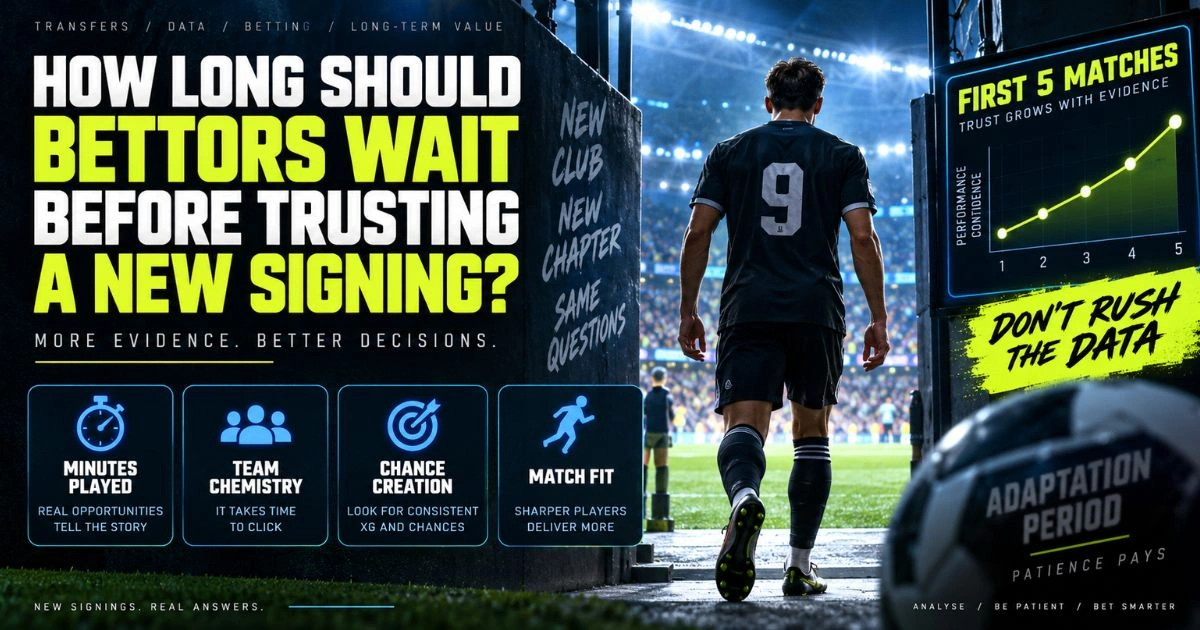
A new signing can change the mood around a football club overnight.
A striker arrives after scoring 20 goals the previous season. A creative midfielder joins for a large transfer fee. A new centre-back is expected to fix a defence that conceded far too easily.
For bettors, the temptation is to react immediately.
If the player is clearly talented, why wait?
Because signing a good footballer and immediately improving a team’s betting profile are not the same thing.
New players need to learn tactical instructions, understand teammates, build match fitness and sometimes adapt to an entirely different league. Their role may also turn out to be different from the one they had at their previous club.
This uncertainty is particularly important around the end of the transfer window. Our guide to how Transfer Deadline Day changes football predictions explains how arrivals, departures and expected line-ups can change the value of existing team statistics.
There is no universal rule saying bettors should wait exactly five or ten matches. A better approach is to wait until there is enough evidence to understand how the player is actually being used.
There Is No Magic Number of Matches
Five matches sounds like a reasonable sample. Ten sounds safer.
Neither guarantees anything.
A new striker could start five consecutive games and immediately become the focal point of the attack. Another may make five appearances but play only 110 minutes in total.
Those are completely different samples.
Instead of counting appearances, start with:
Minutes played
Number of starts
Tactical role
Fitness level
Quality of opposition
Whether the player completes matches
How stable the starting eleven is
As a general working rule, around 400–600 competitive minutes can begin to provide useful clues about a player’s role and underlying performance.
That is roughly five to seven full matches.
It is still a small sample, particularly for goals, but it gives you much more information than two substitute appearances and one start.
Minutes Are More Important Than Appearances
Football statistics can become misleading when appearances are counted without context.
Imagine Player A has made six appearances.
That sounds like enough to start evaluating him.
But his minutes are:
18
12
25
8
30
15
He has played only 108 minutes.
Now compare Player B, who has started four times and played 345 minutes.
Player B has technically made fewer appearances, but you already know much more about how he fits into the team.
For betting analysis, minutes provide the better denominator.
This is especially important for:
Goals per 90
Expected goals per 90
Shots per 90
Chances created per 90
Touches in the penalty area
Defensive actions
Do not trust an impressive per-90 statistic produced from 70 or 80 minutes of football.
Start With the Player’s Role
Before deciding whether a new signing has improved the team, work out what the manager actually wants him to do.
A striker can be:
The main penalty-box finisher
A target forward
A false nine
A pressing forward
A second striker
A wide forward moving centrally
Those roles produce very different betting implications.
Suppose a striker scored 18 goals at his previous club while averaging four shots per match.
At his new team, he drops deeper, touches the ball more often outside the penalty area and averages only 1.8 shots.
His reputation has not changed, but his scoring probability probably has.
This is why bettors should not simply import statistics from the previous club.
The player needs to be analysed inside the new system.
Expected Goals Can Help Before the Goals Arrive
Actual goals are one of the slowest statistics to stabilise because finishing can be highly variable over short periods.
A new striker might score four goals from his first six shots.
Another could go five matches without scoring despite repeatedly receiving excellent chances.
Expected goals can help distinguish between those situations.
Consider two fictional forwards after 450 minutes.
Striker A
4 goals
1.8 xG
9 shots
4 shots on target
Striker B
1 goal
3.7 xG
18 shots
8 shots on target
The headline numbers make Striker A look far more dangerous.
The underlying numbers suggest Striker B is receiving significantly better and more frequent scoring opportunities.
Our expected goals guide explains how xG can help distinguish sustainable chance creation from short-term finishing that may exaggerate or hide a new striker’s real attacking impact.
For future team-goal or player-scoring predictions, Striker B may actually be the more interesting case.
The question is not simply whether the player has scored yet.
Ask whether the system is consistently putting him in positions where goals are likely.
Watch Penalty-Area Involvement
For attacking players, one useful adaptation signal is how frequently they reach dangerous areas.
Check:
Touches inside the penalty area
Shots inside the box
Big chances
Passes received behind the defence
Crosses directed towards the player
Cut-backs received
Set-piece involvement
A new striker who regularly receives the ball six or seven times inside the box is becoming integrated even if the goals have not arrived yet.
A player who spends most of the match isolated from the penalty area may still be struggling with the system.
This can be more informative than watching the goal column alone.
New Midfielders Can Take Longer to Understand
Attackers tend to attract the most attention because goals provide obvious evidence.
Midfielders can be harder to evaluate.
A creative midfielder may need time to understand:
When forwards make their runs
Which side the full-backs overlap
Where the manager wants possession progressed
Who takes set pieces
When to press
How much defensive responsibility is required
A player could produce no goals or assists in his first six appearances while significantly improving the team’s chance creation.
Instead of waiting only for assists, examine:
Chances created
Key passes
Passes into the penalty area
Progressive passes
Expected assists
Set-piece delivery
If those numbers improve, the signing may already be affecting goal predictions even before his personal output catches up.
Defensive Signings Need Partnership Data
New defenders present a different problem.
Their individual ability may be obvious, but defending depends heavily on coordination.
A centre-back needs to understand:
When the defensive line steps forward
Which defender attacks aerial balls
How the goalkeeper communicates
How midfielders cover space
Set-piece marking assignments
This can take several matches.
Suppose a team signs a highly rated defender and immediately keeps two clean sheets.
Before assuming the defence has been fixed, examine the matches.
Perhaps the opponents produced only 0.5 and 0.7 xG.
That is encouraging.
But if the opponents produced 1.8 and 2.0 xG and simply missed their chances, the clean sheets may exaggerate the improvement.
For defenders, judge the change in chances allowed, not just goals conceded.
Our guide to clean-sheet statistics and goal markets explains how clean sheets should be checked against xGA, shots allowed, goalkeeper performance and opponent quality before concluding that a new defender has improved the structure.
League Adaptation Matters
Moving between clubs in the same competition is usually easier than moving between leagues.
A player arriving from abroad may need to adjust to:
Higher match tempo
Different refereeing
Greater physicality
Less space
More aggressive pressing
Different tactical expectations
A striker who regularly received several seconds on the ball in one league may find defenders closing him much faster in another.
This does not mean players from weaker leagues should automatically be distrusted.
It means their previous statistics require context.
For example, 20 goals from 15 xG in a lower-quality league cannot simply be projected into 20 goals at a stronger level.
Wait to see whether the player can reproduce the chance volume, not just the old finishing numbers.
Fitness Can Delay the Real Sample
A Deadline Day signing may technically be available immediately but still be weeks away from peak condition.
Perhaps the player:
Missed pre-season
Trained individually
Returned from injury
Had limited competitive minutes
Joined after a long transfer dispute
A player operating at 70% fitness can give a misleading first impression.
Minutes may be restricted, pressing intensity lower and substitutions earlier.
In these situations, the useful sample starts when the player is consistently fit enough to perform his intended role—not necessarily from the date of his debut.
Practical Example: Trusting a New Striker Too Quickly
Imagine a striker joins a new club and scores three goals in his first four matches.
Bettors immediately start backing him to score.
But his underlying numbers show:
3 goals
1.1 xG
Only 6 shots
One penalty
One goal from outside the box
His finishing has been excellent, but the volume is low.
The next match is against a strong defence that allows very few shots inside the penalty area.
Backing him at a short price purely because he has scored three in four would be risky.
The goals are real. The repeatability is uncertain.
Practical Example: A Signing Worth Trusting Before the Goals Arrive
Now imagine another striker has played six matches and scored only twice.
However, he has:
3.9 xG
21 shots
11 shots on target
Several big chances
Regular penalty-area touches
500 competitive minutes
He is also starting every match and has become the team’s penalty taker.
The scoring total is modest, but his role is extremely clear.
This may be a better point to start trusting him for player goals or team Over markets than waiting until he eventually scores in three consecutive matches.
When Can Bettors Start Trusting the Data?
A useful framework is to think in stages.
First 1–3 matches: observation
Focus on position, minutes, fitness and tactical role. Avoid strong conclusions from goals or assists.
Around 4–7 matches
Underlying statistics begin to become useful. Look at shots, xG, penalty-area touches, chances created and how often the player starts.
Around 8–12 matches
The sample becomes more useful for comparing the new player’s performance with the team’s previous baseline. Home-away differences and opponent quality can also be evaluated more meaningfully.
The same sample-size problem affects team-level trends early in a season. Our guide to why early-season goal statistics can be misleading explains how a small number of matches, uneven opposition and unusual results can distort apparently strong patterns.
Even after 12 matches, nothing becomes certain. Football performance changes because of injuries, tactics and form.
The goal is not to reach perfect certainty. It is to stop relying mainly on assumptions.
Does the Signing Change the Whole Team?
Sometimes the most important effect is not the player’s individual statistics.
A new striker may force defenders deeper, giving midfielders more space. A defensive midfielder can allow both full-backs to attack. A ball-playing centre-back can improve possession and help the team create more attacks.
When evaluating a signing, compare the team’s numbers before and after his introduction:
Goals
xG
Shots on target
Possession in attacking areas
xGA
Big chances created
Big chances conceded
You are trying to identify whether the team itself has changed.
When those changes affect the team’s own scoring outlook, our team-to-score betting guide explains how scoring frequency, xG, opponent conceding rates and current team news should be combined.
Frequently Asked Questions
How many matches should I wait before judging a new signing?
There is no fixed number, but roughly five to seven full-match equivalents can provide an initial useful sample. Eight to twelve matches normally offer a clearer picture.
Are goals the best measure for a new striker?
No. Goals matter, but xG, shots, big chances and penalty-area involvement can show whether the scoring rate is sustainable.
Should I trust statistics from the player’s previous club?
Use them as background information. Tactical role, league strength and quality of teammates can change significantly after a transfer.
Do defenders need more time to settle?
Sometimes. Defensive performance relies heavily on communication and coordination, so new centre-back partnerships may need several matches.
Can a new signing improve betting predictions before scoring?
Absolutely. A midfielder creating more chances or a striker producing strong xG can improve a team’s attacking outlook before their personal goals and assists increase.
Final Thoughts
Bettors should not decide whether to trust a new signing based on one brilliant debut—or one disappointing one.
The first few appearances are best used to understand the player’s role. After several hundred minutes, underlying statistics such as xG, shots, chances created and penalty-area involvement begin to provide more useful evidence.
For many players, 400–600 minutes can provide an initial signal, while 8–12 matches offer a more reliable picture. But the quality of those minutes matters more than simply counting games.
Watch whether the player starts regularly, stays fit, fits the tactical system and changes the team’s underlying performance.
The best time to trust a new signing is not when the headlines say he has settled. It is when the football and the statistics begin telling the same story.
Responsible betting: New signings add uncertainty as well as opportunity. Avoid reacting to a small sample, keep stakes within a fixed budget and never bet money you cannot afford to lose.