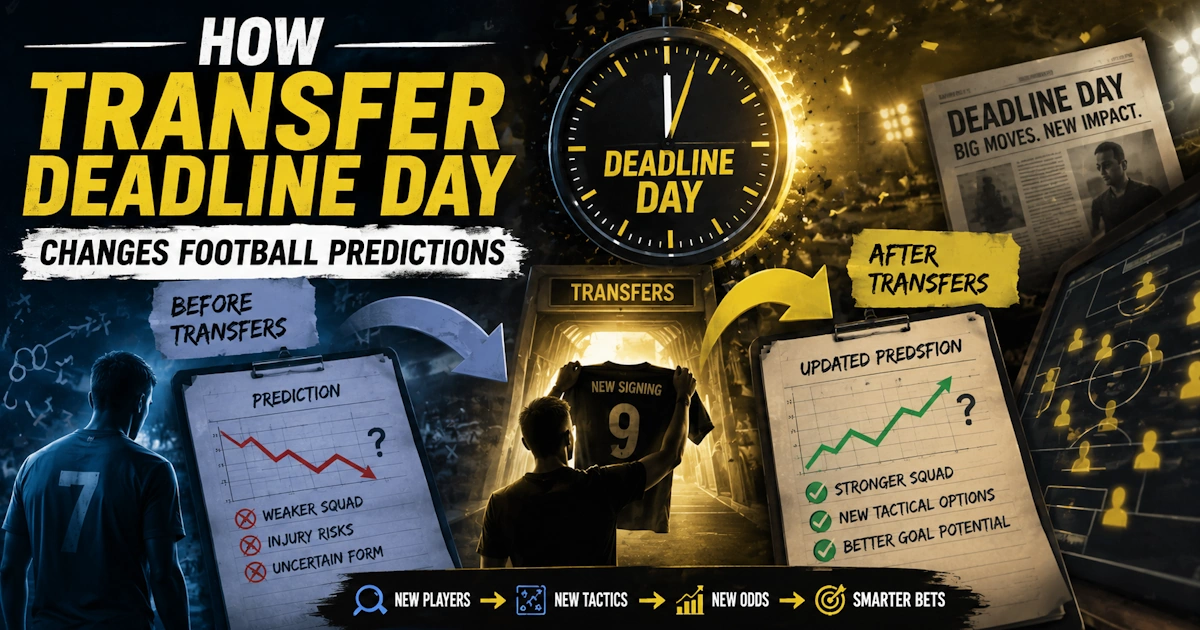
Transfer Deadline Day is entertaining even if you never place a football bet. Deals appear from nowhere, players travel for medicals, clubs suddenly replace important starters and supporters spend half the day refreshing their phones.
For football predictions, though, Deadline Day creates a more serious problem: some of the statistics you have been using may suddenly describe a team that no longer exists.
A club might have played its first four league matches with the same striker, goalkeeper and centre-back partnership. Twenty-four hours later, the striker has been sold, a new goalkeeper has arrived and two defenders are competing for a place in the starting eleven.
The league table has not changed. The historical goal statistics have not changed. But the team has.
That is why the days around the transfer deadline require a slightly different approach. Recent form still matters, but squad changes, tactical roles and expected line-ups deserve much more weight than usual.
For the broader analytical framework, read our guide to football goal predictions, including form, team news, venue data, expected goals and tactical context.
Do Not Judge Transfers by the Number of Signings
A club signing six players does not automatically mean its predictions need to be completely rewritten.
The important question is who will actually play.
A team could sign:
Two young prospects
A reserve goalkeeper
A backup full-back
A midfielder who needs several weeks to regain fitness
That may have almost no immediate effect on its goal profile.
Another club could make only one Deadline Day signing but bring in a new first-choice striker. That single transfer could significantly affect team totals, BTTS and Over/Under predictions.
Focus on changes to the expected starting eleven rather than the size of the transfer list.
Losing a Key Player Can Matter More Than Signing One
Deadline Day analysis often concentrates on exciting arrivals. Departures can be more important.
Suppose a team has scored in eight of its previous ten matches and averages 1.7 goals per game.
That looks like a strong attacking trend.
However, its leading striker has scored seven of the team’s 17 goals and has just been transferred.
The historical average still says 1.7, but almost 41% of those goals came from a player who is no longer available.
That does not mean the team will stop scoring. It means the previous statistic needs adjusting.
Check whether the departing player was responsible for:
Goals
Assists
Expected goals
Shots
Set pieces
Penalties
Chance creation
Pressing from the front
Our expected goals guide explains how xG can help measure how much of a team’s attacking threat was connected to the departing player rather than relying only on his goal total.
A player can influence the attack even without scoring regularly.
Look at Goal Contribution, Not Reputation
Big names attract attention, but their statistical role matters more than their reputation.
Imagine a club signs a famous winger. Headlines immediately suggest the attack has improved.
But perhaps the team’s existing problem is not wide creativity. It may already create plenty of crosses while lacking a reliable centre-forward to finish them.
The transfer could improve the squad without immediately increasing expected goals.
Now consider a less glamorous signing: a defensive midfielder who protects the centre-backs and allows both full-backs to attack higher.
That player might indirectly increase goal production because the team can commit more players forward without becoming completely exposed.
When evaluating a signing, ask what tactical problem the player solves.
New Strikers Do Not Automatically Mean More Goals
A new centre-forward naturally attracts attention from Over bettors.
But there is a major difference between signing a good striker and immediately having a functioning attack.
A forward may need time to learn:
Teammates’ crossing patterns
Pressing responsibilities
Set-piece movements
Runs behind the defence
How the manager wants possession built
There may also be fitness issues.
A striker who completed a full pre-season with another club could be ready immediately. A player who trained alone for several weeks may need time before starting 90-minute matches.
This is why confirmed line-ups are particularly important after the deadline.
Do not assume a new attacker will start simply because the transfer fee was large.
Defensive Transfers Can Change Goal Predictions Quickly
Defensive changes can sometimes affect predictions faster than attacking signings.
A new striker can be introduced gradually. A club with an injured centre-back may have no choice but to immediately start its new defender.
This creates uncertainty.
Central defence depends heavily on:
Positioning
Communication
Offside-line coordination
Goalkeeper understanding
Marking responsibilities
Two individually strong defenders can still make mistakes if they have barely trained together.
Our guide to how missing defenders affect football goal predictions explains how centre-back changes, replacement quality and unfamiliar defensive partnerships can alter the expected goal pattern.
A completely new centre-back partnership may therefore increase the appeal of BTTS or opposition team totals during the first few matches.
On the other hand, signing an experienced goalkeeper or defensive midfielder may quickly improve a previously vulnerable structure.
Goalkeeper Changes Deserve More Attention
Goalkeepers are sometimes overlooked when analysing transfer effects.
They should not be.
A goalkeeper influences more than shot stopping. Modern keepers also affect:
Playing out from the back
Defensive line height
Cross collection
Long distribution
Counterattacks
Communication at set pieces
Suppose a team conceded 1.8 goals per match partly because its goalkeeper consistently performed below expected-goals-on-target measures.
Replacing him with a stronger goalkeeper could reduce future goals conceded even though the defenders remain unchanged.
The opposite situation can occur when a reliable first-choice goalkeeper leaves and an inexperienced replacement takes over.
This can make old clean-sheet percentages less trustworthy.
Our guide to clean-sheet statistics and goal markets explains why clean-sheet percentages should be interpreted alongside goalkeeper performance, defensive structure, xGA and opponent quality.
Deadline Day Can Change Tactical Formations
Transfers sometimes reveal a manager’s future plans.
If a club suddenly signs two wing-backs, it may be preparing to use a back three.
If it sells a traditional striker and signs a versatile forward, the manager may prefer a fluid front line.
If two defensive midfielders arrive, the team could become more conservative.
Watch for structural changes such as:
4-3-3 becoming 3-4-2-1
Two strikers becoming one
More attacking full-backs
A deeper midfield
A higher defensive line
Formation changes can have a bigger effect on goal betting than individual player quality.
A new system may increase attacking numbers while also creating defensive problems during the adjustment period.
Squad Depth Matters for Future Fixtures
Deadline Day does not only affect the next match.
It can influence predictions for months.
This becomes especially important for clubs playing in domestic cups and European competitions.
A team with only 13 or 14 trusted senior players may perform well when everyone is fit but struggle badly during fixture congestion.
Adding quality substitutes can help maintain attacking intensity across several matches.
For goal predictions, consider whether the club now has:
Two reliable strikers
Rotation options on the wings
Replacement centre-backs
Creative midfield depth
Multiple set-piece takers
Squad depth becomes particularly valuable when predicting teams after European matches or during weeks containing three fixtures.
Our guide to goal predictions after European matches explains how squad depth, rotation, travel and recovery time can affect attacking and defensive performance during congested schedules.
Recent Statistics May Need a Reset
Imagine a club produces these first five results:
3-1
2-2
2-1
3-0
2-1
Over 2.5 has landed in all five matches.
That 100% rate looks extremely persuasive.
Then Deadline Day brings major changes:
Leading striker sold
First-choice winger injured
Defensive midfielder signed
New manager announces a more controlled system
Would you still treat that 5/5 Over statistic as equally relevant?
Probably not.
Our guide to why early-season goal statistics can be misleading explains why small samples become even less reliable when transfers, new managers or tactical changes alter the team behind the numbers.
The results happened, but the conditions that created them may have changed.
Early after the transfer window closes, give more weight to the current squad and tactical setup rather than blindly following percentages produced by the previous lineup.
Check Whether the New Player Actually Improves the Position
Not every transfer is an upgrade.
Clubs sometimes sign players because they are available rather than because they perfectly fit the team.
Compare the outgoing and incoming player statistically.
For an attacker, consider:
Goals per 90
Non-penalty xG
Shots per 90
Chances created
Assists
Minutes played
For a defender:
Aerial success
Defensive errors
Ball recoveries
Duels
Ability in possession
Performance against comparable opposition
League quality also matters.
A striker scoring 20 goals in a weaker competition cannot automatically be expected to maintain the same rate after moving to a stronger league.
Do Not Forget Late Registration and Eligibility
A completed transfer does not always mean the player will feature immediately.
There may be questions around:
Registration
Work permits
International clearance
Fitness
Tactical preparation
Competition eligibility
Before using a signing in your prediction, confirm that the player is actually available.
This sounds obvious, but Deadline Day creates exactly the kind of environment where bettors react to headlines before checking the likely starting eleven.
Practical Example: Attack Becomes Less Reliable
Suppose a team has:
Scored in 9 of 10 matches
Averaged 1.9 goals
Produced 1.7 xG
Recorded BTTS in 7 of 10
Its leading striker then leaves on Deadline Day.
He was responsible for:
35% of the team’s goals
Most penalties
The highest xG in the squad
Nearly four shots per match
No direct replacement is signed.
The old BTTS and team-goal statistics remain useful background information, but backing Team Over 1.5 immediately becomes less attractive.
Our team-to-score betting guide explains how scoring frequency, xG, shots on target, opponent conceding rates and current team news should be combined before backing an individual team goal.
The attack now has to prove that someone else can convert the chances.
Practical Example: Defensive Changes Support Goals
Now imagine a club sells its first-choice centre-back late in the window.
Its replacement arrives only two days before an away match.
The other starting defender is also returning from injury, while the opponent has scored in eight consecutive home games.
Even if the team’s season-long defensive average is respectable, the current situation looks less stable.
BTTS – Yes or the home team’s Over 0.5/1.5 goals could become more attractive than the old statistics suggest.
This is a good example of current team news overriding a broader historical trend.
Markets Most Affected by Deadline Day
Some betting markets are particularly sensitive to transfer activity.
Team to Score
Key attacking departures or defensive arrivals can quickly change scoring probabilities.
BTTS
Changes at both ends of the pitch matter. A stronger attack combined with an unsettled defence can increase BTTS potential.
Over/Under 2.5
Formation changes, new forwards and defensive disruption can alter the expected tempo and chance volume.
First Team to Score
New attacking systems or changes in pressing intensity can affect how teams begin matches.
Our first-team-to-score guide explains how opening-goal percentages, first-half scoring, early xG, venue splits and tactical changes can be used to assess that market.
Player Markets
These are obviously sensitive to transfers because penalty takers, free-kick takers and starting positions may change immediately.
A Transfer Deadline Prediction Checklist
Before betting shortly after the window closes, check:
Important incoming players
Important departures
Percentage of goals lost through transfers
Changes to the expected starting eleven
New defensive partnerships
Goalkeeper changes
Tactical formation
Squad depth
Player fitness
Registration and availability
Whether old statistics still describe the current team
Confirmed line-ups
This is one of the periods when checking team news close to kick-off can provide far more value than simply looking at the league table.
Frequently Asked Questions
Should I avoid betting immediately after Transfer Deadline Day?
Not necessarily. The uncertainty can create opportunities, but selections should rely more heavily on current team news and expected line-ups.
Does signing a striker immediately improve Over 2.5 chances?
No. The player must be fit, available and suitable for the tactical system. Integration can take time.
Are departures more important than arrivals?
They can be. Losing a player responsible for a large percentage of goals or chance creation may immediately weaken historical attacking statistics.
Should previous-season statistics still be used?
Yes, but cautiously. They remain useful for understanding the team’s general style, particularly when the manager and core squad remain intact.
How long does it take before post-transfer statistics become reliable?
There is no fixed number. Watch how quickly new players enter the starting eleven and whether the manager changes the tactical system. Several matches are normally needed before new trends become clearer.
For a more detailed framework, our guide on how long bettors should wait before trusting a new signing explains how minutes played, tactical role, fitness and underlying statistics can show whether an arrival has genuinely settled into the team.
Final Thoughts
Transfer Deadline Day changes football predictions because it changes the players behind the statistics.
A team can carry the same name, manager and league position while becoming noticeably stronger or weaker within a few hours.
The key is to identify which transfers actually matter. A backup signing may have almost no immediate effect, while losing one striker, goalkeeper or central defender can change several betting markets at once.
Pay particular attention to expected line-ups, goal contribution, defensive partnerships and tactical changes. During the first few matches after the window closes, be willing to reduce the importance of historical averages when the squad has changed significantly.
Statistics remain valuable. You simply need to make sure they still describe the team that is about to walk onto the pitch.
Responsible betting: Transfer news can create excitement and encourage quick decisions. Wait for reliable team information, keep stakes within a fixed budget and never bet money you cannot afford to lose.