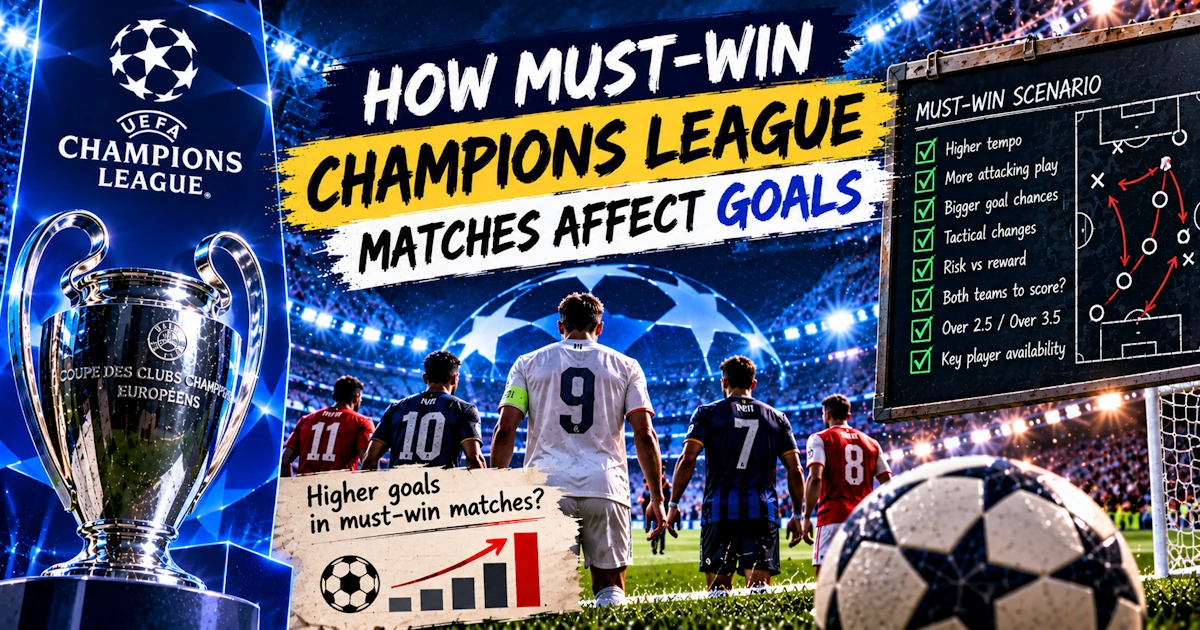
“Must-win” is one of the most overused phrases in football betting. A team needs three points to qualify, so the obvious prediction seems to be that they must attack, therefore there will be goals.
Sometimes that logic works. But not always.
A team that desperately needs to win can attack aggressively from the first minute. Another may become more cautious because conceding first would make its situation even worse.
Some managers wait until the final 20 or 30 minutes before taking major risks. For Champions League goal predictions, the useful question is not simply whether this team needs to win.
It is: How will needing to win change the way this team plays?
That distinction can make must-win situations useful for Over 2.5, BTTS, second-half goals and late-goal markets without treating motivation as a guarantee.
What Is a Real Must-Win Match?
Not every important Champions League match is genuinely must-win. Under the current league-phase format, 36 clubs play eight matches against eight different opponents.
The top eight qualify directly for the round of 16, teams ranked ninth to 24th enter the knockout phase play-offs, and teams finishing 25th to 36th are eliminated. That creates several different types of pressure.
A team may need to win because:
It is fighting to stay inside the top 24
It wants to reach the top eight
A draw is unlikely to be enough
Goal difference may decide its final position
Results elsewhere have changed the qualification situation
But timing matters. Being 25th after Matchday 2 is not the same as being 25th before Matchday 8.
Early in the league phase, plenty of points remain available. Later, mathematical possibilities become much clearer.
Must-Win Pressure Becomes Stronger Late in the League Phase
Motivation generally becomes more useful for prediction as the competition progresses. Imagine a team has four matches remaining and can recover from one disappointing result.
Now imagine only one match remains, where a win means qualification and a draw means elimination. There is very little ambiguity.
If the match remains level late, that team eventually has to increase its risk. That can mean:
Extra attackers
Higher full-backs
More aggressive pressing
Centre-backs stepping higher
Fewer players protecting transitions
Those tactical changes are what can increase the probability of goals. It is not the words “must win” themselves.
The Champions League Already Has a Strong Goal Environment
The completed 2025/26 Champions League league phase produced 487 goals in 144 matches, an average of about 3.38 goals per game. UEFA reported that this surpassed the previous league-phase total of 470.
That gives goal bettors a useful background. The competition already contains elite attackers, high pressing and strong chance creation.
A genuine must-win situation can add another reason for some matches to become aggressive. But the average should never be applied blindly to one fixture.
A team still needs the attacking quality to take advantage of its motivation.
Must Win Does Not Mean Attack From Minute One
This is perhaps the biggest misconception. Imagine Team A needs a win, and many bettors expect a full attack from kick-off.
But the manager may think differently. If Team A concedes in the first 15 minutes, its job becomes much harder.
The tactical plan may therefore be:
Stay balanced early
Avoid giving away counterattacks
Increase pressure gradually
Take bigger risks after half-time if necessary
This can create a match with a relatively cautious first half and a much more open second half. For that reason, a must-win situation can sometimes be more interesting for Over 1.5 Second-Half Goals than an aggressive first-half goal market.
Game State Is More Important Than the Pre-Match Label
A must-win match can change completely depending on the score. Suppose Team A needs a victory.
If the score is 1-0 after 60 minutes, Team A may now become more conservative because it already has what it needs. If it is 0-0 after 60 minutes, the pressure increases, and the manager may add another attacker.
If it is 0-1 after 60 minutes, the team may need at least two goals, making its defensive structure increasingly vulnerable. The exact same pre-match motivation produces three completely different match situations.
This is why must-win fixtures can be especially useful for live analysis.
Practical Example: 0-0 After 65 Minutes
Imagine Team A needs three points to qualify. Before the match it averages 1.8 xG, 5.5 shots on target, and strong home scoring numbers.
The score remains 0-0 after 65 minutes, and a draw is not enough. The manager replaces a defensive midfielder with a forward, and the full-backs move higher.
Suddenly the match contains:
More attackers
Less midfield protection
More counterattacking space
Even if the first hour was quiet, the final 25 minutes can become much more suitable for goals. This is where the standings and game clock work together.
Must-Win Teams Can Also Become Vulnerable
Most bettors focus on the team that needs to score. But increasing attacking risk also affects the opponent.
Suppose a team pushes eight players forward. If possession is lost, the opposition may attack 3 against 3, or even 3 against 2.
That means a must-win situation can create goals at both ends. This is particularly interesting when the opponent has:
Fast wingers
Strong counterattacks
A quick striker
Good long passing
In that situation, BTTS or Over 2.5 may be more attractive than simply backing the must-win team to score.
Practical Example: Counterattacking Opponent
Imagine the home side needs to win and has 1.9 home xG. The visitors average only 45% possession but have quick forwards and regularly score from transitions.
At 1-1 after 70 minutes, the home side starts committing more players forward. Possible endings include 2-1, 1-2, 2-2, or 3-1.
The must-win pressure does not only improve the home attack. It creates better opportunities for the visitors too.
That is what can make the full-match goal market attractive.
A Must-Win Favourite Is Different From a Must-Win Underdog
Team quality matters. Suppose Realistic Team A is an elite side averaging 2.2 xG, 6.5 shots on target, high possession, and several big chances.
It needs to win at home, which is meaningful because the team has the ability to convert urgency into sustained pressure. Now imagine a weaker side averages 0.8 xG, 2.3 shots on target, and few big chances.
It also needs to win. The motivation is identical, but the attacking capability is not.
Need does not create quality. A poor attack does not suddenly become elite because qualification is at stake.
Use xG to Judge Whether the Team Can Respond
Before using motivation in an Over prediction, check the underlying attack. Suppose the must-win team averages 1.9 xG and has created good chances throughout the season.
The situation may encourage it to create even more. Now suppose it averages 0.9 xG and struggles to enter the penalty area.
The fact it needs three points does not solve those structural problems. A strong must-win Over candidate usually combines motivation, attacking ability, and vulnerable opposition.
You want all three.
Shots on Target Matter Too
A team may dominate possession without regularly threatening the goalkeeper. Imagine 70% possession with 17 total shots, but only 3 on target.
That is not necessarily a strong goal profile. For must-win matches, look for teams capable of turning possession into accurate attempts.
If the side already averages five or six shots on target, greater urgency can be meaningful. If it normally produces only two, more possession may simply create more low-quality attempts.
Goal Difference Can Add Another Layer
The current league-phase format uses goal difference as the first tiebreaker when teams are level on points, followed by goals scored and further criteria. This can create unusual situations.
Suppose a team needs not only to win but also to improve its goal difference relative to nearby competitors. At 2-0 after 70 minutes, a normal team may slow the game down.
A team chasing qualification through goal difference may still value 3-0 or 4-0. That can strengthen:
Favourite Team Over 2.5
Over 3.5
Late goal markets
However, never assume a team needs a big win without checking the actual standings.
Both Teams Needing a Win Can Be Very Interesting
One of the strongest potential goal situations occurs when a draw is poor for both sides. Imagine before the final matchday Team A is in 23rd place and needs a win to feel secure, while Team B is in 26th place and likely needs a win to qualify.
At 1-1 after 70 minutes, neither side is satisfied. The game may lose much of its tactical caution, and both managers can introduce attackers.
That creates a natural environment for late chances. But once again, attacking quality matters, and two desperate but weak attacks can still produce 1-1.
When a Draw Helps One Team
Now consider a different situation where Team A needs only a draw, but Team B needs to win. At 1-1 after 75 minutes, Team A wants the game to stop, while Team B needs the match to open.
This creates an interesting tactical battle. Team A may:
Defend deeper
Waste less possession forward
Keep more players behind the ball
Team B may:
Push full-backs higher
Add another striker
Increase crossing
Press aggressively
For prediction purposes, the team needing the win may dominate possession, while the other becomes increasingly dangerous on the counterattack.
First Goal Can Completely Change a Must-Win Prediction
Suppose you expect an open match because both teams need victory. After eight minutes, Team A scores.
What happens next? Team A may now protect the lead, while Team B must chase.
This can still produce goals because the game becomes asymmetric. But if the team that needs only a draw scores first, the match may become much more defensive.
When analysing must-win football, always think through different score scenarios. Ask what happens if the favourite scores first, and what happens if the underdog scores first.
A good goal prediction should make sense under several realistic game states.
Must-Win Does Not Automatically Make BTTS Strong
Suppose an elite home team must win against a weak visitor, and the favourite dominates completely. Possible scores are 3-0, 4-0, and 2-0.
This is a good potential Over or team-total situation, but it is not necessarily good for BTTS. For Both Teams to Score, the weaker side still needs a believable route.
Check:
Away xG
Shots on target
Counterattack quality
Set pieces
Home clean-sheet rate
Never use motivation as a substitute for attacking quality.
Set Pieces Can Help Weaker Teams
A weaker team that must win may struggle in open play but still have a route through set pieces. Look for strong corner delivery, tall centre-backs, dangerous free kicks, and opponent weakness in aerial duels.
One set-piece goal can completely change the match. If an underdog scores first, the stronger team may then attack aggressively, creating a much more open goal environment.
This is especially relevant for BTTS predictions.
Watch for Rotation Before Calling It Must-Win
A supposedly crucial match may become harder to interpret if the lineup is unexpected. Suppose a team needs victory but rests its main striker, creative midfielder, and first-choice winger.
Its motivation may be high, but its attacking quality has still fallen. Likewise, defensive rotation may make the game more open.
Always check expected and confirmed lineups before assuming motivation will produce the expected tactical effect.
Practical Example: Strong Over Candidate
Imagine a final league-phase fixture where the home side needs a win. It averages 2.0 home xG, 5.9 shots on target, and 2.1 goals scored.
The visitors concede 1.7 away xGA, have few clean sheets, and carry a strong counterattacking threat. A draw is poor for the home side, making scores like 2-1, 3-1, and 2-2 possible.
Here, the must-win factor strengthens an Over 2.5 case already supported by the statistics. That is how motivation should be used.
Practical Example: Must Win but Poor Over Candidate
Now imagine the home side needs victory but averages 0.9 xG, 2.5 shots on target, and 0.8 goals per match. Its opponent allows only 0.8 xGA, keeps many clean sheets, and defends deeply.
The match may become more attacking late, but the basic goal environment remains weak. Possible results include 1-0, 0-0, and 1-1.
“Must win” alone is not enough to justify Over 2.5.
Practical Example: Better for Late Goals
Imagine two teams with decent attacks but cautious managers, and both need a win. The first half is controlled, and at 55 minutes it is 0-0.
At 70 minutes, it is still 0-0, and now the tactical situation changes dramatically. A draw is becoming increasingly useless.
This may be a better spot for a late-goal or second-half goal prediction than backing a high total before kick-off. Sometimes the strongest effect of motivation appears only when the clock begins forcing decisions.
A Simple Must-Win Goal Checklist
Before using motivation in a Champions League prediction, check:
Is it genuinely must-win?
How many matches remain and is a draw useful?
What do results elsewhere mean and does goal difference matter?
What happens if the team scores or concedes first?
Does it have strong xG and produce enough shots on target?
Can the opponent counterattack?
Are both teams motivated to attack and are key attackers available?
Is the defence rotated and does the coach usually take risks?
Is the goal-market price still attractive?
If “must win” is your only reason for backing goals, the analysis is too weak.
Frequently Asked Questions
Do must-win Champions League matches usually have more goals? Not automatically. Needing a win can increase attacking risk, especially late in matches, but some teams begin cautiously because conceding would make their situation worse.
Are must-win matches good for Over 2.5? They can be when motivation is supported by strong attacking statistics, defensive weaknesses and a tactical reason for the match to open up.
Is BTTS good when both teams need to win? Potentially. If both have credible attacking quality and neither can accept a draw, the game can become open. But both teams must still have realistic scoring routes.
When does must-win pressure matter most? Usually later in the league phase, particularly when qualification scenarios become mathematically clear and there are few or no matches left.
Are late-goal markets useful in must-win matches? They can be. If a draw is not enough and the match remains level late, managers may increase attacking risk and leave more space defensively.
Final Thoughts
Must-win Champions League matches can create excellent goal situations. But the phrase itself is not a prediction.
The important part is what the standings force a team to do differently. If a club needs victory and the match remains level after 70 minutes, risk may increase dramatically.
More attackers come on, full-backs move higher and defensive protection disappears, which can create goals at both ends. On the other hand, a team may approach the first hour cautiously because it knows conceding first would be disastrous.
The best approach is therefore to combine motivation with:
xG
Shots on target
Team quality
Defensive strength
Game state
Lineups
Counterattacking threat
And always ask one final question. If this team must win, does it actually have the attacking quality to do something about it?
When the answer is yes, motivation can strengthen a goal prediction. When the answer is no, “must win” may be nothing more than a tempting football story.
Responsible betting: Qualification pressure can influence tactics but cannot guarantee goals or results. Use motivation alongside current performance data, compare probability with price, keep stakes controlled and never bet money you cannot afford to lose.