
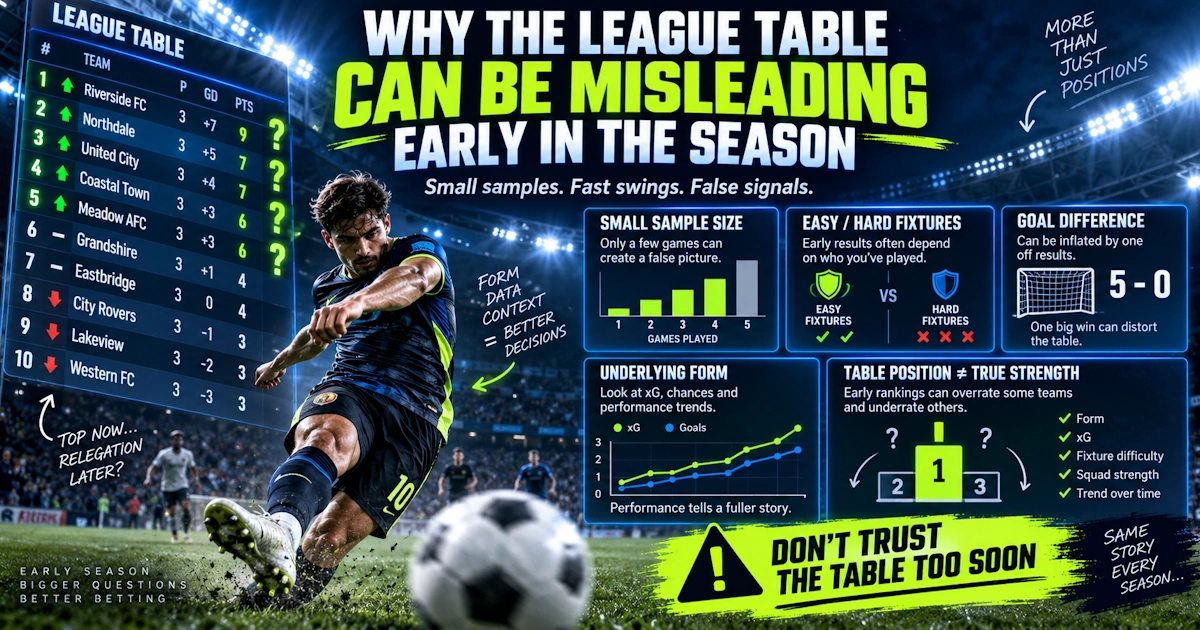
The league table feels objective.
One team is second. Another is 15th. One has 12 points from five matches, while another has only four. It is natural to assume that the higher-ranked side is playing better football.
Early in the season, that assumption can be dangerous.
After only four, five or six matches, the table is heavily influenced by fixture difficulty, home and away balance, penalties, red cards and a few fortunate or unfortunate moments. A team can sit near the top after facing several weak opponents, while another may look poor simply because it started the season against three title contenders.
The table tells you what has happened. It does not always tell you how well the teams have actually performed.
For football predictions, the early weeks are a good time to look beneath the standings.
For goal-market analysis specifically, our guide to why early-season goal statistics can be misleading explains how small samples, unusual scorelines and uneven fixture lists can distort Over/Under and scoring trends.
Small Samples Create Big Differences
The first problem is simple: there have not been enough matches.
After five rounds, one victory can move a team several places up the table.
Imagine three clubs:
Team A: 10 points
Team B: 8 points
Team C: 6 points
At first glance, Team A looks significantly stronger.
But the difference between Team A and Team C is only one win and one draw.
Over a 38-match season, six points are meaningful. After five matches, they can be produced by one late winner, one missed penalty or one questionable red card.
This is why early league positions should be treated as provisional evidence rather than a reliable ranking of team quality.
Fixture Difficulty Can Distort the Table
Not every team has played the same quality of opponents.
This is probably the biggest reason early-season tables can mislead bettors.
Suppose Team A has started against clubs that finished:
17th
14th
12th
A newly promoted team
Another struggling side
It collects 13 points and moves into the top three.
Team B begins against:
The champions
The runners-up
Two European qualifiers
A strong away opponent
It earns only five points.
If these teams meet in round six, the league table may suggest Team A is much stronger.
The schedule suggests otherwise.
Before using league position in a prediction, check who each team has actually faced.
A good early record against weak opposition should be valued differently from a moderate record against elite teams.
Home and Away Balance Matters
The early fixture list can also be unbalanced by venue.
One team may have played four of its first six matches at home. Another may have had four away trips.
That difference can have a major impact on points.
Imagine a club has:
3 home wins
1 away draw
1 away defeat
It sits high in the table with 10 points.
Another side has:
1 home win
2 away draws
2 away defeats
It has only five points.
The gap looks large, but the first team benefited from more favourable home fixtures.
If the next match is away, its overall table position may exaggerate its strength.
For early-season predictions, always separate:
Home points
Away points
Home goals
Away goals
Home xG
Away xG
The league table combines everything. Your analysis should not.
Our guide to home and away form for goal bets explains why venue-specific performance can reveal strengths and weaknesses that broad season statistics hide.
Goal Difference Can Be Distorted by One Match
Goal difference often looks like a useful secondary measure.
Usually it is.
Early in the season, one extreme result can dominate it.
Suppose a team records these five results:
1-0
0-1
1-1
0-0
5-0
Its goal difference is +5.
That looks excellent.
But four of the five matches were extremely close. Most of the advantage came from one unusually large victory.
Another team may have five competitive matches but a goal difference of only +1.
The raw table makes the first team look far more dominant than its week-to-week performances suggest.
Check whether goal difference is spread across several matches or created by one exceptional scoreline.
Expected Goals Can Tell a Different Story
Expected goals are useful early in the season because results can be heavily influenced by finishing.
Suppose Team A has:
12 points
9 goals scored
4 goals conceded
That looks strong.
But its underlying numbers are:
5.8 xG
7.0 xGA
The team has scored far more than expected while conceding fewer than the chances allowed would suggest.
Now consider Team B:
6 points
5 goals scored
7 conceded
Its xG numbers are:
8.2 xG
5.9 xGA
The table says Team A is much better.
The underlying performances suggest Team B may actually be playing the stronger football.
This does not mean xG predicts every result. It helps identify when results and performances are moving in different directions.
Our expected goals guide explains how xG and xGA can reveal whether recent results are supported by chance quality or influenced by short-term finishing and goalkeeping.
Finishing Streaks Can Move Teams Up the Table
Short-term finishing can be extremely volatile.
A striker may score four goals from five shots on target. A goalkeeper may save almost everything for a few weeks. A team may convert nearly every big chance it creates.
Those runs can produce points without necessarily being sustainable.
Imagine a side scores eight goals from only 4.5 xG in its first five matches.
It may genuinely have excellent finishers. But maintaining that level of conversion throughout the season is difficult.
The opposite can happen too.
A team may create 9.0 xG but score only four times. Its league position looks disappointing even though the attack is regularly reaching good positions.
This is why early results should be compared with chance creation.
Red Cards and Penalties Can Have a Huge Impact
One unusual event carries much more weight after five matches than after 25.
Suppose a club has lost two matches heavily.
Both defeats came after first-half red cards.
Its league position and goals-conceded statistics may look terrible, but 11-v-11 performance could be much more stable.
Penalties can also distort the table.
A team awarded three penalties in its first five matches may collect extra points that are unlikely to be repeated at the same rate.
When reviewing early standings, check:
Red cards
Penalties
Own goals
Late winners
VAR decisions
Goalkeeper errors
You do not need to dismiss the results. You need to understand how they happened.
Our guide to how red cards affect Over/Under goal bets explains how a dismissal can completely change attacking output, defensive structure and the meaning of the final score.
Promoted Teams Can Be Overrated or Underrated
Promoted clubs are especially difficult to judge early.
One may begin with two home wins and immediately sit in the top half. Supporters start talking about a comfortable season.
Another loses three consecutive matches and appears destined for relegation.
Both conclusions may be premature.
Promoted sides often face unusual early dynamics:
Opponents do not yet know their style well
Home crowds provide extra energy
Players begin with confidence from promotion
Tactical weaknesses may not be exposed immediately
After several matches, established teams begin adapting.
The opposite can happen too. A promoted team may face three strong clubs early, lose all three, then improve once the schedule becomes easier.
League position alone does not tell you whether the team has adapted successfully.
Our guide to analysing newly promoted teams explains how lower-division form, squad changes, tactical adaptation and early top-flight performances should be assessed before judging whether promotion has changed the team’s real level.
New Managers Can Create Temporary Results
A managerial change can influence early standings in both directions.
A new manager may begin with simple defensive instructions and produce several narrow victories.
The table looks excellent, but the long-term attacking numbers may remain poor.
Another coach may introduce a complex pressing system that causes mistakes initially. The team drops points but gradually improves.
Early-season bettors should ask whether results match the tactical process.
Useful questions include:
Is the team creating more chances?
Is it conceding fewer high-quality chances?
Does the formation look settled?
Are players comfortable with the system?
Are the results dependent on late goals?
Sometimes the lower-ranked team is actually improving faster.
Practical Example: The False Top-Four Team
Imagine a team sits fourth after six rounds with 13 points.
Its record looks impressive.
Closer analysis shows:
Four matches were at home
It faced three bottom-half teams
Two wins came through penalties
It has scored 10 goals from 6.2 xG
It allows 1.5 xGA per match
The team may still be good, but its fourth-place position probably exaggerates its performance.
If it now travels to a stronger opponent, backing it simply because of the table would be risky.
Practical Example: The Misleading Bottom-Half Team
Now imagine another side sits 14th with six points.
Its record looks poor.
However:
Four of six matches were away
It faced three top-six clubs
It produced 8.5 xG
It allowed only 6.4 xGA
It missed several big chances
The table suggests weakness.
The underlying numbers suggest a team that could improve quickly once the fixture difficulty decreases.
This type of side can be interesting before the wider market fully adjusts.
Look at Points Versus Performance
One useful early-season question is: Are the points supported by the performances?
For example:
Team A:
12 points
Positive goal difference
Strong xG difference
High shot numbers
Few big chances conceded
That table position has several forms of support.
Team B:
12 points
Negative xG difference
Several narrow wins
Low shot volume
High opposition chance quality
That position looks more fragile.
The league table becomes more useful when other metrics confirm what it says.
Which Statistics Should Bettors Use Instead?
You should not ignore the table completely.
Use it alongside:
xG and xGA
Shots on target
Big chances
Home and away form
Fixture difficulty
Goal difference
Opponent quality
Injuries
Tactical changes
Red cards and penalties
The aim is not to find one perfect statistic.
It is to build a more complete picture than the standings provide on their own.
When Does the League Table Become More Reliable?
There is no exact round when the table suddenly becomes trustworthy.
However, by roughly 8–12 matches, some of the early distortions begin to reduce.
Teams have usually:
Played more balanced home-away schedules
Faced a wider range of opponents
Settled new signings
Adapted to new managers
Produced larger statistical samples
By 15–20 matches, the table generally contains much more meaningful information about actual team strength.
Even then, fixture difficulty and injuries still matter.
Early-Season Table Checklist
Before using league position in a prediction, check:
Matches played
Fixture strength
Home-away balance
Goal difference distribution
xG versus actual goals
xGA versus goals conceded
Red cards
Penalties
New managers
Transfer changes
Promoted-team adjustment
Strength of upcoming opponent
The earlier the season, the more context you need.
Frequently Asked Questions
How many matches are too few to trust the table?
The first five or six rounds are usually too small to draw strong conclusions. League position can change dramatically from one result.
Is xG more useful than points early in the season?
It can provide useful context, especially when results and performances differ. It should still be combined with tactical and team information.
Should I ignore league position completely?
No. The table is useful, but early in the season it should be treated as one part of the analysis rather than the main prediction tool.
Can a top-ranked team still be overrated?
Yes. Easy fixtures, home-heavy schedules, penalties or unusually efficient finishing can temporarily inflate a team’s position.
When does the table become more dependable?
Around 8–12 matches, patterns usually become clearer. By the middle of the season, league position is generally much more informative.
Final Thoughts
The league table is one of football’s clearest statistics, but early in the season it can also be one of the easiest to misinterpret.
A team sitting third may simply have enjoyed a favourable schedule. Another in 13th may have played better football against much stronger opponents.
Small samples, home-away imbalance, finishing streaks and unusual match events can all distort the standings.
Instead of asking only where a team is ranked, ask why it is ranked there.
Compare points with fixture difficulty, expected goals, shots, venue-specific form and tactical performance. As the season progresses, the table becomes increasingly meaningful.
During the opening weeks, however, the best predictions often come from seeing what the standings have not yet had time to show.
Responsible betting: Early-season standings can create false confidence. Use multiple indicators, keep stakes within a fixed budget and never bet money you cannot afford to lose.