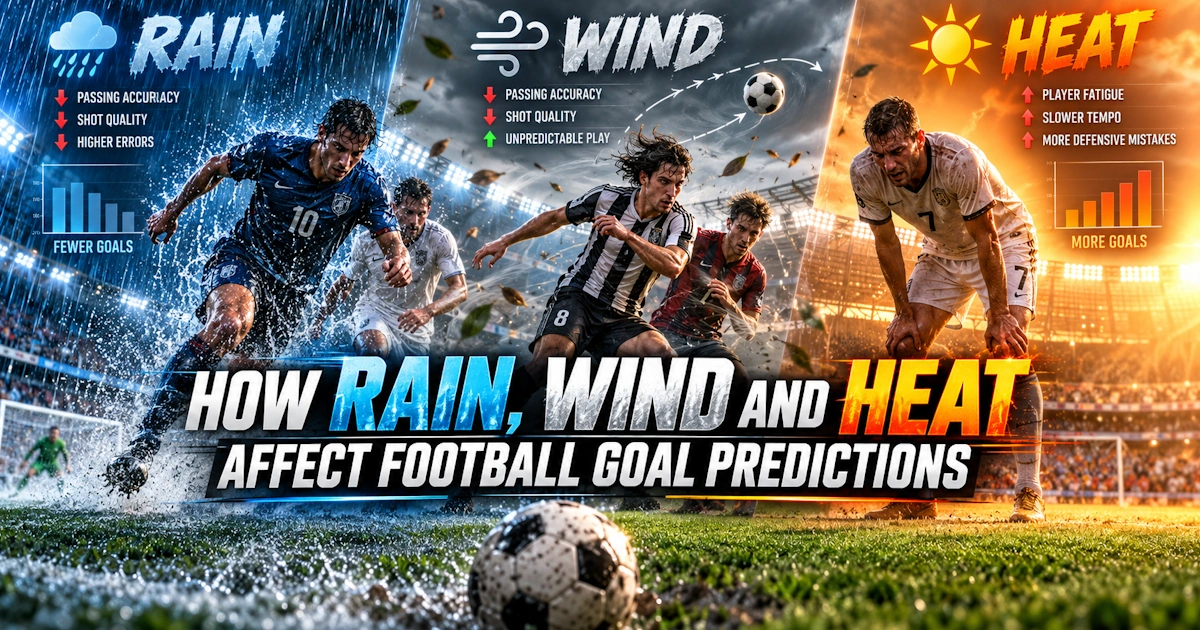
Weather is one of the easiest factors to overanalyse when predicting football goals. A forecast shows heavy rain and bettors immediately think: Under 2.5 Goals.
Strong wind appears and suddenly nobody expects accurate passing. A match played in extreme heat creates another assumption, that the players will become tired, so there should be late goals.
Each idea contains some logic, but weather does not affect every match in the same way. Professional teams can adapt their tactics, modern pitches drain water quickly, players adjust their running intensity, and elite stadiums often provide much better playing surfaces than they did decades ago.
Research also suggests that weather influences some aspects of football performance more clearly than others. A systematic review of 21 professional-football studies found that environmental conditions often affected physical performance, while technical performance was frequently less affected.
Players also appeared capable of adjusting their pacing to maintain important parts of their match performance. For football predictions, weather should therefore be treated as an adjustment to your normal analysis, not as a reason to ignore xG, team strength, shots and tactics.
Weather Rarely Works as a Standalone Prediction System
Suppose you have identified a match where both teams average strong xG, five or more shots on target, weak defensive numbers, and high BTTS rates. Then you discover moderate rain is forecast.
Should you immediately change from Over 2.5 to Under 2.5? Probably not.
The weather would need to be severe enough to meaningfully change how the match is played. This is the central principle: start with the football, then adjust for the weather.
Do not start with the weather and build the entire prediction around it.
How Rain Changes a Football Match
Rain can affect several parts of the game. A wet surface can make the ball:
Travel faster
Skid after bouncing
Become more difficult for goalkeepers to hold
Increase the difficulty of defensive clearances
But heavy rain can create the opposite effect if water begins collecting on the pitch. The ball may suddenly slow down or stop, making passing less predictable and dribbling more difficult.
This explains why simply saying “rain means fewer goals” is too simplistic. Different types of rain can affect the match in different ways.
Light Rain Can Actually Help Fast Football
On a good modern pitch, light rain can create a slick surface. That can help teams that prefer:
Fast passing
One-touch combinations
Low crosses
Quick transitions
The ball may travel quickly across the grass, making defensive reactions more difficult. Imagine two technically strong teams that already play at a high tempo.
Moderate rain on an excellent surface may do very little to reduce their attacking threat. It could even make some passes and crosses more difficult to defend.
The key is pitch condition, not merely whether rain appears in the weather forecast.
Heavy Rain Is More Important Than Ordinary Rain
There is a major difference between light rain throughout the match and a severe storm producing standing water. If drainage cannot cope, the match changes dramatically.
Players may avoid short passing through flooded areas, and defenders can become more cautious. Teams may use:
Longer balls
More crosses
More direct football
This can decrease the quality of normal possession attacks, but it can also create defensive errors. A defender expecting the ball to continue rolling may see it stop in water, and a goalkeeper may misjudge a skidding shot.
So even extreme rain does not automatically point towards an Under, as it often increases uncertainty.
Direct Rainfall Evidence Is Less Clear Than Bettors Often Assume
Scientific research on football weather has concentrated much more heavily on temperature, humidity and altitude than rainfall. A systematic review covering 21 professional-football studies found significant environmental effects mainly in physical performance, while technical indicators were often relatively stable.
That is an important warning against making large probability adjustments simply because rain is forecast. Unless the conditions are extreme, team quality and tactics will usually remain much stronger predictors than the rain icon on a weather app.
Wind Can Be More Disruptive Than Rain
Strong wind can directly interfere with the ball’s flight. This matters for:
Long passes
Crosses
Corners
Goalkeeper kicks
High balls
Long-range shots
A pass that is perfectly weighted in calm conditions may carry too far with a strong tailwind. Playing into the wind can cause the opposite problem, where the ball may slow dramatically.
This makes wind particularly relevant for teams that depend heavily on aerial or direct football.
Tactical Style Determines How Much Wind Matters
Consider two teams. Team A builds through short passes, keeps the ball on the ground, and uses central combinations.
Team B uses long diagonal balls, crosses frequently, and targets a tall striker. Strong wind is likely to interfere with Team B’s normal attacking method much more.
This is why weather adjustments should always be tactical. Do not simply reduce expected goals for both teams because wind speed is high.
Ask: Which team relies on actions that the wind is likely to disrupt?
Champions League Research Found Measurable Weather Effects
A 2024 study examined 583 Champions League matches across five seasons and analysed temperature, humidity and wind speed alongside 31 technical performance indicators. Researchers found that meteorological factors affected several important attacking actions.
Temperature was particularly associated with counterattacking shots, while wind speed was associated with changes in shots from the six-yard area. The study did not establish a simple rule such as: more wind equals fewer goals.
Instead, it showed something more useful: weather can alter how chances are created. That is a better way to think about it for predictions.
Wind Can Create Goalkeeper Problems
Goalkeepers need to judge the flight of crosses, corners, free kicks, and long shots. Strong or gusty wind can make this harder.
A cross may suddenly carry farther than expected, or a goalkeeper might begin moving forward and then realise the ball is drifting behind. This can create unusual chances.
So strong wind may reduce the accuracy of attacking play while simultaneously increasing the chance of individual errors. That again makes a simple Under prediction dangerous.
Heat Has Stronger Scientific Evidence
Extreme heat has been studied much more extensively. Research generally shows that footballers alter their physical output in hot conditions.
A study involving elite players compared matches played at around 21°C with matches at approximately 43°C. In the extreme heat, total distance covered fell by around 7%, while high-intensity running fell by approximately 26%.
That is a substantial difference. A separate systematic review also concluded that heat generally has a negative effect on physical performance, although the exact size of the effect varies considerably between studies and conditions.
For goal predictions, this can affect pressing, transitions and the overall tempo of the match.
Hot Weather Can Slow the Match
Imagine two teams normally play aggressive pressing football. Their strategy depends on repeated sprints, fast recovery runs, intense pressing, and quick transitions.
In extreme heat, maintaining that pace for 90 minutes becomes difficult, and players may consciously conserve energy. The match can contain:
Slower possession
Less pressing
Fewer repeated transitions
This could reduce the chance of a chaotic high-scoring game. Research across four professional leagues supports this idea, as warmer conditions were associated with lower total, high-speed and sprint distances.
Heat Does Not Automatically Mean Under 2.5
There is another side. A slowing defence can also become vulnerable late in the match.
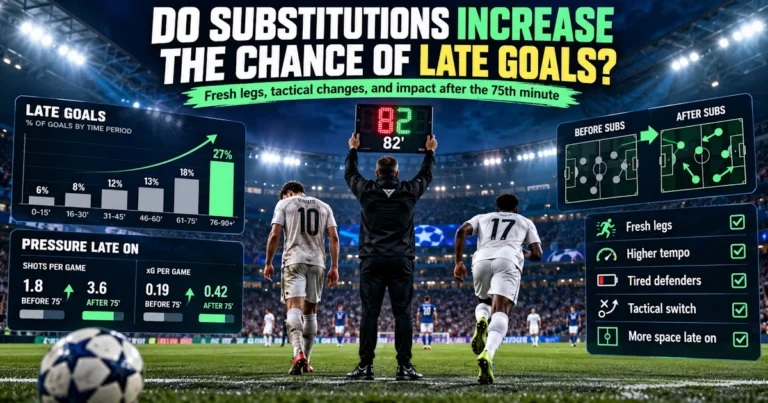
Suppose the temperature is very high and defenders have spent 70 minutes dealing with repeated attacks, physical duels, and recovery runs. Fresh substitutes can then create problems.
The match may begin slowly but open later. So extreme heat can potentially produce a lower early tempo plus greater late fatigue, rather than simply fewer goals from start to finish.
For live predictions, this distinction can be useful.
Recent Research Shows Teams Adapt Their Style in Heat
A study across four professional football leagues found that higher temperature and heat stress were associated with fewer passes, fewer final-third passes, fewer touches and fewer take-ons. However, the number of key passes leading directly to a shot or goal did not show the same relationship with heat.
That suggests professional teams may reduce overall activity without losing every important attacking action. They adapt.
This is another reason weather effects are rarely as simple as: hot equals Under.
Humidity Makes Heat More Difficult
Temperature alone does not describe how uncomfortable conditions really are. A match at 30°C with low humidity can feel very different from 30°C with extremely high humidity.
High humidity makes it harder for sweat to evaporate effectively, which reduces the body’s ability to cool itself. Research and professional-football heat guidance both recognise that heat, humidity, solar radiation and low air movement can combine to increase physical strain.
For prediction purposes, pay attention to the combination rather than only the temperature number.
Practical Example: Heat Supports a Slower Match
Imagine two pressing teams normally produce high running intensity, frequent turnovers, and fast transitions. The match is scheduled in extreme heat.
Both managers have previously reduced pressing intensity in similar conditions, and neither team has strong bench depth. Possible effects include:
Lower tempo
More controlled possession
Fewer transitions
If your original analysis already leaned towards Under 3.5, the heat may strengthen that view. But the weather should be supporting an existing argument rather than creating it.
Practical Example: Heat Could Help Late Goals
Now imagine the same conditions, but both clubs have strong benches. After 65 minutes, each manager introduces a fresh winger and a fresh striker.
The defenders have already played more than an hour in difficult conditions. If the match is still competitive, fresh pace can become important.
The better market might be Second-Half Over 1.5 or a late-goal market rather than a pre-match Over 3.5. Weather can change when you expect goals, not only how many.
Cold Weather Is Often Overrated
Bettors sometimes assume extremely cold conditions automatically reduce goals. But cold-weather football is normal in many European countries.
Professional players use warm-up routines, thermal clothing, heated facilities, and modern pitches. A large five-season Bundesliga study covering 1,530 matches found temperature to be the most sensitive environmental variable for physical activity, affecting total distance and sprint efforts across playing positions.
However, situational factors such as team strength and match context were more important for many technical actions. This supports a broader principle: weather matters, but team quality and match situation often matter more.
Snow Is Different From Cold
Cold temperature and snow should not be treated as the same thing. A cold but clear evening on a perfect pitch may have almost no practical effect.
Heavy snow can alter ball movement, visibility, footing, and passing accuracy. Ground staff can often clear snow successfully, but severe conditions create greater uncertainty.
As with heavy rain, surface quality becomes the main issue.
Practical Example: Strong Wind Against a Crossing Team
Suppose the favourite normally creates most of its chances through overlapping full-backs, high crosses, and long diagonal passes. Forecast wind is unusually strong and gusty, and the opponent defends deeply.
Your original prediction was Favourite Team Over 2.5 Goals. The weather may justify reducing confidence because the favourite’s main attacking route is particularly sensitive to wind.
That is a sensible weather adjustment.
Practical Example: Rain Should Not Change the Prediction
Now imagine excellent modern drainage, moderate rain, and two teams playing short passing football. Their combined xG is around 3.2, they have strong shots-on-target numbers, and weak defensive records.
There is little reason to abandon an Over prediction just because rain is falling. The football evidence remains much stronger.
Look at the Stadium Too
Weather exposure differs significantly between stadiums. Some grounds are highly enclosed, protected from strong wind, and equipped with excellent drainage.
Others are much more exposed. Two matches with identical weather forecasts may therefore experience very different actual playing conditions.
If wind is your concern, stadium design can matter, and if rain is your concern, drainage quality can matter. Do not assume the forecast tells you exactly what conditions will be like on the pitch.
Check the Forecast Close to Kick-Off
Weather forecasts become less reliable the further into the future you look. A forecast made three days earlier may change significantly.
For weather-sensitive predictions, check conditions closer to kick-off. Useful information includes:
Temperature
Humidity
Rainfall intensity
Sustained wind
Wind gusts
Gusts can sometimes be more important than the average wind speed because they make ball flight less predictable.
Weather Should Change Probabilities, Not Create Certainty
Suppose your normal analysis gives Over 2.5 at 60%. Severe weather might make you reduce that estimate to 56%.
That does not mean Under suddenly becomes guaranteed. Similarly, ideal playing conditions may improve your confidence slightly.
Think in probabilities. Weather is one input among many.
Weather Prediction Checklist
Before changing a goal prediction because of weather, check:
Is the weather genuinely extreme and how much rain is expected?
Is the pitch known for good drainage?
What is the wind speed and are strong gusts expected?
Does either team rely heavily on crosses or long balls?
What are the temperature and humidity, and do the teams normally press intensely?
How deep are the benches and could fatigue matter late?
What do xG and shots on target already suggest?
Are injuries or rotation more important than the weather?
Has the market already adjusted the odds?
If normal football statistics strongly support a selection, mild weather should rarely be enough to reverse it.
Frequently Asked Questions
Does rain usually mean fewer football goals? Not necessarily. Light or moderate rain on a good surface may have little negative effect, while severe rain can disrupt passing and increase mistakes. Scientific evidence does not support treating ordinary rain as an automatic Under signal.
Does strong wind affect goal predictions? Yes, especially for teams relying on crosses, long passes and aerial football. But wind can also cause goalkeeper and defensive errors, so it does not automatically mean fewer goals.
Does extreme heat reduce football performance? Research generally suggests that it can. In one elite-football experiment, extreme heat reduced total distance by about 7% and high-intensity running by roughly 26%.
Is humidity important? Yes. High humidity can make hot conditions more stressful because evaporative cooling becomes less effective. Heat and humidity should therefore be considered together.
Should weather be a major factor in football predictions? Usually it should be a secondary factor. Current xG, team strength, tactics, shots, lineups and home-away form normally deserve more weight unless conditions are genuinely extreme.
Final Thoughts
Rain, wind and heat can change football matches, but weather does not provide a simple betting formula. Rain can speed the ball across a wet surface or destroy passing when water begins collecting.
Wind can reduce crossing accuracy but also create goalkeeper mistakes. Extreme heat can lower running intensity and slow pressing, yet tired defenders may become more vulnerable later.
The most useful approach is therefore to ask: How does this specific weather affect these specific teams? A strong wind matters much more to a crossing team than to one playing short passes.
Extreme heat matters more to a high-intensity pressing side than to a team already comfortable controlling games at a slower pace. And ordinary rain on an excellent modern pitch may barely change the prediction at all.
Start with xG, shots, defensive strength and tactics, and then use weather to adjust the picture. That keeps you from making one of the most common prediction mistakes: turning a weather forecast into a football forecast.
Responsible betting: Weather can change match conditions but cannot guarantee a goal total or result. Use it alongside current team statistics and tactics, compare probability with the available price, keep stakes controlled and never bet money you cannot afford to lose.