
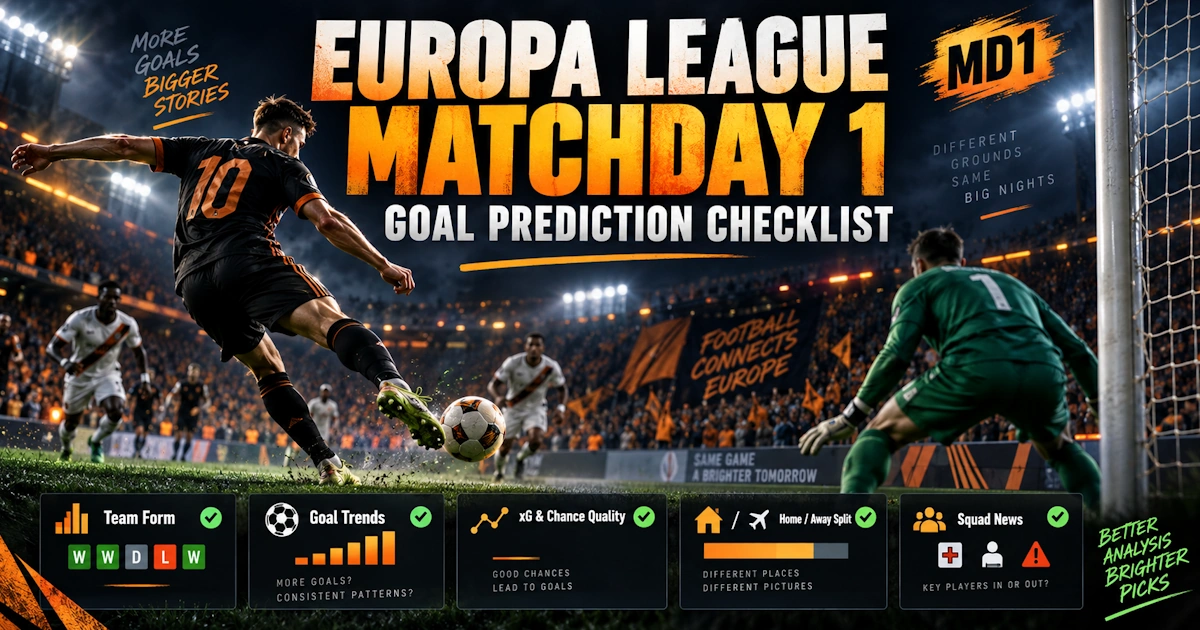
Europa League Matchday 1 is a fascinating round for goal predictions because it brings together teams from very different football environments.
A club competing near the top of a major European league may face a domestic champion from a smaller competition. Some teams arrive after playing several league matches, while others may already have gone through multiple qualifying rounds. New signings are still settling, and there is no current league-phase form to rely on.
That makes Matchday 1 different from analysing the competition in November or December.
The Europa League itself is not automatically an Over competition. The 2025/26 league phase produced 386 goals across 144 matches, an average of 2.69 goals per game. Interestingly, 1-0 and 2-1 were the two most common scorelines and together accounted for 19% of matches.
For bettors, the lesson is useful: goals are common enough to create opportunities, but every Matchday 1 fixture needs to be analysed individually.
Understand the Europa League Format First
The current Europa League league phase contains 36 teams in one table. Each club plays eight different opponents, with four matches at home and four away. Teams finishing first to eighth advance directly to the round of 16, positions nine to 24 enter the knockout play-offs, and teams ranked 25th to 36th are eliminated.
On Matchday 1, however, there is almost no table pressure.
A team losing its opening match still has seven opportunities to recover. That can produce a different tactical environment from Matchday 7 or 8, where a club may desperately need three points.
Do not assume every side will attack recklessly simply because it is playing in Europe.
Some managers may be perfectly satisfied with a controlled away draw to begin the campaign.
Start With Domestic Home and Away Form
The first statistics to check are the ones most closely related to the venue.
For the home side, look at its domestic home numbers. For the visitor, use its away figures.
Useful indicators include:
- Goals scored and conceded
- Over 2.5 percentage
- BTTS percentage
- Clean sheets
- Failure-to-score rate
- xG and xGA
- Shots on target
Imagine the home team has scored in nine of its previous ten competitive home matches and averages 1.9 goals.
The visitors have conceded in eight of their last ten away matches and allow around five shots on target per game.
That gives the home team a believable scoring route before you even consider the overall match total.
The same analysis should then be performed in the opposite direction to decide whether BTTS is realistic.
Adjust for the Strength of the Domestic League
Europa League Matchday 1 creates plenty of statistical traps because teams arrive from different leagues.
A club may average 2.4 goals per match domestically because it is vastly stronger than most of its opponents.
Another may average only 1.5 goals but compete every weekend against stronger defenders.
The first club does not automatically have the better attack.
Ask:
- How strong is the domestic competition?
- Does the team normally dominate possession?
- What happens against stronger opponents?
- Has it faced teams with similar quality to its Europa League opponent?
- Can it create chances when it does not control the ball?
This is especially important with domestic champions and clubs emerging from qualifying rounds.
The raw statistics need to be translated into the new level of opposition.
Qualifying Matches Can Provide Useful Evidence
Unlike some teams entering the league phase directly, others may already have played several European qualifiers.
Those matches can be extremely useful.
Domestic numbers show how a club performs in its usual environment. European qualifiers can reveal whether its style transfers against unfamiliar opposition.
Suppose a team averages 2.2 goals domestically but managed only:
- 0.9 xG
- Three shots on target
- Very few penalty-area entries
against stronger opponents during qualifying.
Its domestic scoring average suddenly looks less convincing for Matchday 1.
Conversely, a smaller club that created good chances in several qualifying rounds may deserve more respect than its name recognition suggests.
Expected Goals Can Filter Out Hot Finishing
Early-season numbers often contain small samples.
A club might arrive on Matchday 1 after scoring 11 goals in four league matches.
That looks excellent.
But if those goals came from only 6.5 xG, the attack has been finishing at an unusually high rate.
Now consider another team with six goals from 9.2 xG.
Its results look weaker, but the chance creation may actually be stronger.
When analysing Matchday 1, compare:
- Actual goals
- xG
- Non-penalty xG
- Big chances
- Shots inside the penalty area
- Shots on target
The goal is to discover whether early results are supported by repeatable attacking performance.
Shots on Target Can Confirm the Threat
A high shot total is not enough.
A team can take 17 attempts without genuinely troubling the goalkeeper.
Suppose the home team averages:
- 16 total shots
- 5.5 shots on target
- 1.8 xG
That is a healthy attacking profile.
If the visitor also allows around five shots on target away, the numbers reinforce each other.
Now consider a team averaging 15 shots but only 2.3 on target and 0.9 xG.
The attack is active, but the chance quality is much weaker.
For goal predictions, accurate attempts and quality chances generally matter more than raw shot volume.
Decide Whether One or Both Teams Will Supply the Goals
This is one of the most important Matchday 1 questions.
Suppose a strong favourite faces a weaker opponent.
You expect scorelines such as:
- 3-0
- 4-0
- 3-1
That may support Over 2.5, but BTTS depends on the outsider finding the net.
Now consider two more evenly matched attacking clubs.
Possible scores include:
- 1-1
- 2-1
- 1-2
- 2-2
BTTS may be better because 1-1 is enough.
Do not simply conclude that a game “looks like goals”.
Ask where those goals are expected to come from.
The First Goal Can Be Particularly Important
The 2025/26 Europa League league phase provides an interesting game-state statistic: the team scoring first went on to win 75% of matches.
That does not mean you should simply back the first scorer live.
It tells you that the opening goal can strongly influence how Europa League matches develop.
Some teams become excellent at controlling a lead. Others continue attacking and create an open match when the opponent has to chase.
For pre-match goal analysis, check how the teams behave after:
- Scoring first
- Conceding first
- Leading at half-time
- Falling behind away from home
A potentially open fixture can become very controlled if the right team scores first.
New Signings Can Make Old Statistics Less Reliable
Matchday 1 arrives shortly after the summer transfer window.
That means some season statistics may already describe a team that has changed.
Check whether a club has:
- Sold its leading scorer
- Signed a new striker
- Changed goalkeeper
- Replaced a centre-back
- Added an attacking midfielder
- Changed formation
A team that recorded excellent defensive numbers last season may now have an entirely new centre-back partnership.
Similarly, a club that struggled to score may have added two starting attackers.
Current personnel should carry more weight than old reputation.
Check the Starting Line-Ups
Confirmed line-ups are particularly valuable on Europa League nights because rotation can be unpredictable.
A manager may prioritise the domestic league and rest several players.
But the word rotation does not automatically mean fewer goals.
If two forwards are rested, attacking potential may decrease.
If two centre-backs and the goalkeeper are rotated while the main forwards start, the match could become more attractive for goals.
Look at exactly which positions have changed.
This can shift the preferred market from Over 2.5 to Under, or from BTTS – No to BTTS – Yes.
Travel Can Matter More in the Europa League
Europa League clubs can face demanding journeys across Europe.
For Matchday 1, consider:
- Travel distance
- Time zones
- Domestic fixture before the match
- Domestic fixture afterwards
- Climate
- Recovery days
Travel does not automatically produce fewer goals.
A tired side may attack less effectively, but defensive organisation can suffer too.
Use travel as an adjustment rather than a standalone reason for an Under bet.
Practical Example: Strong Over 2.5 Candidate
Imagine a home team enters Matchday 1 with:
- 2.0 home goals per match
- 1.8 home xG
- More than five shots on target
- Over 2.5 in six of eight home fixtures
The visitors:
- Score regularly away
- Concede in eight of ten
- Allow 1.6 xGA
- Use fast forwards on counterattacks
The home team also plays with an aggressive high defensive line.
There are several routes to three goals.
The hosts can score twice, while the visitors have enough transition threat to contribute.
Possible scores such as 2-1, 3-1 and 2-2 support an Over 2.5 prediction.
Practical Example: BTTS Is Better Than Over
Now imagine both teams:
- Score in around 80% of relevant matches
- Average approximately 1.4–1.6 goals
- Keep few clean sheets
- Produce moderate rather than exceptional xG
Likely results include 1-1, 2-1 and 1-2.
BTTS – Yes may be more suitable because the 1-1 result wins.
You do not need the third goal.
Practical Example: Avoiding the Favourite Trap
Suppose a famous club hosts a smaller European side.
The obvious expectation is a comfortable home victory.
But closer analysis shows:
- Favourite missing its main striker
- Several new attacking players still adapting
- Visitor defends with a compact back five
- Visitor creates very little going forward
- Favourite has produced modest early-season xG
The match could easily become 1-0 or 2-0.
In this case, Under 3.5 or BTTS – No may fit the expected pattern better than Over 2.5.
A major name does not automatically create a high-scoring game.
Europa League Matchday 1 Goal Checklist
Before choosing a market, check:
- Relevant home and away form
- Domestic league strength
- European qualifying performances
- Goals compared with xG
- Shots on target
- Over 2.5 and BTTS rates
- Clean sheets and failure-to-score rates
- Transfers and new signings
- Defensive partnerships
- Confirmed line-ups
- Tactical matchup
- Set-piece threat
- Travel and recovery
- Which team is expected to provide the goals
- Whether the odds reflect the uncertainty
The strongest selections usually have several separate indicators supporting the same match scenario.
Frequently Asked Questions
Is Europa League Matchday 1 usually high-scoring?
The competition can produce plenty of goals, but the 2025/26 league phase averaged 2.69 per match overall. Individual matchup analysis remains more useful than assuming every Europa League game will be open.
Should domestic form be trusted?
Yes, but adjust it for league strength and opponent quality. Strong domestic numbers may not transfer directly into European competition.
Are qualifying-round statistics useful?
Yes. They can show how teams perform against unfamiliar or stronger opposition and may be more relevant than domestic dominance alone.
Is BTTS better than Over 2.5?
It depends on the expected score pattern. BTTS can be better when both teams are likely to score but neither regularly produces three goals alone.
Should I wait for confirmed line-ups?
Often, yes. Europa League rotation can significantly change both attacking and defensive expectations.
Final Thoughts
Europa League Matchday 1 requires more context than simply checking recent results.
Teams arrive from different leagues, with different levels of European experience and very different summer preparation. Domestic scoring averages may be useful, but they need to be adjusted for opponent strength, venue and tactical style.
Start with home and away statistics. Add xG, shots on target and qualifying performances. Then check transfers, line-ups, travel and how each team is likely to approach the game.
Most importantly, decide what kind of score you actually expect.
If both sides have realistic scoring routes, BTTS may fit. If one strong favourite can provide three goals alone, Over 2.5 or a team total may be better. If one side intends to defend deeply and the favourite lacks attacking sharpness, a lower total can make more sense.
Matchday 1 contains uncertainty, but that uncertainty becomes easier to manage when every selection has a clear statistical and tactical explanation.
Responsible betting: Early European matches can be unpredictable. Use several indicators together, keep stakes within a fixed budget and never bet money you cannot afford to lose.