The Champions League and Europa League look similar on the betting screen. Both offer Over/Under goals, BTTS, team totals, handicaps and match-result markets. Both now use a 36-team league phase in which every club plays eight different opponents.
But treating the two competitions in exactly the same way can be a mistake.
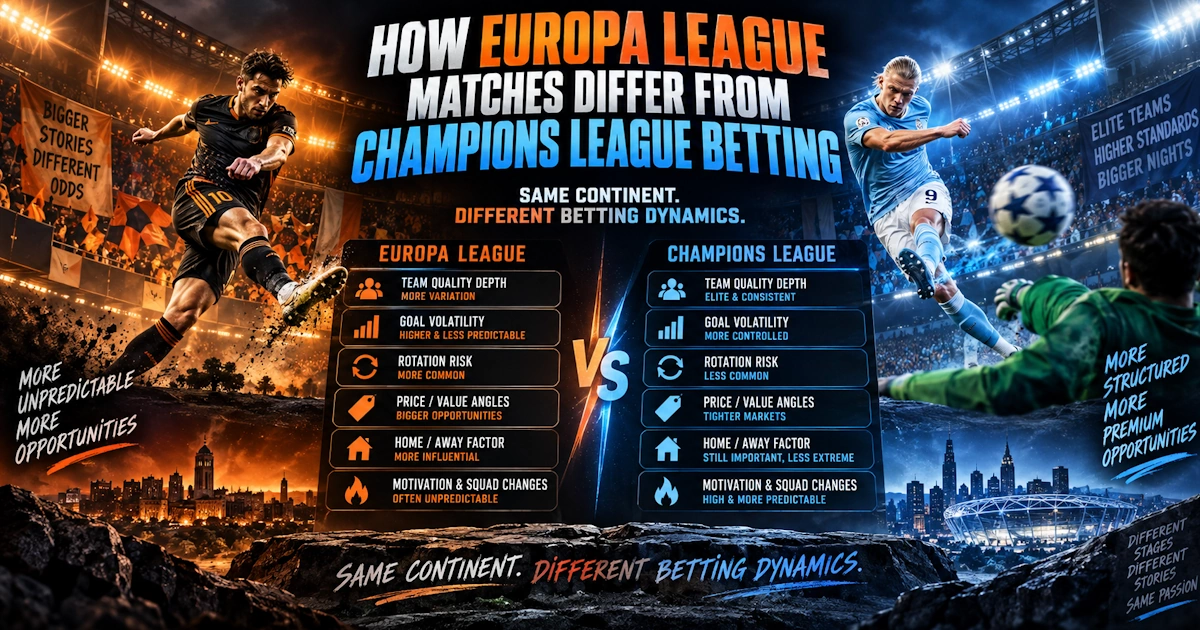
The Champions League generally contains Europe’s strongest clubs and more elite attacking talent. The Europa League has a wider range of team levels, more unusual tactical matchups and, in many cases, greater uncertainty around rotation and priorities.
The scoring numbers show a clear recent difference. During the 2025/26 league phase, the Champions League produced 487 goals in 144 matches, averaging 3.38 per game. The Europa League produced 386 goals from the same number of matches, averaging 2.69.
That does not mean Champions League equals Over and Europa League equals Under. It means the starting environment is different, and bettors should adjust their analysis accordingly.
The Formats Are Similar, but the Teams Are Not
Structurally, the competitions now have a great deal in common.
Both Champions League and Europa League league phases contain 36 teams. Each club plays eight matches, four at home and four away. The top eight qualify directly for the round of 16, teams ranked ninth to 24th enter the knockout phase play-offs, and those finishing 25th to 36th are eliminated.
So the biggest difference is not the format.
It is the type of teams inside it.
Champions League clubs are more likely to have deep squads filled with high-level attackers. Europa League fixtures can feature anything from strong clubs from major leagues to champions and qualifiers from smaller competitions.
That wider variation can make direct statistical comparisons more difficult.
Champions League Matches Have Recently Produced More Goals
The recent scoring difference is large enough to matter.
The Champions League’s 3.38 goals per match in 2025/26 was almost 0.7 goals higher than the Europa League’s 2.69.
There are several possible reasons.
Elite Champions League teams often combine high shot volume with outstanding finishing quality. They can also punish defensive mistakes more efficiently. A weaker side may survive a poor defensive moment in another competition; against one of Europe’s best attacks, the same mistake can immediately become a goal.
That can create matches where the favourite covers Over 2.5 almost by itself.
A 3-0 or 4-0 is enough.
In the Europa League, the stronger side may still dominate but lack the same finishing quality. A similar performance could end 1-0 or 2-0.
This is why competition-level scoring context can be useful before moving into the individual fixture.
Europa League Matches Often Need More Team-Specific Analysis
The wider range of clubs in the Europa League makes league strength especially important.
Imagine two teams both average 1.9 goals domestically.
One plays in a major European league against high-quality defences every weekend.
The other dominates a smaller domestic competition and regularly has more than 60% possession.
Their 1.9-goal averages are not necessarily equivalent.
When they meet in Europe, ask:
- How strong was the opposition behind the statistics?
- Can the smaller-league team create chances without dominating possession?
- Has it faced aggressive pressing before?
- How does it defend against faster attackers?
- Does the stronger club take the Europa League seriously enough to use its best team?
This kind of adjustment is useful in the Champions League too, but it becomes particularly important in the Europa League.
Rotation Can Be a Bigger Betting Issue
Europa League team sheets can be difficult to predict.
A club from the Premier League, Serie A or Bundesliga may consider domestic qualification more important than one early league-phase fixture. A manager can therefore rest several first-choice players.
That does not automatically mean you should bet Under.
You need to know where the rotation happens.
Suppose a team rests:
- Its striker
- Two creative midfielders
- An attacking winger
That clearly reduces attacking expectations.
Now suppose it keeps the main attack but rests:
- Goalkeeper
- Two centre-backs
- Defensive midfielder
That could actually increase Over 2.5 or BTTS potential.
The word “rotation” is almost useless without knowing the positions involved.
Champions League Rotation Can Be More Manageable
Champions League clubs rotate too, but elite squads can often replace strong players with other high-quality options.
That reduces the impact of some changes.
If an elite striker is rested but another international forward starts, the team’s attack may remain dangerous.
A Europa League participant with less depth may experience a much bigger drop when two important starters are removed.
For bettors, squad depth matters as much as the number of changes.
Compare the actual replacements rather than simply counting how many players have been rotated.
Set Pieces Can Matter More in Europa League Analysis
Europa League matches can be especially interesting for set-piece analysis.
UEFA’s review of the 2025/26 league phase found that 19% of goals, excluding penalties, came from set plays. Midtjylland were a particularly strong example, with half of their 18 league-phase goals arriving from set-piece situations.
This matters because some Europa League teams may not create many high-quality open-play chances against stronger opposition.
Corners, free kicks and long throws can become their most realistic scoring route.
Before dismissing an underdog for BTTS, check:
- Corner production
- Aerial strength
- Set-piece goals
- Quality of delivery
- Opponent’s weakness defending dead balls
A club expected to have only 35% possession may still be capable of scoring from one well-designed corner.
The First Goal Can Be Particularly Important
Europa League data also shows how strongly the opening goal can influence the match.
During the 2025/26 league phase, the team scoring first went on to win 75% of matches. UEFA also found that 1-0 and 2-1 were the most common scorelines, together accounting for 19% of games.
That is useful for live betting.
Some Europa League teams become extremely difficult to break down once they take the lead. They may lower the tempo, defend compactly and play on the counterattack.
A pre-match Over 2.5 candidate can therefore change quickly after an early 1-0.
In the Champions League, elite attacking quality can sometimes keep matches open despite the first goal. The 2025/26 league phase produced 487 goals and an average winning margin of 1.78 goals, showing how frequently matches continued producing scoring opportunities.
Again, these are competition-level tendencies rather than rules.
Travel Can Create More Extreme Europa League Situations
Europa League travel can be more varied.
Teams may travel between very different parts of Europe, sometimes while managing a difficult domestic schedule.
That can affect:
- Recovery
- Training time
- Starting line-ups
- Match intensity
- Second-half performance
A Thursday away fixture followed by a domestic Sunday match also creates a classic short-recovery situation.
Managers know this and may control tempo once ahead.
However, fatigue can also weaken defending. A tired midfield may stop tracking runners, creating late BTTS or Over opportunities.
Travel should therefore adjust the prediction rather than automatically push you towards an Under.
Practical Example: Champions League Over Candidate
Imagine two Champions League teams with:
Home side
- 2.2 home goals
- 2.0 home xG
- Six shots on target
Visitors
- 1.7 away goals
- Strong counterattacking attack
- Few clean sheets
Both use aggressive defensive lines.
A 2-1, 3-1 or 2-2 result has several realistic routes.
In this case, Over 2.5 fits the competition environment and the individual matchup.
Practical Example: Europa League Under Candidate
Now imagine a Europa League favourite that has rotated several attackers.
The visitors:
- Play with a compact back five
- Create little away
- Would accept a draw
- Depend mostly on set pieces
The favourite should dominate possession, but it may lack the attacking quality needed to turn that control into three goals.
Possible results include:
- 1-0
- 2-0
- 1-1
Under 3.5 or BTTS – No may be more logical than Over 2.5.
The famous club name should not override the actual starting eleven.
Practical Example: Europa League BTTS Opportunity
Consider a stronger home side that retains its main attack but rotates two defenders.
Its opponent is weaker overall but has:
- Scored in seven of eight competitive matches
- Strong set-piece numbers
- Fast counterattacking forwards
The favourite remains likely to score.
The defensive changes give the underdog a realistic route as well.
Instead of backing the favourite at short match odds, BTTS – Yes or Home Win & BTTS could become more interesting.
Do Not Use Competition Reputation as the Bet
The biggest mistake is reducing the analysis to:
- Champions League = goals
- Europa League = unpredictable
Both statements are too broad.
The Champions League did average substantially more goals in 2025/26, but individual fixtures can still be defensive. The Europa League averaged fewer goals, yet it also contained several 4-3 matches and a 6-0 result.
Use competition statistics as your baseline.
Then analyse:
- Home-away performance
- xG and xGA
- Shots on target
- League strength
- Squad depth
- Rotation
- Travel
- Tactical style
- Set pieces
- Motivation
The specific matchup should always have the final say.
Frequently Asked Questions
Does the Champions League produce more goals than the Europa League?
It did in the 2025/26 league phase. The Champions League averaged 3.38 goals per match compared with 2.69 in the Europa League.
Is Over 2.5 better in the Champions League?
Not automatically. Higher competition-wide scoring helps provide context, but individual team statistics and odds remain more important.
Is rotation more important in Europa League betting?
It can be, particularly for clubs balancing European football with major domestic objectives. Always check which positions are being rotated.
Are set pieces important in Europa League predictions?
Yes. UEFA reported that 19% of 2025/26 league-phase goals excluding penalties came from set plays, making dead-ball strength worth checking carefully.
Do both competitions use the same league-phase system?
Broadly, yes. Both have 36 clubs, eight matches per team, and the same top-eight and 9th-to-24th qualification structure.
Final Thoughts
Europa League betting requires a slightly different mindset from Champions League analysis.
The Champions League has recently produced a higher scoring environment and generally contains deeper, more powerful attacking squads. The Europa League offers greater variation in league strength, squad depth, tactical quality and rotation.
That does not make one competition easier to predict.
It means different information deserves more weight.
In Champions League goal markets, elite attacking quality and the ability of one favourite to cover a total alone can be particularly important. In the Europa League, team sheets, set pieces, travel and the difference between first-choice and reserve players often deserve closer attention.
Start with the competition context, but finish with the two teams actually playing.
That is the difference between using “Champions League” or “Europa League” as a label and using the competition as a useful part of your football analysis.
Responsible betting: Competition trends describe large samples, not individual matches. Check current team information, use a fixed staking budget and never bet money you cannot afford to lose.