
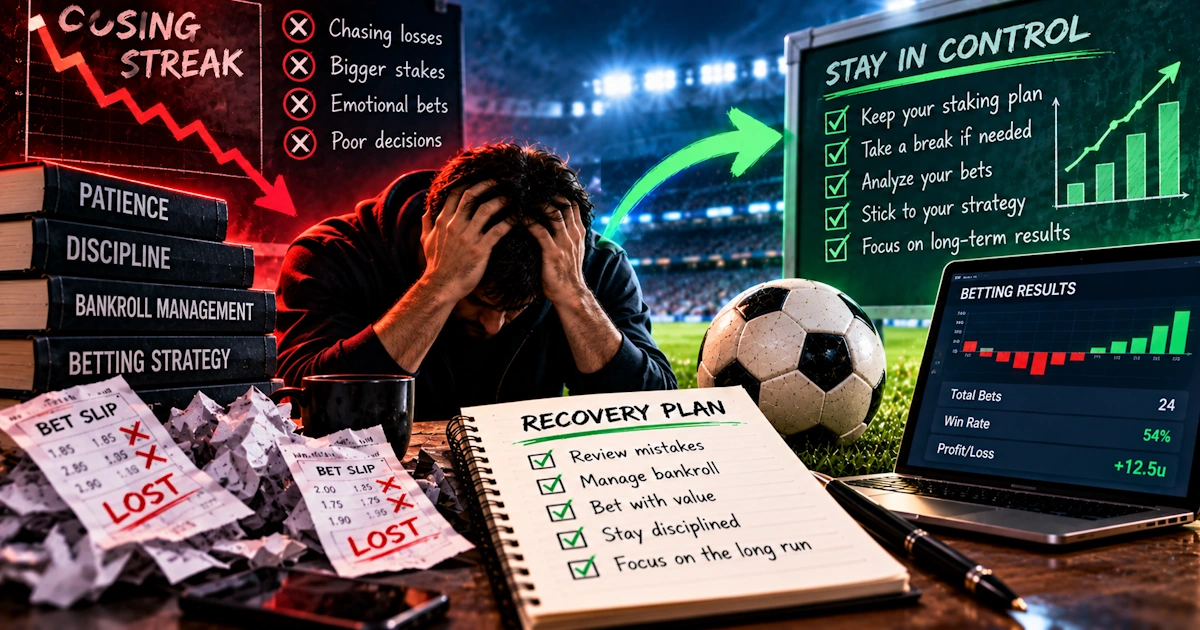
Every football bettor eventually experiences a losing streak.
It does not matter whether you use xG, shots on target, statistical models or detailed tactical analysis. Even a good prediction can lose because football contains uncertainty.
A striker can miss a penalty. A red card can completely change the match. A goalkeeper can produce an outstanding performance. A team can create 2.5 xG and still fail to score.
The dangerous part is not the losing streak itself.
The dangerous part is what happens next.
Many poor bankroll decisions begin with one thought: “I need to win the money back.”
That mindset can lead to larger stakes, weaker selections and bets you would never normally make.
The best response to a losing streak is therefore not to search for a guaranteed winner. It is to protect your bankroll, review your process and make sure emotion does not start controlling your decisions.
Losing Streaks Are Mathematically Normal
Suppose your betting method is genuinely good and wins 55% of selections over the long run.
That still means approximately: 45% of bets lose.
Losing four or five bets in a row is therefore completely possible.
Even six or seven consecutive losses do not automatically prove that the strategy has stopped working.
Think about a simple coin.
If an event has a 50% probability, the chance of losing five consecutive independent attempts is: 0.5⁵ = 3.125%
That may sound small, but if you place hundreds of bets, sequences like this eventually become likely to appear somewhere.
Football probabilities are also never known perfectly.
A bet you believe has a 60% chance may actually be closer to 55%.
That makes losing runs even more normal.
Do Not Increase Stakes to Recover Quickly
The classic chasing mistake is increasing the next stake after a loss.
For example:
Bet 1: €10 – Loss
Bet 2: €20 – Loss
Bet 3: €40 – Loss
Bet 4: €80 – Loss
The bettor is no longer choosing stake size based on bankroll or value.
The stake is being controlled by previous losses.
That is dangerous because the next match does not become more likely to win simply because the last three lost.
Each prediction still has its own probability.
Chasing only increases the amount of damage if the losing streak continues.
Why Martingale Systems Fail So Quickly
A Martingale strategy usually doubles the stake after every loss.
It looks attractive because one eventual win can recover previous losses.
But the numbers grow extremely fast.
Starting with €5:
€5
€10
€20
€40
€80
€160
€320
After six losses, the next required stake is already €320.
The total amount previously lost is: €315
A normal football losing run can therefore create an enormous financial risk.
No staking system removes uncertainty.
It only changes how much money is exposed to it.
Keep Your Standard Stake Unchanged
One of the simplest protections is flat staking.
Suppose your normal stake is: 1 unit
During a losing streak, keep it at 1 unit.
Do not move to:
2 units because you “really like” the next match
3 units because the previous bet was unlucky
5 units because you want to recover the weekend
The stake should be decided before emotions become involved.
If anything, a significant losing streak may justify reducing stakes temporarily rather than increasing them.
Protect the Bankroll First
Imagine your bankroll is: €1,000
Your standard stake is: 1% = €10
After eight consecutive losses, you are down: €80
Bankroll: €920
That is uncomfortable, but manageable.
Now imagine you reacted by increasing stakes:
€10
€20
€30
€50
€80
A similar losing sequence could remove hundreds of euros.
The purpose of bankroll management is to make sure ordinary variance cannot destroy your capital.
A losing streak becomes much less dangerous when every bet represents only a small percentage of the bankroll.
Take a Short Break If Decisions Become Emotional
Not every losing streak requires stopping.
But you should stop temporarily if you notice that your thinking has changed.
Warning signs include:
Searching for bets you normally would skip
Increasing stakes
Betting leagues you do not follow
Betting immediately after a loss
Feeling that the next match “must win”
Adding late-night matches just to recover money
Ignoring your normal checklist
At that point, the problem is no longer statistical.
It is behavioural.
Even taking one day away from betting can prevent a normal losing run from becoming a much larger financial mistake.
Review the Bets Before Blaming the Strategy
A losing result does not automatically mean the prediction was bad.
Suppose you backed Over 2.5 Goals.
The match finished: 1-1
But the data shows:
3.1 combined xG
12 shots on target
Four big chances
One missed penalty
The bet lost.
The underlying analysis may still have been reasonable.
Now compare another loss.
You backed Over 2.5 because:
The previous H2H finished 4-2
One team scored three goals last week
You liked the odds
The match produced:
0.9 combined xG
Three shots on target
Few dangerous attacks
That may have been a weak prediction.
The losing streak should be reviewed bet by bet.
Separate Bad Luck From Bad Analysis
A useful monthly review can classify losses into categories.
Good decision, bad result Your reasoning was strong, the price was reasonable and the match broadly played as expected.
Weak decision, deserved loss Important information was ignored or the bet did not meet your normal criteria.
Good idea, bad price The prediction itself was reasonable, but the odds were too short.
Changed circumstances A red card, early injury or unexpected tactical change completely altered the match.
This prevents you from rebuilding a good strategy just because of short-term variance.
It also stops you from blaming luck when the real problem is poor selection quality.
Check Whether Your Odds Were Good
Closing Line Value can help during a losing streak.
Suppose you took: Over 2.5 at 2.00
The market closed at: 1.78
Your bet lost.
But you secured a much better price than was available near kick-off.
Now imagine most of your losing bets show the opposite pattern:
You took 1.75 and they closed around 1.95.
That may suggest your entry timing or probability estimates need work.
Again, one bet proves nothing.
But a pattern across 20 or 30 selections can be informative.
Reduce the Number of Bets
A losing streak often becomes worse because bettors increase volume.
They think: “More matches give me more chances to recover.”
But more bets also create more opportunities to lose.
Suppose your normal approach produces three strong selections on Saturday.
After several losses, you suddenly place ten.
The extra seven are unlikely to be as carefully researched as the first three.
This often creates a cycle: Losses → more bets → weaker bets → more losses.
One of the best responses to a losing streak is often to become more selective.
Practical Example: Controlled Response
Imagine you lose six bets in a row.
Your bankroll falls from: €500 to €470
Your standard stake is €5.
A disciplined response might be:
Keep stake at €5 or reduce slightly
Stop adding extra matches
Review the six bets
Check xG and closing odds
Continue only when a new selection meets your normal criteria
The bankroll remains healthy.
The losing run becomes data.
Now compare that with chasing.
You increase the next stake to €20, then €30.
Two more losses can turn a manageable €30 drawdown into something much worse.
Drawdowns Need Perspective
Suppose your bankroll falls from €1,000 to €800.
That is a: 20% drawdown
To return from €800 to €1,000, you need: €200 ÷ €800 = 25% growth
If the bankroll falls 50%, the recovery becomes much harder.
From €1,000 to €500: You now need: 100% growth just to return to the starting point.
That is why protecting the bankroll during bad periods matters more than trying to recover quickly.
Do Not Change Strategy After Five Bets
Small samples can create emotional overreaction.
Imagine your strategy performed well over 200 bets.
Then you lose five in a row.
Those five bets contain very little information compared with the larger sample size.
Now imagine the last 50 or 100 selections show:
Falling ROI
Negative closing-line value
Worse performance in the same markets
Repeated analytical mistakes
That is more meaningful.
Strategy changes should come from evidence, not frustration.
Set a Stop Rule
A simple stop rule can help remove emotion.
For example: If I lose 5 units in one day, I stop.
Or: If I lose 8 units in a week, I review before continuing.
This is not because the next bet is necessarily bad.
It is because decision quality often declines when frustration increases.
A stop rule protects you from yourself during the exact moment when discipline is hardest.
Avoid the “One Big Bet” Mentality
After a bad week, the temptation may be: “I just need one strong 2.00 bet to recover everything.”
That is dangerous.
If your usual stake is €10, suddenly staking €100 changes the entire risk structure.
One result now matters ten times more than normal.
If it loses, the emotional pressure becomes even stronger.
Recovery should come from normal betting activity over time, not from one rescue bet.
Keep a Losing-Streak Checklist
When results turn negative, ask:
Am I still using normal stakes?
Am I placing more bets than usual?
Are my selections meeting the same criteria?
Did I take good prices?
Is my bankroll still within acceptable drawdown limits?
Were losses caused by poor analysis or normal variance?
Have I started betting emotionally?
Should I pause and review?
Am I trying to recover money rather than find value?
If the main reason for a bet is “I need to win back what I lost,” skip it.
Frequently Asked Questions
How many consecutive losses are normal?
There is no fixed number. Even a profitable strategy can experience several consecutive losses because losing outcomes remain part of the probability distribution.
Should I increase my stake after a losing run?
No. Previous losses do not make the next selection more likely to win.
Should I stop betting completely during a losing streak?
Not always. But taking a break can be useful if your decisions have become emotional or your normal selection standards are slipping.
How do I know whether the strategy is broken?
Judge it over a meaningful sample using ROI, average odds, closing-line value and prediction quality rather than only a few recent results.
Is chasing losses the same as increasing stakes?
Increasing stakes after losses is one form of chasing. Placing extra bets or entering weaker markets purely to recover money is another.
Final Thoughts
A losing streak is not automatically a crisis.
It is part of working with probabilities.
The real danger begins when a normal statistical drawdown changes your behaviour.
Stakes increase.
Selection standards fall.
More matches are added.
The goal changes from finding value to recovering yesterday’s losses.
That is when small losing runs can become large ones.
The better response is much less dramatic.
Keep stakes controlled. Review the decisions. Separate bad luck from bad analysis. Reduce volume if necessary and give the bankroll time to recover through normal, disciplined selections.
Most importantly, accept one uncomfortable truth: You do not need to recover losses today.
If your approach genuinely has value, recovery should come from many future decisions—not from one desperate bet.
Responsible betting: Chasing losses can quickly turn a manageable drawdown into a serious financial problem. Use fixed limits, take breaks when emotions affect decisions and never bet money you cannot afford to lose.