Over 3.5 Goals is a demanding football market.
You need at least four goals for the bet to win.
A 2-1 result may feel like an open, entertaining game, but it still loses. So does 3-0. That makes Over 3.5 very different from Over 2.5, where three goals are enough.
Because of this, simply finding two attacking teams is not enough.
A good Over 3.5 selection usually needs several scoring routes. Both teams may contribute, one favourite may be capable of scoring three or four alone, or the tactical matchup may create enough chances for the game to become unusually open.
The goal is not to find matches that could produce four goals. Almost any football match can do that.
The goal is to find matches where four goals are supported by the underlying statistics.
Start With the Expected Goal Environment
Before considering Over 3.5, ask how many goals the match is realistically expected to produce.
Suppose two teams have these averages:
Home team
1.9 goals scored
1.3 conceded
Away team
1.6 goals scored
1.5 conceded
There is a reasonable base for goals.
Now compare a fixture where both teams average close to one goal scored and concede around one.
The second match may still finish 2-2, but you are depending much more heavily on unusually efficient finishing.
For Over 3.5, you generally want a match environment already pointing towards three or more expected goals, rather than hoping an ordinary fixture suddenly explodes.
xG Is More Useful Than Recent Scorelines
Recent results can make Over 3.5 look much easier than it really is.
Imagine a team’s last four matches finished:
4-1
3-2
2-2
4-0
That looks perfect.
But suppose those matches produced only moderate expected goals (xG) and included:
Two penalties
One red card
Several long-range goals
Goalkeeper errors
The results may exaggerate the true attacking level.
Now imagine another team’s matches have finished:
2-1
1-1
2-0
1-2
Less exciting.
But the games consistently produce around 3.0 combined xG and several big chances.
The second profile may have more future Over 3.5 potential than the scorelines suggest.
For this market, compare:
Goals
xG
xGA
Big chances
Non-penalty xG
Four goals are much more believable when chance creation supports them.
Combined xG Can Be a Strong Filter
There is no perfect xG number that guarantees Over 3.5.
However, as a practical filter, matches where both teams regularly combine for around 3.0 expected goals or more deserve extra attention.
For example: Home attacking xG: 1.9 Away attacking xG: 1.5
That gives a combined attacking expectation of around:3.4 xG
Now add defensive weakness: Home xGA: 1.4 Away xGA: 1.8
The matchup contains several reasons for chances.
Compare that with a fixture where the two attacks average only 1.1 and 0.9 xG.
You would need exceptional finishing to reach four goals.
Over 3.5 becomes much more dependent on luck.
Shots on Target Should Be High
A team cannot score four goals without creating enough dangerous attempts.
Shots on target are therefore one of the most useful supporting statistics (widely tracked by sources like FBref).
Imagine a match involving teams averaging: Home: 6.0 shots on target Away: 5.0 shots on target
That creates around 11 accurate attempts before adjusting for opponent strength.
Now compare two teams producing only: 2.8 and 2.5
The second match has a much weaker base.
As a practical guideline, a fixture where both teams regularly combine for nine or more shots on target can be interesting for high goal lines, especially when xG is also strong.
But quality still matters.
Ten weak shots straight at the goalkeeper are less useful than six high-quality attempts from inside the penalty area.
Both Teams Scoring Makes Four Goals Easier
There are many ways to reach four goals.
The easiest are often:
2-2
3-1
1-3
That is why BTTS statistics are useful.
Suppose both teams:
Score in 80% of relevant matches
Concede in 75%
Produce strong xG
Keep few clean sheets
The chance of a balanced high-scoring game increases.
If both teams score once, you already have two goals.
You now need only two more.
Compare that with a match where the likely pattern is 3-0.
The Over can still win, but you are asking one side to produce almost everything.
Both approaches can work, but they require different analysis.
One Dominant Favourite Can Also Carry the Market
Do not assume BTTS is required.
Some of the best Over 3.5 situations involve one elite attack against a very weak defence.
Imagine:
Home favourite
2.5 goals per home match
2.3 home xG
Seven shots on target
Away defence
Concedes 2.0 away goals
Allows 1.9 xGA
Gives up many big chances
Likely scorelines might include:
4-0
4-1
3-1
Here, the favourite may be capable of covering most or all of the required total.
This can be particularly relevant when the underdog has very little attacking quality.
In such cases, Favourite Team Over 2.5 Goals may sometimes be cleaner than full-match Over 3.5.
Defensive Weakness Must Be Real
High-scoring markets become much stronger when the defences actively contribute to the problem.
Check:
xGA
Shots on target conceded
Big chances allowed
Clean-sheet rate
Defensive errors
Goalkeeper performance
Suppose Team A scores regularly but faces a defence allowing only 0.8 xGA.
That creates resistance.
Now suppose the opponent allows:
1.8 xGA
Six shots on target
Several clear chances
The attacking team has a much easier route to multiple goals.
Ideally, an Over 3.5 candidate combines strong attacks with at least one genuinely vulnerable defence.
High Defensive Lines Can Produce Extreme Matches
Tactical style matters.
Two teams using high defensive lines can create a match with repeated transition opportunities.
One broken press can leave:
Three attackers against three defenders
A striker running behind the centre-backs
Large spaces around midfield
If both teams attack aggressively, the game can become end-to-end.
This is particularly useful for Over 3.5 because one goal can make the match even more open.
The side that concedes begins taking more risks, which creates more counterattacking space.
That game-state effect can push a three-goal match towards four or five.
Weak Goalkeepers Can Increase the Ceiling
Goalkeeper quality is especially relevant for aggressive goal lines.
Two teams might create similar chances, but the quality of finishing and goalkeeping determines whether the match ends 2-1 or 3-2.
Check:
Save percentage
Goals prevented
Backup goalkeeper status
Recent goalkeeper form
Suppose the first-choice goalkeeper is missing and the replacement has limited experience.
If the opponent already creates strong xG and many shots on target, the change can strengthen an Over 3.5 case.
However, do not use poor goalkeeping as the main reason.
You still want enough chances to be created first.
Conversion Rate Can Identify Unsustainable Over Trends
A team scoring from an unusually high percentage of shots can produce several Over 3.5 matches.
That does not mean the trend will continue.
Imagine a team has scored: 14 goals from 50 shots
Conversion rate:28%
That is extremely high.
If its xG is only 8.0, finishing is running far above expectation.
The next match may still produce goals, but blindly following the recent Over trend becomes risky.
For Over 3.5, the best profile is usually:high chance volume + reasonable conversion
rather than:moderate chance volume + incredible finishing
The first is easier to sustain.
Game State Is Crucial
Over 3.5 often needs the match to become open.
The first goal can help.
Suppose a strong favourite scores after 15 minutes.
The underdog now has to decide whether to stay defensive or attempt to respond.
If it pushes forward, more space appears.
A second early goal can create even more dramatic changes.
At 1-1 after 25 minutes, both teams may continue attacking.
At 2-0 after 30 minutes, the trailing side may have no choice but to take risks.
This is why Over 3.5 can be especially attractive live when an already open match produces an early goal (a dynamic discussed in our late goals guide).
First-Half Activity Can Confirm a Live Over 3.5
Suppose it is 1-1 after 35 minutes.
The match has already produced:
1.9 xG
Seven shots on target
Three big chances
That is very different from a 1-1 created by:
One penalty
One goalkeeper error
Almost no other opportunities
The scoreline alone does not tell you whether another two goals are likely.
For live Over 3.5, chance creation matters just as much as the current total.
Practical Example: Strong Over 3.5 Candidate
Imagine the home team has:
2.1 home xG
2.3 goals scored
6.2 shots on target
Conceded in 7 of 10
The visitors have:
1.6 away xG
1.7 goals scored
4.8 shots on target
Conceded in 8 of 10
Both use aggressive attacking systems.
Neither has important attacking absences.
The combined profile suggests:
Strong shot volume
Strong xG
High scoring frequency
Defensive vulnerability
Possible results include: 2-2, 3-1, 3-2
Over 3.5 has multiple realistic routes.
Practical Example: Over 2.5 Good, Over 3.5 Too Aggressive
Now imagine:
Home team
1.7 xG
Away team
1.2 xG
Both score fairly regularly, but neither produces huge shot volume.
Likely scores include:
2-1
1-2
1-1
Over 2.5 may be reasonable.
Over 3.5 requires one extra goal that the statistics do not strongly support.
This distinction matters.
A good Over 2.5 match is not automatically a good Over 3.5 match.
Practical Example: Favourite Can Score Four
Imagine a dominant home side with:
2.6 home xG
7 shots on target
Several big chances per match
The visitors:
Allow 2.1 xGA
Concede many shots
Are missing two defenders
The away attack is weak.
Possible results:
4-0
3-0
4-1
Over 3.5 may still work, but the best market could be:Favourite Team Over 2.5 Goals
That isolates the strongest part of the prediction.
Always compare markets rather than assuming the full-match total is best.
Odds Matter
Over 3.5 usually offers higher odds than Over 2.5 because four goals are harder to achieve.
That does not automatically make it better value.
Suppose you estimate: Over 3.5 probability = 38%
Fair odds: 1 ÷ 0.38 ≈ 2.63
If the bookmaker offers:3.00
the price may be interesting.
If it offers:2.20
the market is asking for a much higher probability than your analysis suggests (this is why measuring Closing Line Value is important).
The prediction and the price must be evaluated separately.
Avoid Adding Over 3.5 Just for Better Odds
This happens frequently with accumulators.
Over 2.5 is priced at: 1.65 Over 3.5 is priced at: 2.45
The larger price looks attractive.
But if your actual analysis supports three goals much more strongly than four, moving to Over 3.5 simply to increase the odds is poor discipline.
Choose the goal line that matches your expected score distribution.
Not the one with the most exciting payout.
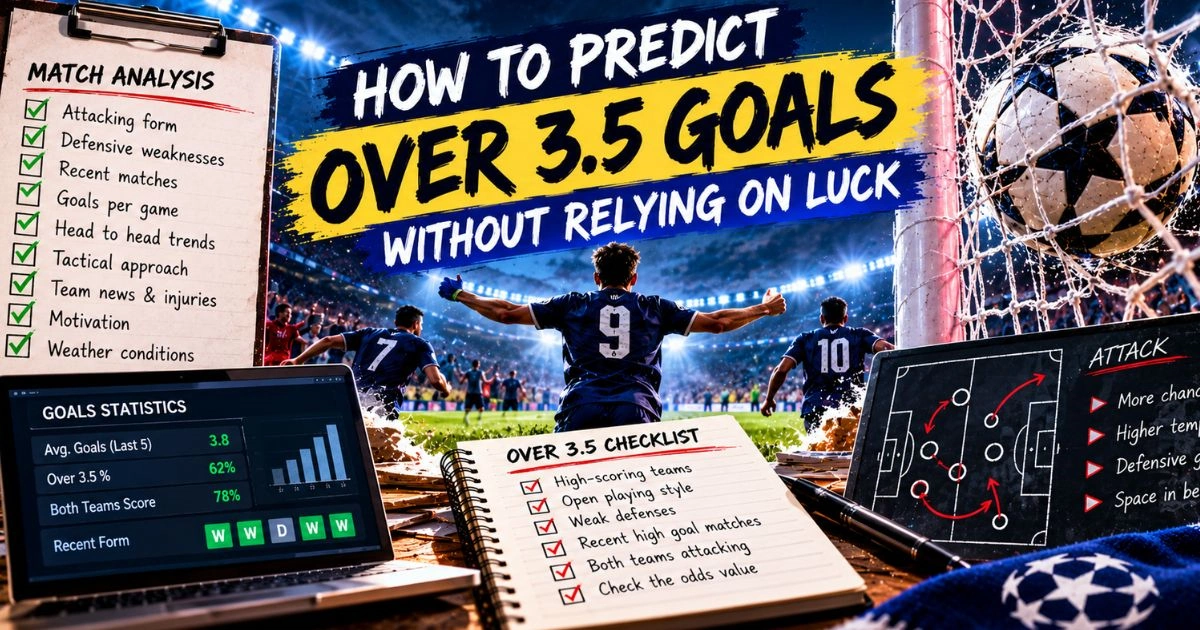
Over 3.5 Goals Checklist
Before backing Over 3.5, check:
Combined xG
xGA
Shots on target
Big chances
Home and away splits
BTTS frequency
Clean-sheet rates
Failure-to-score rates
Conversion rate
Goalkeeper quality
Defensive injuries
Attacking line-ups
High defensive lines
Counterattacking potential
Game state
Whether one team can score three or four alone
Whether the odds offer enough value
The more independent indicators supporting four goals, the less you are relying on unusual finishing.
Frequently Asked Questions
Is Over 3.5 much harder than Over 2.5?
Yes. Over 3.5 requires four goals, while Over 2.5 needs only three. A common 2-1 result wins Over 2.5 but loses Over 3.5.
What combined xG is good for Over 3.5?
There is no fixed threshold, but matches consistently producing around 3.0 or more combined expected goals can be worth investigating when other indicators also support a high total.
Does BTTS help Over 3.5?
Usually. If both teams contribute, scorelines such as 2-2 and 3-1 become realistic. But one dominant favourite can also cover the total alone.
Are shots on target important?
Very. High shot volume reaching the target provides stronger evidence of repeated scoring opportunities than total shots alone (see stats on Understat).
Is Over 3.5 good for accumulators?
It can be, but the higher line adds significant risk. Do not use it simply to increase combined odds when Over 2.5 is better supported by the match data.
Final Thoughts
Predicting Over 3.5 Goals should never begin with: “This match feels like a goal fest.”
Four goals require a stronger statistical case than three.
Look for high combined xG, plenty of shots on target, weak defensive numbers and tactical styles that create space.
Then decide where the goals are expected to come from.
Sometimes both teams can contribute to a 2-2 or 3-1 result. In other matches, one dominant favourite may be capable of scoring four alone.
Most importantly, do not confuse recent high-scoring results with repeatable attacking quality.
Penalties, red cards, goalkeeper mistakes and unusually high conversion can create spectacular scorelines without making the next Over 3.5 a strong prediction.
The best selections are those where four goals can be explained before the match begins.
If the only argument is that the teams have been “involved in crazy games lately,” you are probably relying too much on luck.
Responsible betting: Over 3.5 is a higher-variance market that can lose even in an entertaining three-goal match. Use several indicators together, compare probability with price, keep stakes controlled and never bet money you cannot afford to lose.