Europa League Matchday 2 gives football bettors something that Matchday 1 cannot: real European evidence from the current season.
You can now see how each team handled its opening opponent, whether domestic form carried into Europe and whether the manager changed tactics for the competition.
But one European match is still a very small sample.
A team that won 3-0 on Matchday 1 is not automatically a strong Over 2.5 selection one week later. Another side that lost 0-1 may have created enough chances to deserve two or three goals.
The best way to analyse Europa League Matchday 2 is therefore to combine the new European information with a much larger set of domestic statistics.
The current Europa League league phase contains 36 teams, with every club playing eight different opponents—four at home and four away. The top eight qualify directly for the round of 16, while teams finishing ninth to 24th enter the knockout phase play-offs.
That format makes every result important, but Matchday 2 is still far too early to treat most matches as desperate must-win situations.
Start by Reviewing Matchday 1 Properly
Do not simply look at the score.
Look at how the result happened.
Imagine Team A won its first Europa League match:3-0
Impressive.
But the deeper numbers show:
1.2 xG
Four shots on target
One penalty
Opponent missed two big chances
The result may be better than the performance.
Now imagine Team B lost:1-0
but produced:
1.7 xG
Six shots on target
Three big chances
The second team may actually have shown more attacking potential.
When reviewing Matchday 1, check:
xG and xGA
Shots on target
Big chances
Penalties
Set pieces
Possession in dangerous areas
Whether the final score reflected the chances
The performance matters more than the headline result.
Do Not Forget Domestic Form
One Europa League match should never replace several weeks of domestic evidence.
Suppose a club has played:
Seven league matches
One Europa League match
You have eight current competitive performances available.
Use them.
Domestic statistics can reveal whether Matchday 1 was normal or unusual.
For example, a team may have scored three Europa League goals after averaging only:0.9 xG domestically
That should make you cautious.
Another may have failed to score in Europe despite averaging:1.8 xG and five shots on target in its domestic league.
That team could be more dangerous than the first result suggests.
The key is adjusting domestic numbers for opponent quality.
Compare Matchday 1 and Matchday 2 Opponents
Under the league-phase format, teams face eight different opponents rather than playing the same group rivals home and away.
That makes opponent strength extremely important.
Suppose a team dominated Matchday 1 against a weaker opponent:
65% possession
18 shots
2.3 xG
3 goals
Matchday 2 may be away against a much stronger side.
Do not simply expect another dominant attacking performance.
Ask: Was the Matchday 1 performance strong because of the team, or because of the opponent?
Ideally, compare how both teams perform against opponents of similar quality.
The Home-Away Change Matters
Europa League teams can look very different depending on venue.
In principle, UEFA’s format gives each club one home and one away match across the opening two matchdays.
That makes home-away splits particularly useful.
Imagine a team produces:
At home
1.9 xG
5.5 shots on target
2.0 goals
Away
1.1 xG
3.0 shots on target
1.0 goal
If Matchday 1 was at home and Matchday 2 is away, the previous European result needs adjusting.
Analyse the home team at home against the away team away rather than relying only on overall season averages.
Understand the Europa League Goal Environment
The completed 2025/26 Europa League league phase produced 386 goals in 144 matches, an average of 2.69 goals per game.
That tells us something useful.
Goals are common, but the competition is not automatically an Over 2.5 market every week.
In fact, UEFA found that 1-0 and 2-1 were the most common final scorelines, appearing in a combined 28 matches, or 19% of the league phase.
That is an important reminder.
A competition can produce plenty of goals overall while still containing many tight individual matches.
Analyse the fixture first.
Use the competition average only as background.
Use xG to Judge Whether Goals Are Sustainable
Expected goals can help identify misleading early-season results.
Suppose Team A has scored:
10 goals from 5.8 xG
Its finishing has been extremely efficient.
Team B has scored:
6 goals from 8.0 xG
Its results look weaker, but its chance creation may be stronger.
For Matchday 2, Team B could actually have the more sustainable attacking profile.
Compare:Goals vs xG
and:Goals conceded vs xGA
A defence that has conceded only three goals despite allowing 7.5 xGA may have benefited from strong goalkeeping or poor opposition finishing.
That matters when deciding between Over and Under markets.
Shots on Target Should Confirm the xG
xG should not be used alone.
Shots on target provide another layer.
Imagine:
Team A
15 shots per match
3 shots on target
Team B
11 shots per match
5.5 shots on target
Team A has more total attempts.
Team B may be creating the more dangerous shooting profile.
For goal predictions, look for matches where both:chance quality and accurate shot volume
support the selection.
A potential Over match becomes much stronger when both teams regularly test the goalkeeper.
Ask Where the Goals Will Come From
This is one of the best filters for any goal prediction.
Do not simply decide: “Over 2.5 looks good.”
Ask: Who is expected to score the three goals?
Suppose a strong home favourite faces a weak visitor.
Likely scores:
3-0
3-1
4-0
Over 2.5 may be logical.
BTTS may not be.
Now consider two balanced attacking teams.
Likely scores:
1-1
2-1
1-2
2-2
Here, BTTS may be more attractive because the 1-1 result also wins.
Understanding the likely source of the goals helps you choose the correct market.
The First Goal Can Be Particularly Important
UEFA’s analysis of the 2025/26 league phase found that the team scoring first went on to win 75% of matches. The average opening goal arrived in the 30th minute.
This matters for both pre-match and live predictions (covered in our late goals guide).
Some teams become very good at controlling games after taking the lead.
Others continue attacking.
Before backing an aggressive Over market, ask how the favourite usually behaves at 1-0.
Does it:
Keep pressing?
Search for a second quickly?
Drop deeper?
Slow down possession?
The answer can completely change the value of Over 2.5 or Over 3.5.
Goals Can Arrive in Clusters
Another interesting Europa League statistic is that 23% of goals in the 2025/26 league phase were followed by another goal within five minutes. UEFA noted that this was well above the general statistical distribution it used for comparison.
That does not mean you should automatically expect two quick goals.
But it highlights the importance of game state.
After conceding, a team may become:
Emotionally unsettled
More aggressive
Less structurally organised
Vulnerable to another transition
This can be useful when analysing live goal markets.
If an already open game suddenly becomes 1-0, watch how the losing team responds.
Do Not Ignore Set Pieces
Set pieces deserve special attention in the Europa League.
Excluding penalties, 19% of goals in the 2025/26 league phase came from set plays.
That is almost one in five.
When analysing Matchday 2, check:
Corner threat
Free-kick delivery
Aerial strength
Goals conceded from crosses
Height mismatches
Missing centre-backs
A team may not create huge open-play xG but can still carry a serious goal threat through corners and free kicks.
This is especially important when an underdog needs only one goal for BTTS.
Look at Where Chances Are Being Created
UEFA found that 84% of goals during the 2025/26 Europa League league phase were scored from inside the penalty area.
That gives us a useful practical lesson.
Do not become overly impressed by teams taking 15 or 20 shots if most are low-quality attempts from distance.
Look for:
Touches inside the penalty area
Cutbacks
Close-range chances
Crosses reaching attackers
Passes behind the defensive line
Central shooting positions
A team consistently entering the box has a more believable scoring route.
Team News Can Override Historical Statistics
Before finalising a Matchday 2 prediction, check the expected line-ups (using sources like Flashscore).
Important absences include:
Main striker
Creative midfielder
Defensive midfielder
Starting centre-back
First-choice goalkeeper
Imagine a team has excellent defensive numbers but both starting centre-backs are unavailable.
Its historical clean-sheet percentage immediately becomes less reliable.
Likewise, the return of a main striker can improve a team that produced good xG but poor finishing in Matchday 1.
Current personnel matter more than season averages.
Watch for Rotation
Europa League teams often have domestic priorities as well.
Some clubs may have:
A major league match at the weekend
Injured starters
A congested schedule
Strong squad depth
Do not automatically assume rotation means fewer goals.
A rotated attack may be weaker.
But a rotated defence may be more vulnerable.
Sometimes both happen at once.
Instead of asking whether a team will rotate, ask:Which positions are changing?
Replacing a winger has a different impact from replacing the goalkeeper and two centre-backs.
Matchday 2 Is Not Usually a Must-Win Situation
The Europa League league phase lasts eight matches. Teams finishing in the top eight advance directly, positions nine to 24 enter the play-offs, and only the bottom 12 are eliminated after the league phase.
That means a club losing Matchday 1 is under some pressure.
But Matchday 2 is not automatically a desperate elimination match.
Be careful with reasoning such as: “They lost the first match, so they have to attack.”
A manager may actually become more cautious because another defeat would be damaging.
Motivation matters.
But tactical behaviour matters more.
Practical Example: Strong Over 2.5 Candidate
Imagine the home side has:
1.8 home xG
5.4 shots on target
Scores in 9 of 10 home matches
Concedes regularly
The visitors have:
1.5 away xG
4.5 shots on target
Strong counterattacking pace
Few clean sheets
Matchday 1 also showed both teams creating chances.
Neither has important attacking absences.
Likely scores include:
2-1
1-2
2-2
This is a much stronger Over profile than simply saying both clubs scored three goals in their previous matches.
Practical Example: BTTS Better Than Over 2.5
Suppose:
Home side
Scores consistently but rarely scores more than twice.
Away side
Creates around 1.3–1.5 xG and has scored in most away matches.
Both defences concede regularly.
Likely results include:
1-1
2-1
1-2
BTTS includes the 1-1 result.
Over 2.5 does not.
In this situation, the same statistical analysis may point towards BTTS rather than the full-match total.
Practical Example: Matchday 1 Overreaction
Imagine a team won its Europa League opener:4-1
The market immediately shortens its Over 2.5 price for Matchday 2.
But the opening game included:
1.5 xG
One penalty
A red card
Four goals from five shots on target
The next opponent is stronger defensively.
That 4-1 result should not be ignored.
But it should not be projected directly into the next fixture either.
Always ask whether the process supports the scoreline.
Europa League Matchday 2 Prediction Checklist
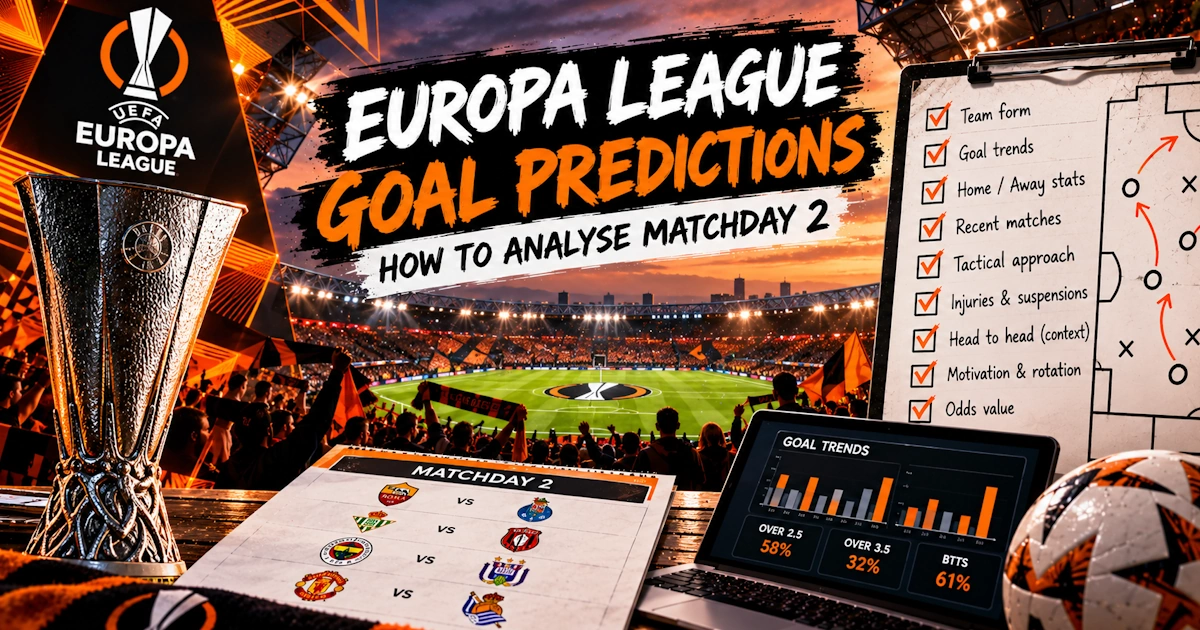
Before choosing a goal market, check:
Matchday 1 performance, not only the score
Domestic form
xG and xGA
Shots on target
Big chances
Home-away splits
Matchday 1 opponent quality
Matchday 2 opponent quality
Scoring and failure-to-score rates
Clean-sheet numbers
Set-piece strength
Defensive vulnerabilities
Goalkeeper performance
Injuries and suspensions
Expected rotation
Tactical style
Who is expected to score
Whether the available odds offer value
A strong prediction should normally have several of these factors pointing in the same direction.
Frequently Asked Questions
Is Europa League Matchday 2 good for goal predictions?
It can be because we now have current European evidence from Matchday 1. However, one match remains a very small sample and should be combined with domestic statistics.
How many goals are scored in Europa League matches?
The 2025/26 league phase produced 386 goals in 144 games, an average of 2.69 per match.
Is Over 2.5 always better than BTTS?
No. If 1-1 is a realistic result, BTTS may provide the better match for your analysis. If one strong favourite can score three alone, Over 2.5 may make more sense.
How important are set pieces?
Very useful. Excluding penalties, set plays produced 19% of the goals in the 2025/26 Europa League league phase.
Should I trust Matchday 1 results?
Use them as new evidence rather than final proof. xG, shots, opponent strength and match circumstances can reveal whether the result was sustainable.
Final Thoughts
Europa League Matchday 2 is a useful point in the competition because the first European performance is now available for analysis.
But it is also an easy stage to overreact.
A 4-0 win can make an attack look unstoppable. A 0-1 defeat can make another team look poor. Neither conclusion is safe without understanding the chances behind the score.
Start with domestic xG, shots, home-away form and current squad strength.
Then add what Matchday 1 taught you.
Check whether the second opponent is stronger or weaker, whether the venue has changed and whether injuries or rotation have altered the expected line-up.
Finally, ask the most practical question:
Where are the goals supposed to come from?
If you can clearly explain why both teams should score, BTTS may be appropriate. If one side can produce most of the total, Over 2.5 or a team total may be better. If neither side creates enough high-quality chances, the correct prediction may simply be to avoid the Over market.
That is much more reliable than judging Europa League Matchday 2 from Matchday 1 scorelines alone.
Responsible betting: Matchday 2 statistics can improve your analysis but cannot remove uncertainty. Compare several indicators, evaluate the price as well as the prediction, keep stakes controlled and never bet money you cannot afford to lose.