There is something different about the final 15 minutes of a group-stage football match. A team that has been patient for 70 minutes suddenly needs a goal. Full-backs move forward. Another striker comes on. Centre-backs start appearing at corners. The defensive line moves closer to halfway.
At the same time, the opponent suddenly has acres of space to counterattack. It is easy to understand why bettors associate final group matches with late goals.
But is the idea actually supported by football data? The answer is: Sometimes-but the group situation matters much more than the words “final matchday.”
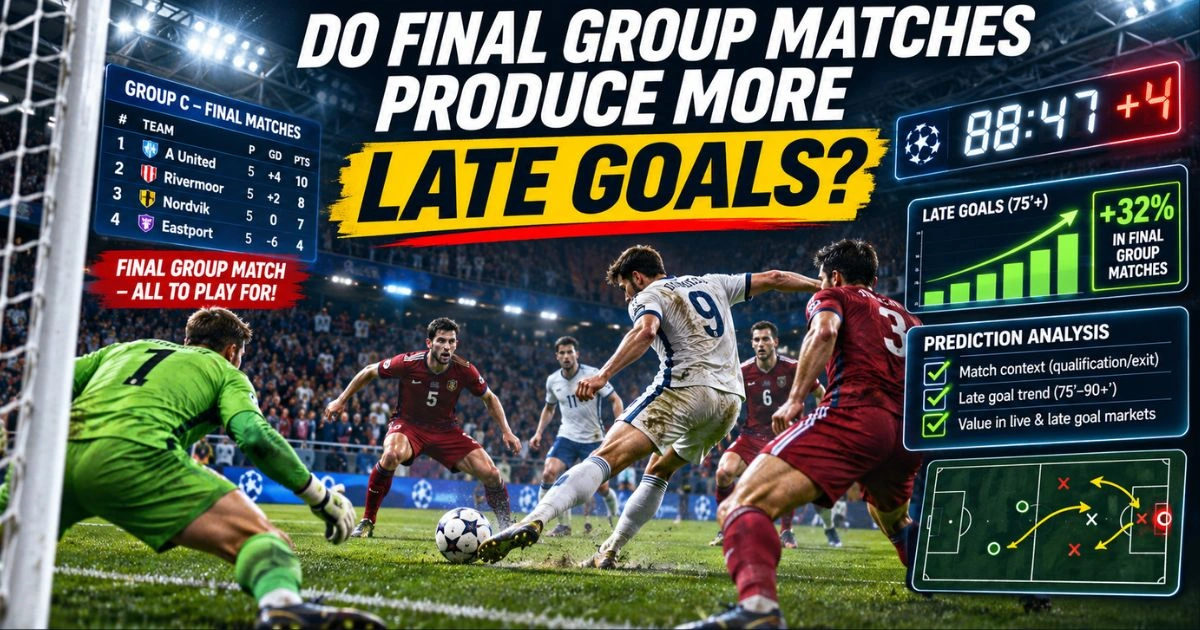
Research across major international tournaments has consistently found that goals become more frequent later in matches. However, a final group game only creates an additional late-goal advantage when the current score forces one or both teams to take greater risks. If a draw suits everyone, the exact opposite can happen.
Goals Are Already More Common Late in Football Matches
Before considering group-stage pressure, there is an important general football trend. A study analysing five consecutive FIFA World Cups found that goal frequency increased as matches progressed, with the highest proportion of goals occurring during the final 15 minutes. Researchers discussed several possible explanations, including fatigue, declining concentration and tactical risk-taking late in games.
Research on the 2022 World Cup group stage found that 64.2% of goals were scored in the second half, compared with 35.8% before half-time. This answers questions for bettors weighing up Over 1.5 Second-Half Goals: When Is It a Sensible Bet? So late goals are not unique to final group matches; football naturally becomes more goal-friendly as time runs out. The interesting question is whether qualification pressure makes that normal late-game effect even stronger.
Why Goals Become More Likely Late
Several things happen as a football match progresses:
Players become physically tired.
Decision-making can become less precise.
Defensive concentration can fall.
Substitutes enter with fresh legs.
Most importantly, teams become increasingly aware of what the current score means. If a team needs to score, there is a major difference between being 0-0 after 20 minutes and 80 minutes. After 20 minutes, there is no need to panic. After 80, patience may no longer be an option. Research on offensive transitions has also found that successful attacking transitions occur particularly frequently during the final 15 minutes of matches, showing precisely how to predict late goals after the 75th minute. That makes late-game tactical behaviour extremely important for goal predictions.
Final Group Matches Add Another Layer: The Table
In an ordinary league match, a draw may be disappointing but survivable because there is another match next weekend. A final group game is different.
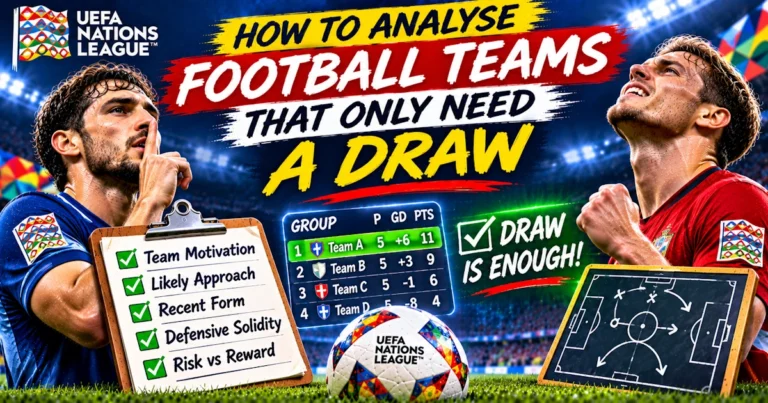
Suppose Team A needs victory to qualify. The match reaches 0-0 after 75 minutes. A draw has almost no value, so Team A now has to change. It may:
Add another striker
Push full-backs higher
Press more aggressively
Commit additional players to corners
Leave fewer defenders protecting against counters
That can increase the probability of both teams scoring, not just Team A. The attacking team creates more pressure, and the defending team receives more space.
The 2024/25 Nations League Final Matchday Shows the Variety
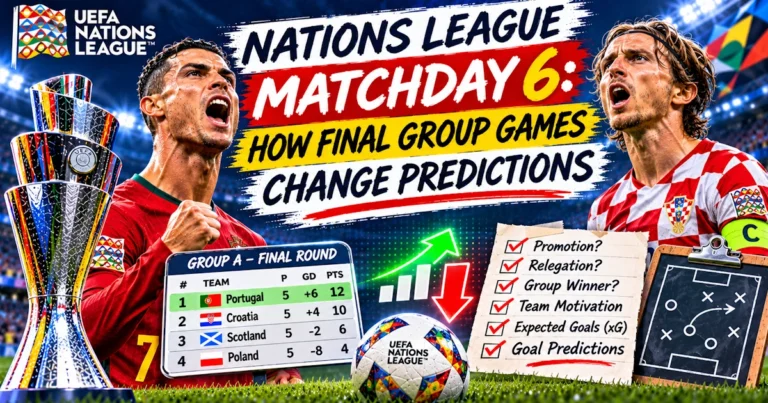
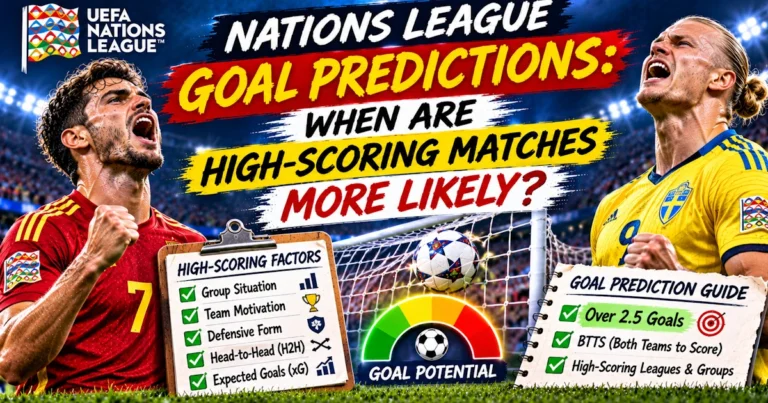
The 2024/25 Nations League Matchday 6 produced 75 goals across 26 matches, an average of approximately 2.88 goals per game. Fourteen of the 26 matches contained at least three goals, while both teams scored in 16.
But the results also show why final-round football cannot be treated as an automatic Over system. There were scorelines such as England 5-0 Republic of Ireland, Norway 5-0 Kazakhstan, Spain 3-2 Switzerland, and Sweden 6-0 Azerbaijan. But there were also cautious 0-0 draws like Serbia vs Denmark and Malta vs Andorra.
The final matchday produced both goal explosions and extremely cautious matches. The difference often comes from what each side needed from the game.
We Have Real Examples of Late Goals Changing Everything
The same Nations League round produced dramatic late moments. Scotland were level 1-1 away to Poland until Andy Robertson scored in added time, giving Scotland a 2-1 win that saved them from direct relegation and sent Poland down instead. Spain also beat Switzerland 3-2 after Bryan Zaragoza converted a decisive penalty in stoppage time. On another final-matchday night, Dominik Szoboszlai scored with the final kick to earn Hungary a 1-1 draw with Germany.
These examples do not prove that every final group match will produce a late goal. They show what can happen when game state, urgency and time pressure interact.
The Strongest Late-Goal Scenario: A Draw Helps Nobody
Imagine the group table means both teams need victory. The match is 1-1 after 72 minutes. If the draw leaves both teams short of their objective, protecting the score makes little sense. Both may take additional risks. That can produce:
Higher defensive lines
More transitions
More shots
More corners
Greater counterattacking space
This is probably one of the most attractive final-round situations for late-goal analysis. The score is balanced, the teams are capable of attacking, and neither can accept the result.
Practical Example: Both Teams Must Win
Imagine:
Team A: 1.7 Expected Goals (xG) per match, 5.2 shots on target, Needs victory
Team B: 1.5 xG per match, Strong counterattack, Also needs victory
Score after 70 minutes is 1-1.
Possible tactical development: Team A introduces another forward. Team B keeps attacking because a draw does not help. Both defensive lines become exposed. Possible final scores: 2-1, 1-2, 2-2, 3-1. Here a late-goal market has a logical foundation. It is not simply “Final group game = late goal.” It is “Neither team benefits from the current score.” That is much stronger reasoning.
One Team Must Win, the Other Needs a Draw
This is another interesting situation. Suppose Team A qualifies with a draw, and Team B needs victory.
At 0-0 after 75 minutes, Team A is currently happy; Team B is not. Team B begins pushing forward, and Team A drops deeper. At first glance, that sounds like one attacking team against one defensive team. But as Team B commits more players forward, Team A can counterattack into increasingly large spaces. That means the late goal could come from either side.
Practical Example: Counterattacking Late Goal
Team A only needs a draw and has fast forwards. Team B must win. At 80 minutes, Team B sends both full-backs forward, and Team A wins possession.
Suddenly Team A has three attackers against three defenders. The team that was supposedly “defending the draw” can now create its best chance of the entire match. This is why late must-win football can improve BTTS and next-goal markets even when only one side urgently needs to score.
When Both Teams Are Happy With a Draw
Now consider the exact opposite. Both teams know a draw gives them what they need. The match reaches 1-1 after 75 minutes.
Why take unnecessary risks? The full-backs may stop overlapping. Midfielders choose safer passes. Players may take longer over restarts, and both teams protect their defensive structure. The late-goal probability may actually fall. This is why final group matches can produce some of the most cautious football of the season. The table can create risk, but it can also remove it.
Do Not Assume 0-0 Means a Late Goal Is Coming
A final-round game may be 0-0 after 70 minutes, but that alone is not enough. Check the live statistics:
Match A: Combined xG 2.0, Shots on target 7, Big chances 4
Match B: Combined xG 0.6, Shots on target 2, Big chances 0
Both are 0-0, but they are not the same betting situation. If Match A also contains a team that must win, bettors will question: Do Must-Win Matches Really Produce More Goals? In Match A, the case for a late goal becomes highly interesting. If Match B has produced almost nothing, motivation alone may not be enough, and this is exactly how to identify matches that could finish 0-0.
Motivation Cannot Create Attacking Ability
Suppose a team desperately needs a goal, but its tournament numbers are 0.8 xG per match, 2.3 shots on target, and few big chances. The table may force it forward, but that does not make it suddenly dangerous. A strong defence may still contain the attack comfortably.
This is why “must score” should always be combined with:
xG
Shots on target
Big chances
Attacking personnel
Opponent defensive quality
Motivation changes behaviour; it does not automatically change ability.
Substitutions Can Make Late Goals More Likely
Final group games often produce aggressive substitutions. A manager who needs victory may replace a defensive midfielder with an attacking midfielder, or switch from a 4-3-3 to a 4-2-4.
Fresh attackers then face defenders who have already played 70 or 80 minutes, creating a meaningful physical and tactical imbalance. Research from the 2022 World Cup group stage found more goals from substitute players than in the 2018 tournament. When analysing live markets, you must ask: Do substitutions increase the chance of late goals? Look at who has come on, not simply how many substitutions have been made.
Defensive Substitutions Can Produce the Opposite Effect
A team protecting qualification may make very different changes. Instead of another attacker, it introduces a defensive midfielder, an extra centre-back, or a defensive full-back. The team can switch from attacking normally to protecting the penalty area. That may make a late goal harder.
Substitution analysis should always be tactical. Ask: Is the manager trying to change the score—or protect it?
Fatigue Adds to the Risk
Late in matches, tired players can lose runners, react more slowly, misjudge clearances, and commit unnecessary fouls. World Cup research has repeatedly suggested that fatigue and declining concentration are plausible explanations for increased scoring in the final 15 minutes. When that normal physical decline combines with a team deliberately taking more tactical risk, late-game conditions can become particularly dangerous.
Set Pieces Become More Valuable
A team that needs a goal with five minutes remaining may stop trying to construct perfect possession attacks. Corners and free kicks become hugely important. Centre-backs move forward, and goalkeepers sometimes join the penalty area in stoppage time.
That creates two possibilities: the attacking team can score from the set piece, or the defending team can clear the ball and counterattack into an almost empty half. This is one reason the final minutes of must-score matches can become chaotic.
Extra Stoppage Time Does Not Automatically Mean Extra Goals
Modern matches can contain substantial additional time. You might assume: More minutes = more stoppage-time goals.
But evidence from the 2022 World Cup group stage is interesting. Average stoppage time increased substantially compared with 2018 (from approximately 7.3 to 11.6 minutes), yet researchers found no statistically significant increase in stoppage-time goals between those tournaments. Additional minutes create more opportunity, but they do not guarantee scoring. The tactical situation during those minutes remains more important.
Other Group Results Can Change Everything
Final group matches often need to be analysed as part of a wider table. Suppose Team A begins the night believing a draw is enough. After 65 minutes, another team scores elsewhere. Now Team A suddenly needs victory. Nothing has changed in its own match, but everything has changed tactically.
This is why live standings can be extremely valuable during final rounds. A pre-match prediction can become outdated without a goal occurring in the game you are watching.
Practical Example: Scenario Changes Mid-Match
Before kickoff: Team A needs a draw if Team C fails to win. At 60 minutes: Team A 0-0 Team B | Team C 1-0 Team D
Team A now needs to score. Its manager responds by introducing an attacking midfielder, pushing full-backs higher, and increasing the press. That is new information. A live goal market may now be stronger than it was five minutes earlier.
Do Not Chase a Late Goal Just Because the Odds Are Bigger
Late goal prices naturally increase as time runs out, which can feel attractive. But the probability is also falling because fewer minutes remain.
Suppose Over 0.5 Goals after 80 minutes = 2.20. That price looks tempting. But you still need evidence that the true goal probability is above the implied probability (1 ÷ 2.20 = 45.5%). If you estimate the chance of another goal at only 35%, the bigger odds do not create value. Always think in probabilities.
Practical Example: Strong Late-Goal Candidate
Minute: 72
Score: 1-1
Both teams need victory.
Live statistics: 2.5 combined xG, 8 shots on target, 4 big chances.
Both managers have introduced attacking substitutes.
Now several independent factors support another goal: strong live chance creation, current score not useful, tactical risk increasing, fresh attackers, and defensive fatigue. This is a much stronger setup than simply seeing “final group match” on the fixture list.
Practical Example: Weak Late-Goal Candidate
Minute: 75
Score: 0-0
Both teams qualify with a draw.
Live statistics: 0.7 combined xG, 2 shots on target.
Both managers have made defensive substitutions.
Here, the fact that it is a final group match may actually strengthen the case against another goal. The competition context works in the opposite direction.
A Late-Goal Checklist for Final Group Matches
Before expecting another goal, check:
What result does each team need?
Does the current score help either side?
Do both teams need to win?
Is another group result changing the scenario?
Current xG, shots on target, and big chances
Quality of attacking and defensive substitutions
Set-piece threat and signs of defensive fatigue
Whether one team is leaving counterattacking space
How many minutes plus stoppage time remain
Whether the available price offers enough value
The group scenario should strengthen the evidence you can already see on the pitch.
Frequently Asked Questions
Are more football goals generally scored late in matches? Research across multiple World Cups has found the highest goal frequency in the final 15-minute period, while 64.2% of goals in the 2022 World Cup group stage were scored in the second half.
Do final group matches automatically produce more late goals? No. Final matches can create more late attacking risk when teams need a result, but a draw that benefits both sides can produce the opposite effect.
What is the best late-goal scenario? A particularly strong situation occurs when the match is level and neither team benefits from a draw, especially if live xG, shots and big chances already show an open match.
Does a team needing to score make a late goal likely? It can increase the chance, but attacking quality still matters. A weak team may take more risks without creating good opportunities.
Should I use live statistics for late-goal predictions? Yes. Current xG, shots on target, big chances, substitutions and tactical behaviour can tell you whether the match is actually opening up rather than relying only on the group table.
Final Thoughts
Final group matches can create excellent conditions for late goals. But being the final matchday is not the reason by itself.
Football already tends to produce more goals later in matches. Fatigue increases, concentration can fall and substitutes bring fresh attacking energy. Final-round pressure can then amplify those effects. If a draw helps nobody, teams may take progressively greater risks. If one side must win, its attacking commitment can create opportunities at both ends. If another result changes the group table, a previously cautious team may suddenly need to attack.
But there is an equally important opposite scenario. If both teams are happy with the current score, the final minutes can become extremely conservative.
That is why the best question is not: “Is this a final group match?” It is: “Who needs the next goal?”
Then add the live evidence. Are chances being created? Are attacking substitutes entering? Are defensive lines moving higher? Is there space for counters? When the table situation, clock and match statistics all point towards increasing risk, a late goal becomes much more believable. That is the real value of final-group analysis.
Responsible betting: Late-match pressure can increase attacking risk but cannot guarantee another goal. Use the current score, live statistics and group situation together, compare probability with the available odds, keep stakes controlled and never bet money you cannot afford to lose.